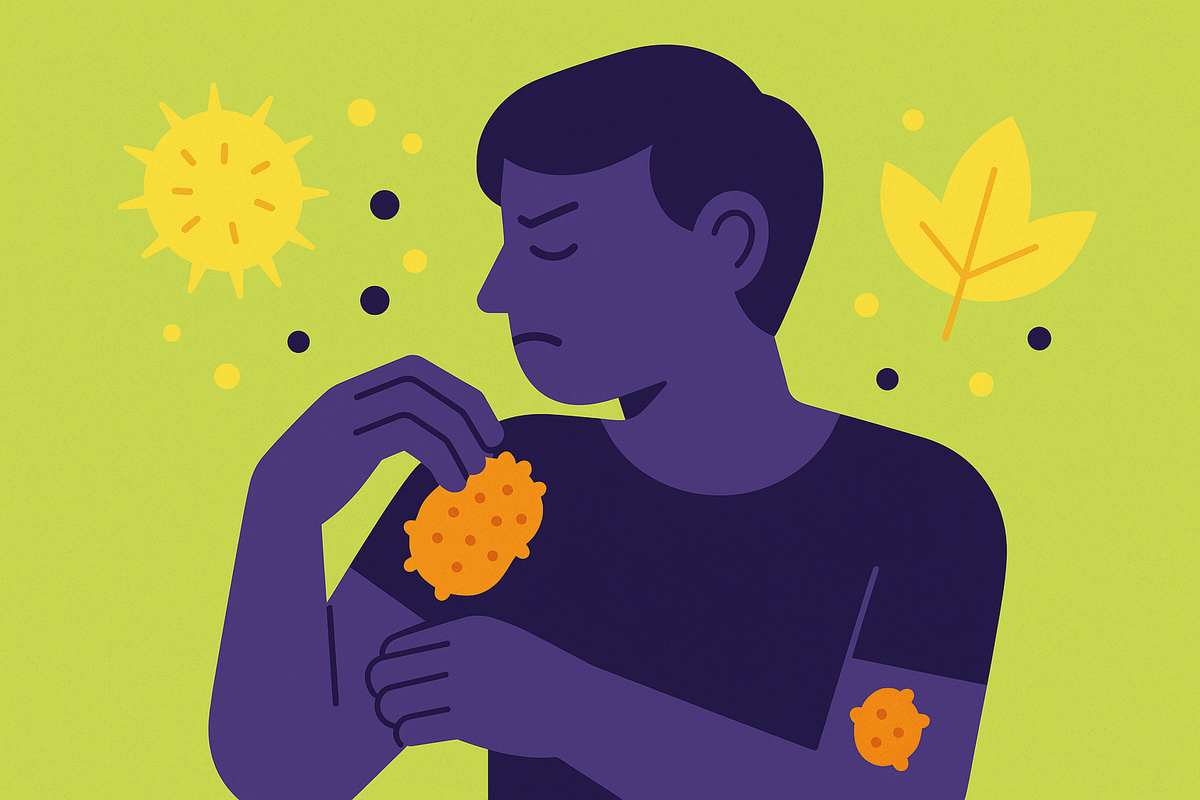
Tree Pollen Allergy and Oral Allergy Syndrome
Raw fruits trigger mouth tingling because tree pollen proteins masquerade as food allergens.
Someone bites into a raw peach in May and feels their lips tingle, their tongue itch, maybe a little swelling along the inside of the mouth. The natural conclusion is that a fruit allergy has shown up out of nowhere. Oral allergy syndrome is a downstream effect of a tree pollen allergy that was already there, with food acting as the messenger rather than the cause. Cleveland Clinic describes it as a contact allergic reaction to vegetables, fruits and nuts that most often occurs in people who already have an allergy to tree, grass, or weed pollen. The pollen sensitivity comes first. The food reaction follows.
That order matters because it separates OAS from what most people picture when they hear "food allergy." Allergy & Asthma Network draws a sharp line here: in OAS, the body builds IgE antibodies against pollen, not against the food. In a true food allergy, those antibodies target the food protein directly. Even a trace amount can be dangerous at any time of year, cooked or raw. OAS doesn't work that way. It stays mostly in the mouth and throat, passes quickly, and often vanishes once you cook the trigger food instead of eating it raw. None of that would make sense if the food itself were the true allergen. That makes sense once you see pollen as the actual source.
The condition goes by a second name that explains itself better: pollen-food allergy syndrome, or PFAS. Where "oral allergy syndrome" describes where the reaction lands, "pollen-food allergy syndrome" describes where it starts. That's a more honest label for what's happening in the body, and it's the frame this piece uses to build the rest of the argument.
The molecular confusion that turns tree pollen into a food trigger
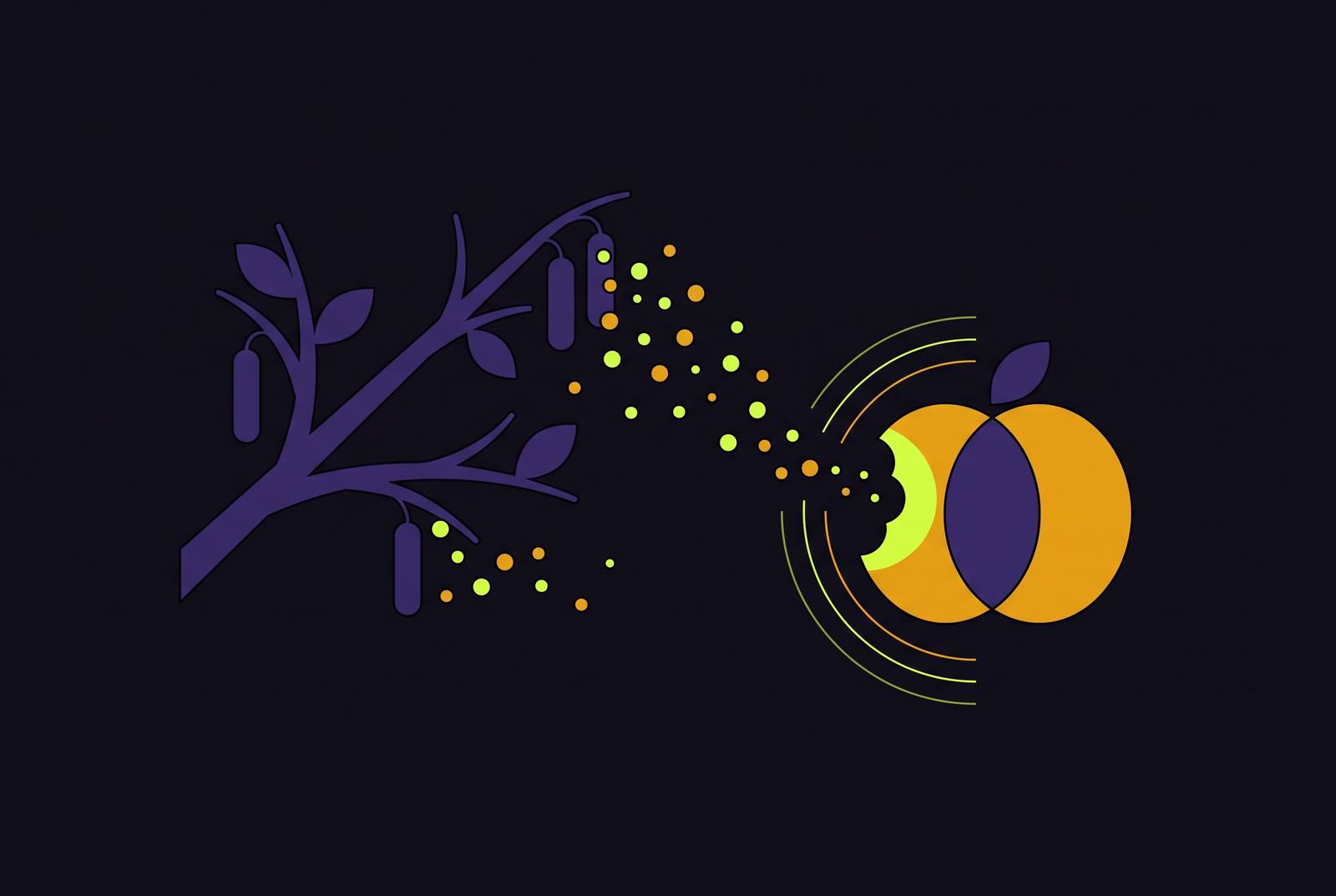
Why would the immune system treat a peach the same way it treats a cloud of birch pollen? The answer sits at the protein level. Certain proteins in raw fruits, vegetables, and nuts are shaped so much like proteins in tree pollen that antibodies trained to spot pollen latch onto the food protein by mistake. The American Academy of Allergy, Asthma & Immunology and allergy foundations describe this directly: tree pollen resembles the protein in certain produce closely enough that the immune system loses the ability to tell them apart.
This is what allergists call IgE-mediated cross-reactivity. An antibody forms in response to repeated pollen exposure, spring after spring, season after season. Once that antibody exists, it doesn't stay narrowly focused on pollen alone. It reacts to anything with a close enough molecular shape, and a surprising number of raw fruits, vegetables, and nuts carry proteins that fit that description well enough to set off the same alarm.
The clearest evidence for this mechanism is something nearly every OAS sufferer has noticed without naming it: cooked versions of the same food often cause no reaction. Heat is the reason. Cooking denatures the cross-reactive protein, bending and unfolding its structure until the IgE antibody no longer recognizes it as a threat. A raw tomato might cause itching and tingling. The same tomato simmered into marinara sauce usually causes nothing, because the structure that confused the immune system in the first place no longer exists once heat has broken it down. A raw peach brings on the familiar tingle in the mouth and throat. A baked peach, structurally altered by the oven, usually passes without incident. That single, observable fact, that cooking changes the outcome, confirms the whole chain: pollen first, protein shape second, cooked structure third. Nothing about this reaction originates in the food on its own.
Which tree pollens and foods cross-react
Not every tree pollen carries the same weight when it comes to OAS, and the foods a person reacts to depend entirely on which pollen their immune system has keyed in on. Birch stands out as the tree most tied to this condition. Research cited by INTEGRIS Health and the American Academy of Allergy, Asthma & Immunology finds that 50 to 75 percent of people allergic to birch tree pollen go on to develop OAS, a rate that makes birch the single most clinically significant tree behind this syndrome in the United States. Birch cross-reacts with a long list of foods: almond, anise, apple, apricot, caraway, carrot, celery, cherry, coriander, fennel, hazelnut, kiwi, parsley, peach, peanut, pear, plum, and soybean. Cleveland Clinic groups these into recognizable categories that make the pattern easier to hold onto: legumes like peanuts and soybeans, seed fruits like avocados, apples, kiwis, and pears, stone fruits like apricots, cherries, peaches, and plums, tree nuts like almonds and hazelnuts, and vegetables like carrots and celery. Someone who reacts to three or four items on that list, all at once, every spring, is very likely dealing with birch sensitization rather than four separate food allergies.
Alder pollen gets far less attention, but it drives a comparable pattern. One allergy resource lists its cross-reactive foods as almond, apple, celery, cherry, hazelnut, peach, pear, and parsley, overlapping heavily with birch's list because the two pollens share similar proteins. Alder's reach is also wider geographically than most people assume. One allergy resource points to it as a common cause of pollen-food allergy syndrome, and says it grows in every U.S. state but Nebraska and South Dakota. OAS occurs with grass, ragweed, and mugwort pollen sensitization too, though those fall outside the tree-pollen pattern this piece is built around.
The broader pattern is geographic: birch, alder, ash, oak, olive, and a long list of other highly allergenic trees grow across most of the country, not in some isolated pocket. Tree-pollen-driven OAS isn't a regional footnote limited to one climate or one kind of forest. It follows wherever these trees grow, which covers most places people in the United States actually live.
OAS symptoms and warning signs
The symptom picture for OAS is usually mild, fast, and localized, but mild doesn't mean it isn't real. Cleveland Clinic lists the typical profile as itching, tingling, or minor swelling of the lips, mouth, tongue, or throat, sometimes with small bumps forming on the lips or inside the mouth. The onset is quick, often within minutes of the first bite. Less commonly, people report nausea, or itching, redness, and swelling of the skin simply from handling certain raw foods, even before eating them.
So why does the reaction almost always stay in the mouth instead of spreading through the body? Stomach acid plays a large role. It breaks down the cross-reactive proteins before they can travel further, which is a structural feature of how the digestive system handles them, not a matter of luck or a mild case versus a severe one. That's also why most OAS reactions resolve within minutes without treatment.
Anaphylaxis from OAS is uncommon, but it does happen, and the line between "uncomfortable" and "emergency" is worth knowing. Cleveland Clinic advises seeking emergency care for difficulty breathing, weakness, or dizziness, symptoms that go beyond the mouth and throat and signal something more serious than typical OAS.
One pattern deserves particular attention because it's some of the clearest evidence for the whole pollen-first argument: Allergy & Asthma Network notes that symptoms tend to get worse during pollen season, when more pollen is circulating in the air. If a food allergy were operating on its own, the calendar shouldn't matter. A peanut allergy doesn't care whether it's April or October. But an OAS reaction to a peach in peak birch season, compared to the same peach eaten in late summer, can feel noticeably different in intensity. That swing tracks the pollen count, not the fruit.
Why OAS is routinely misdiagnosed
OAS follows a meal, not a sneeze, and that timing throws most people off the trail. The natural assumption is that the food caused the reaction, full stop, because nothing about breathing in pollen three hours earlier feels connected to lips tingling over lunch. So the food gets blamed, and the actual cause goes unexamined.
What that misattribution usually looks like in practice: someone quietly stops eating peaches one year, then apples the next, then almonds after that, slowly building a list of foods they've decided their body "can't handle" without ever noticing that every item on the list shares a cross-reactive protein with the same tree pollen they breathe in every spring. The seasonal pattern that would reveal the real cause gets buried under the immediate, visible fact of the itchy mouth, which is far easier to notice in the moment than a slow-building rhinitis that's been present for years.
It takes a trained eye to untangle which allergy is actually driving the reaction. An allergist can trace a reaction to apples back to birch sensitization, alder sensitization, or a true standalone apple allergy, since all three are possible and they don't look identical on paper. You can't self-diagnose based on which food caused the itch here, since the food is often a symptom of something else rather than the source.
That misdiagnosis carries a real cost, and it isn't limited to a shrinking grocery list. Someone managing their reactions purely through food avoidance is, by definition, leaving the tree pollen allergy itself completely untreated. That allergy keeps producing chronic nasal congestion, disrupts sleep through mouth breathing, and circulates inflammatory compounds through the bloodstream that affect how clearly a person thinks, all while the person's attention stays fixed on whether or not it's safe to eat a nectarine.
The wider health toll of the untreated tree pollen allergy underneath OAS
A tree pollen allergy strong enough to trigger OAS doesn't stop at the mouth. The same immune sensitization that makes a raw apple feel itchy is also running, every day of pollen season, in the nose, the sinuses, and the airway, and it causes damage there too.
Sleep takes one of the biggest hits. Allergic rhinitis worsens at night as nasal tissue swells and restricts airflow, pushing people toward mouth breathing and fragmenting the sleep that follows. Someone who has carefully avoided every raw peach, apple, and almond on their list can still be waking up at 2 a.m. congested, because the food choices were never what was driving the congestion.
Cognition takes a hit too, and it's measurable rather than imagined. Inflammatory cytokines released during allergic reactions circulate through the bloodstream and interfere with attention and processing speed. The brain fog that allergy sufferers describe during peak pollen weeks has a physiological basis. For people who also have asthma, one allergy resource notes that tree pollen can trigger allergic asthma symptoms directly, adding a respiratory consequence on top of everything already happening in the nose and bloodstream.
The thread connecting all of it is the same root cause. OAS, disrupted sleep, daytime brain fog, and worsened asthma all trace back to the identical tree pollen sensitization. Cutting peaches and almonds out of a diet does nothing to touch any of the other three. The person avoiding raw fruit in spring is still fighting the same allergy everywhere else it shows up.
What current management of OAS looks like
Standard OAS management focuses almost entirely on the food side of the equation: avoid it raw, change its form, or skip it. Cleveland Clinic's recommendations include avoiding raw versions of trigger foods, peeling fruit before eating it, and microwaving for at least 10 seconds, since cooked, baked, canned, or processed forms are usually safe once heat has denatured the cross-reactive protein. Allergy & Asthma Network adds two more tools to that list: antihistamines for mild symptoms, and an epinephrine autoinjector carried by anyone at risk for a more severe, anaphylactic reaction.
These steps work, as far as they go. None of them address the pollen sensitization that produces the food reaction. A person following every piece of this advice perfectly can still deal with watery eyes, congestion, and disrupted sleep every spring, because the plan only ever addressed the food, not the allergy driving it. The food list itself can also grow unwieldy. Birch alone cross-reacts with more than a dozen foods, and building a long-term diet around avoiding that many raw items, permanently, is a real and ongoing burden rather than a one-time adjustment. Symptoms also reliably intensify during heavy pollen stretches no matter how carefully someone manages their plate, which is further proof that food avoidance is managing a symptom, not the source.
Research is starting to push past avoidance toward something closer to the root cause. A Phase III clinical trial (NCT06771791), launched by University Hospital, Strasbourg, is testing oral immunotherapy using raw apple specifically for birch pollen-food allergy syndrome. The trial's own framing acknowledges that current OAS management is built on food avoidance, and it's upfront about the limits of the evidence so far: small patient numbers, no validated control group, and no double-blind evaluation of the primary endpoint against a placebo in a formal challenge test. That trial doesn't resolve the question of how to treat the pollen allergy underneath OAS. It does mark one of the first serious efforts to study a path beyond peeling fruit and reading ingredient labels, aimed at the sensitization itself rather than the food sitting on the plate.
Sources
- What Is Oral Allergy Syndrome?
- Oral Allergy Syndrome: Why Foods Make Your Mouth Itchy
- Tree Pollen Allergy
- Evaluation of the Efficacy of Oral Immunotherapy With Raw Apple in Patients Allergic to Birch Pollen and Apple: Prospective, Multicenter, Comparative Phase III Study
- What is Oral Allergy Syndrome (OAS)? - Allergy & Asthma Network
- Tree Pollen - Allergy & Asthma Network
- Oral Allergy Syndrome
- Oral allergy syndrome - PMC - NIH