Eczema Flares Triggered by Airborne Allergens
Dust mites, pet dander, and pollen can trigger eczema flares through your bloodstream.
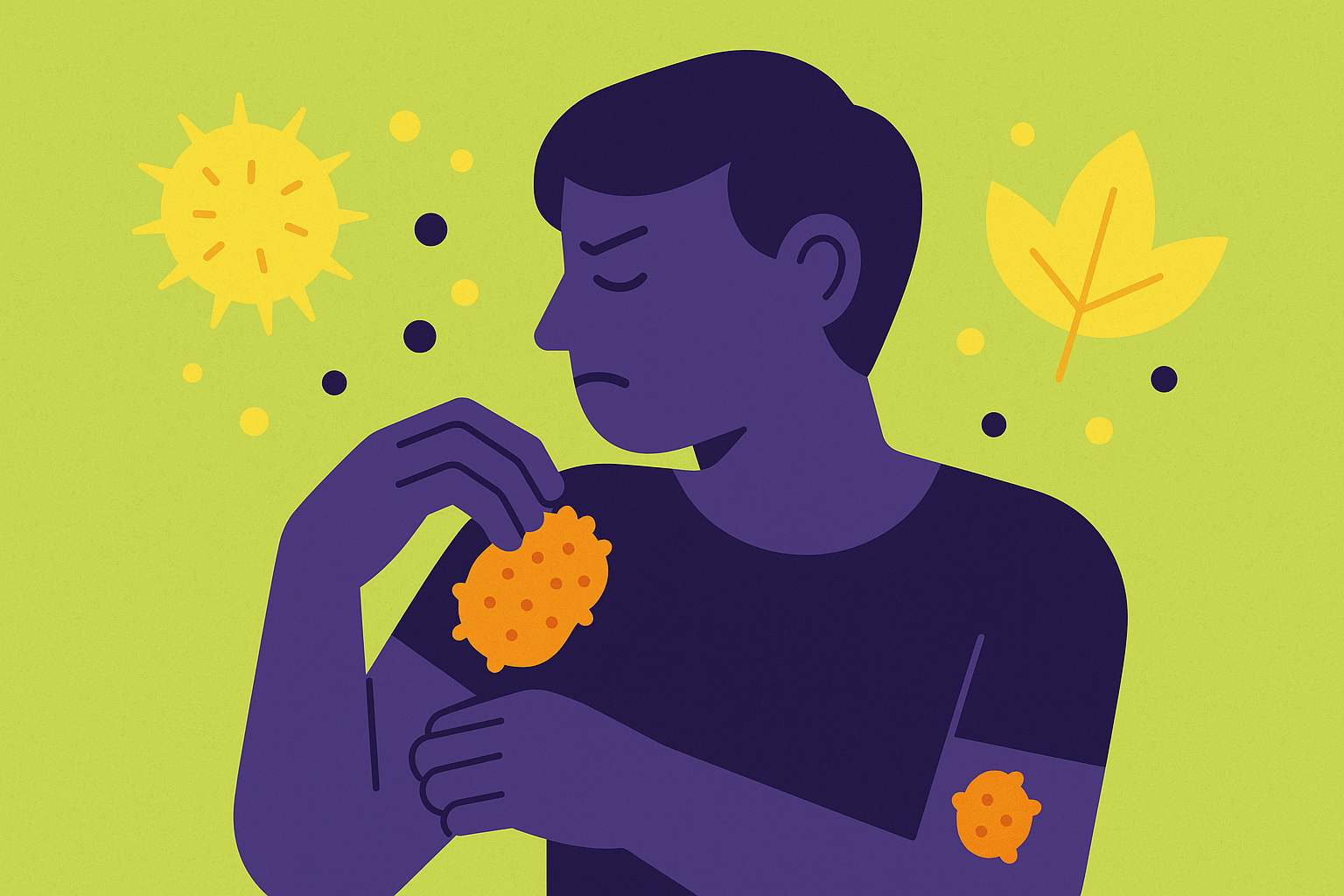
Eczema flares often return with no change in soap, lotion, or routine, and the missing variable is usually in the air. Dust mites, pet dander, pollen, and mold can all push atopic skin into a flare without ever touching a product label.
An airborne explanation for eczema flares without an obvious cause
A reader whose eczema calmed down for weeks, then flared again after moving indoors for winter, after an afternoon at a friend's house with a cat, or as pollen counts climbed in spring, has usually done nothing wrong. Nothing in the skincare routine changed. What changed was the air.
Eczema is a chronic, relapsing condition, and one reason it relapses is structural. The outer layer of skin, the stratum corneum, holds moisture poorly in people with atopic dermatitis and lets irritants and allergens through more easily than it should. Even when the skin looks calm between flares, it still has lower ceramide levels, and it loses water through the surface faster than skin without eczema. The vulnerability doesn't come and go with visible symptoms. It sits there all the time. A shift in the surrounding environment, not just a change in products or habits, can be enough to tip things into a flare. If the routine hasn't moved but the skin has, check the air.
The two biological pathways that connect airborne allergens to skin inflammation
Airborne allergens reach eczema-prone skin by two separate routes, and both explain why a flare can appear on skin that was fully covered and never touched the allergen.
The first route is direct. When dust mite particles, pet dander, or pollen grains land on skin, they can push straight through the weakened barrier, and they set off inflammation right where they land. Healthy skin mounts a defense that keeps these particles out. Eczema-prone skin can't do that nearly as well, so the allergen proteins get past the outer layer and provoke an immune reaction in the tissue underneath. As a result, lesions often appear on the face, neck, forearms, and lower legs, areas exposed to outdoor air or indoor allergen sources, and track with pollen season or known indoor exposure.
The second route requires no contact with the skin. Inhaling an airborne allergen activates the immune system broadly, raising circulating IgE and inflammatory signals that travel through the bloodstream and reach the skin from the inside. This is why some patients notice their eczema getting worse during pollen season even on skin that stayed covered the whole time.
The reason this systemic route exists at all traces back to how eczema is classified. Eczema belongs to what's called the atopic triad, alongside allergic rhinitis and asthma. All three conditions share an underlying tendency called atopy: a tendency to produce excessive IgE in response to ordinary environmental substances that wouldn't trouble most immune systems. The same immune machinery that reacts to pollen in the nose reacts to pollen in the skin. Eczema also tends to appear first in infancy, often followed later by asthma and then rhinoconjunctivitis, a progression doctors call the atopic march. Having one of these conditions raises the odds of developing another, because they're drawing from the same immune setup.
When you put the two pathways together, a problem emerges for anyone managing eczema through avoidance alone. Covering exposed skin or staying indoors blocks the direct pathway. It does nothing for the systemic one. If you avoid touching cat dander but keep breathing it in a shared space, you can still flare, just through a different door. Any strategy aimed at only one pathway is working with half the picture.
Air Pollution and Skin Barrier Damage
Air pollution doesn't just sit in the background as general irritation. Fine particulate matter, known as PM2.5, damages the skin barrier directly, and it makes both allergen pathways described above more dangerous at the same time.
PM2.5 particles and the organic compounds riding along with them get into the skin mainly through hair follicles and through spots where the barrier is already compromised, reaching deeper layers than most people would expect. Once there, the particles bind to a protein called the aryl hydrocarbon receptor, or AhR, which mediates how cells respond to environmental toxins. That binding triggers inflammation that appears as itchiness, swelling, and redness, the same symptoms that define an eczema flare.
This isn't a fringe effect. Rises in PM10, PM2.5, sulfur dioxide, and nitrogen dioxide have all been tied to corresponding increases in outpatient and emergency department visits for eczema care. That's a population-level signal, not an isolated case.
Pollution adds to the two pathways from the previous section, and the risk compounds. Someone sensitized to dust mites or pollen who also lives somewhere with elevated PM2.5 faces damage from two directions at once: pollution weakens the barrier so allergens penetrate more easily, and the inflammatory load from the pollution itself stacks on top of the inflammatory load from the allergen. Secondhand smoke, traffic exhaust, and living near industrial sites likely contribute through similar mechanisms. Before you get into allergen-specific measures, you can cut down on indoor particulate exposure through ventilation and filtration as a reasonable first step.
The specific airborne allergens most likely to drive flares
Not all airborne allergens behave the same way, and the differences affect which exposures to track and how to counter them. Each one has its own timing, its own exposure pattern, and its own way of getting at the skin.
House dust mites are the most studied trigger in this category. The relationship between dust mite allergy and eczema severity is well established: higher dust mite exposure tracks with worse eczema, and reducing exposure tracks with improvement. Exposure here is perennial and happens overnight, so sensitized people often notice their skin is at its worst first thing in the morning, after hours in bed. Allergen-proof mattress and pillow covers are commonly recommended, but the evidence for their benefit in eczema specifically is still limited and low quality. Dust mites don't have an off-season the way pollen does. If your skin is fine in summer and miserable in winter, you may assume the weather itself is the trigger, when the real driver is indoor humidity shifting mite populations.
Cat and dog dander work through the same IgE-mediated mechanism as dust mites, but cat allergen in particular is hard to escape. The particles are small, stay airborne for hours, and cling to clothing and furniture long after a cat has left the room. A person can flare after visiting a home with a cat, or even after contact with someone else's clothing that carried the allergen in from somewhere else, with no cat anywhere nearby. That third-party transfer is part of why cat allergen is one of the toughest triggers to avoid through conventional measures. Dog dander and other animal dander fall into the same perennial sensitization category.
Pollen from trees, grasses, and weeds is one of the environmental factors known to trigger flares in people with atopy. Atopic skin is fragile to begin with, so when pollen gets past the surface, it sets off the same itchy, red patches that define the condition. Pollen follows a calendar: tree pollen peaks in spring, grass pollen in summer, weed pollen, including ragweed, in fall. If a patient's flares track that calendar closely, they are probably dealing with pollen-driven disease. Timing within a day matters too. Tree pollen tends to peak in mid-morning, though overall counts can peak in the afternoon, and counts rise on warm, windy, dry days, exactly the weather that invites people outdoors. The systemic pathway matters here, because some people notice their eczema worsening during high pollen counts even when their skin stayed fully covered the entire time they were outside.
Mold spores add a more tangled picture. Outdoor mold grows in leaf piles, grass, mulch, hay, and under mushrooms, with spore counts highest during hot, humid weather. Indoor mold, growing in damp bathrooms, basements, or HVAC systems, provides a separate, perennial source that has nothing to do with the season outside. Mold sits at the overlap of perennial and seasonal categories: outdoor counts spike in late summer and fall, while indoor exposure runs all year, which makes mold-driven flares some of the hardest to read correctly.
That overlap points to a useful way of organizing all of this. Perennial allergens, dust mites, mold, animal dander, tend to produce symptoms year-round that get worse under specific indoor conditions. Seasonal allergens, mainly pollens, produce symptoms that track spring, summer, or fall. A person whose eczema is worst indoors in winter is more likely dust-mite or mold sensitized. A person whose eczema reliably flares every May and June is more likely grass-pollen sensitized. Both patterns can be confirmed through targeted allergy testing, which turns a hunch built from months of observation into an actual diagnosis.
Why the flare-environment connection is easy to miss without structured observation
Knowing all of this in theory doesn't make it easy to spot in practice. People miss the connection between airborne allergens and a flare constantly, and not because anyone isn't paying attention. It gets missed because the evidence is spread out across time, geography, and multiple triggers layered on top of each other.
Triggers rarely act alone. Multiple mild exposures, a little dust mite, a little pollen, a little pollution, can combine to produce a flare that looks severe, even when no single exposure would have caused it by itself. That means removing one trigger and still flaring doesn't mean the trigger wasn't real. It may just mean two others are still active.
Timing adds another layer of difficulty. A flare driven by the systemic pathway can occur hours after the allergen exposure that caused it, so the cause and the effect don't sit next to each other in memory. And location adds a third. A flare on the inner elbow or behind the knee, nowhere near any surface that touched outdoor air, feels disconnected from a pollen count. But the systemic pathway doesn't care whether the skin was covered. Covered skin flares too.
What if the frustration people feel chasing "the cause" is a sign they're asking the wrong kind of question? Pollen, dust mites, pet dander, mold, and pollution rarely act as a single clean explanation. They combine differently for each person. Trying to control flares by targeting one environmental factor at a time so often ends in frustration instead of an answer.
A structured trigger diary is the most reliable way through this. Tracking skin condition alongside environmental exposures, products used, stress levels, and diet, day by day, turns a blur of maybe-causes into a pattern that can actually be read. It needs to run for at least one full seasonal cycle, because a shorter window will miss pollen-driven patterns. A diary kept only through the winter will never catch a grass-pollen sensitivity that only shows up in June.
What allergy testing reveals that observation alone cannot
A diary narrows the list of suspects. It doesn't confirm which one is guilty. That confirmation comes from allergy testing, which identifies the specific airborne allergens driving an IgE-mediated immune response in the skin, and that identification changes what a treatment plan actually looks like.
Testing draws a sharp line between sensitization patterns that would otherwise look identical from the outside. Someone with year-round indoor dust mite sensitization needs a different set of interventions than someone with seasonal grass pollen sensitization. Without a test, both people might walk away with the same generic advice to "reduce allergen exposure," which helps neither one very precisely.
At-home finger-prick testing followed by a virtual consultation with a board-certified physician has made this kind of precision far more accessible than it used to be, without requiring an in-office visit. Treatment plans built around a confirmed sensitization profile can be sent directly to a patient's door.
A positive test for dust mite or pollen sensitization carries weight beyond respiratory allergy. Because the same IgE-mediated immune system drives both conditions, that result is directly relevant to managing eczema, not just to managing a runny nose or sneezing.
Avoidance Measures and Flare Frequency by Allergen
Once a specific allergen is confirmed, avoidance becomes a targeted response to the exact exposure pattern behind it.
For dust mites, the overnight and perennial nature of exposure means bedroom measures matter most: allergen-proof covers on mattresses and pillows, frequent washing of bedding in hot water, and attention to indoor humidity, since mite populations respond to moisture levels more than to outdoor temperature.
For pet dander, especially cat allergen, avoidance has to account for third-party transfer. Keeping pets out of bedrooms, washing hands and changing clothes after contact with homes that have cats, and frequent vacuuming with a filter rated to capture fine particles all address a trigger that doesn't disappear just because there's no cat in the house.
For pollen, timing avoidance around the daily and seasonal pattern matters. Staying indoors during mid-morning tree pollen peaks or on warm, windy, dry days, showering after extended time outside, and tracking the tree, grass, and weed calendars that match a patient's confirmed sensitization all reduce direct exposure, though the systemic pathway means some residual risk remains even with careful avoidance.
For mold, the indoor and outdoor sources need separate handling. Fix damp bathrooms, basements, and HVAC systems to address the perennial indoor source, and watch outdoor spore counts during late summer and fall to address the seasonal spike.
None of these measures work as well in isolation as they do once testing confirms which allergen, or combination of allergens, is actually responsible. Avoidance aimed at a confirmed trigger reduces flare frequency in a way that avoidance aimed at a guess rarely matches.
Sources
- Pollens allergies| Eczema Foundation
- The Role of Airborne Proteins in Atopic Dermatitis - PMC - NIH
- Hidden Spring Triggers for Eczema
- Aeroallergens in Atopic Dermatitis and Chronic Urticaria
- Advances in research on the association between global air pollution and atopic dermatitis - PMC
- The Role of Air Pollution in the Pathogenesis of Atopic Dermatitis, With a Focus on Oxidative Stress - PubMed
- Air pollutants contribute to epithelial barrier dysfunction and allergic diseases - Annals of Allergy, Asthma & Immunology
- The Relationship between Symptom Flare of Atopic Dermatitis and Airborne Japanese Cedar and Cypress Pollen Counts: A Self-Scoring Diary Study