Sleep Debt From Allergies as a Cognitive Multiplier
Fragmented sleep from allergies compounds cognitive decline faster than most people realize.
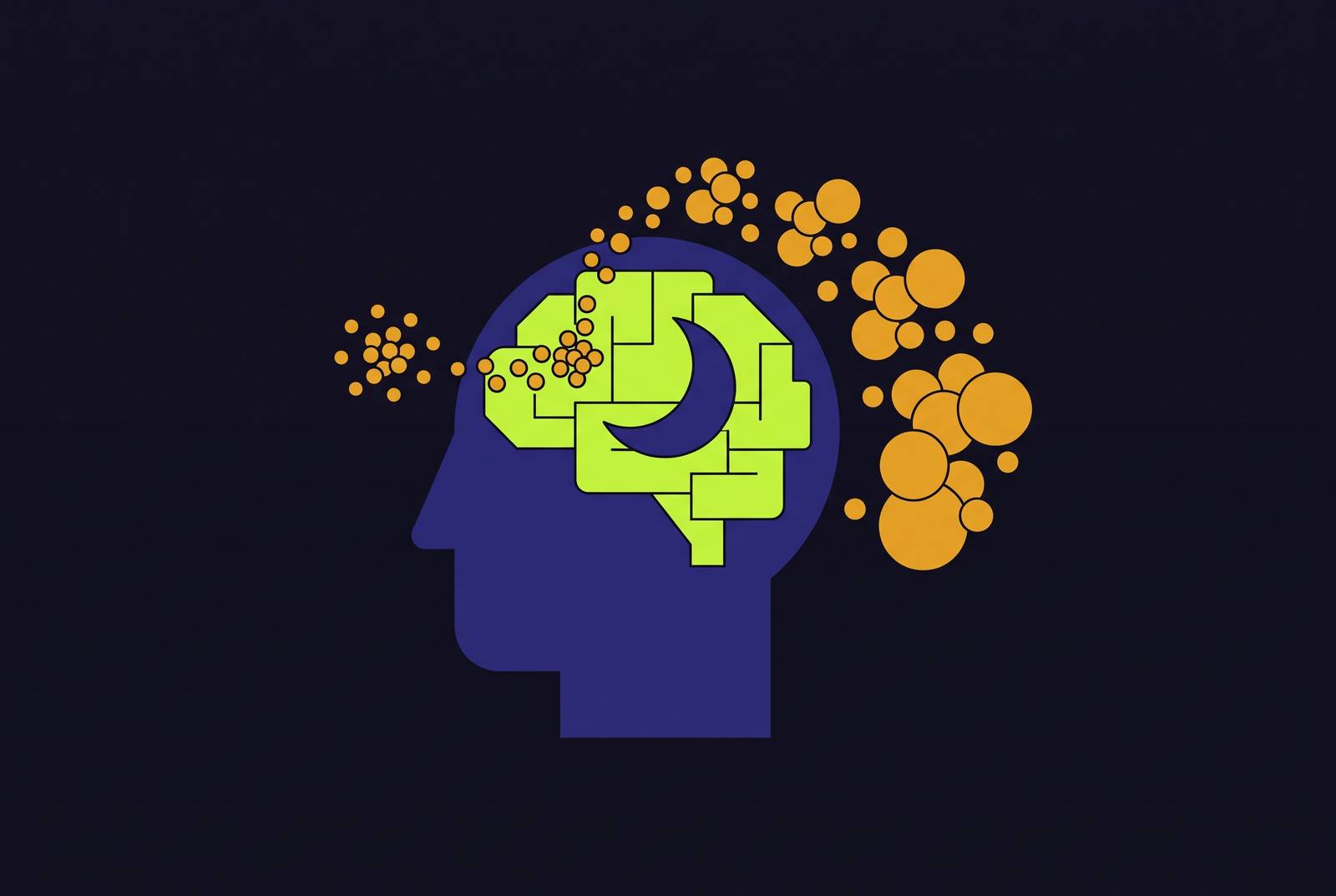
Allergic rhinitis affects roughly 81 million Americans, about 26% of adults and 19% of children as of 2021, and an estimated 500 million people worldwide. Most of that population treats it as a nuisance: sneezing, itchy eyes, a runny nose, solved with a pill. What gets missed is what happens after the sun goes down, when the same immune reaction keeps fragmenting sleep for weeks or months at a stretch, and the resulting cognitive fog gets blamed on stress, screens, or getting older instead of the immune system that never actually clocks out.
If waking up congested, popping an antihistamine, and still feeling mentally slow by 2 p.m. sounds familiar, this is why.
How allergic rhinitis physically disrupts sleep, night after night
Start with the plumbing. A congested nose forces mouth breathing, which reduces airflow efficiency and raises the arousal threshold, so it takes less to jolt someone half-awake throughout the night. That alone fragments sleep architecture. But there's a second mechanism working in parallel, and it's arguably the more interesting one: histamine itself is a wakefulness-promoting neurotransmitter. So the same immune response causing the itching and sneezing is also, at the chemical level, arguing against sleep. The allergic reaction and the sleep drive are working against each other, all night, every night the trigger is present.
The numbers back this up. In a European survey of people with perennial allergic rhinitis, 66.0% reported ongoing sleep problems, and those with problems woke an average of 3.8 times per night. Among that group, 92.0% took 15 minutes or more to fall asleep, and 22.2% took over an hour. A substantial share struggled to get back to sleep after waking, and 69.2% had trouble waking up in the morning because of how tired they still felt. A separate 2023 study found disturbed sleep quality in 67.3% of allergic rhinitis patients.
Seasonal sufferers, the grass and tree pollen crowd, get weeks of this at a time, unlike the occasional rough night everyone has now and then. It's structural. Seasonal sufferers, the grass and tree pollen crowd, get weeks of this at a time. Dust mite and mold sufferers, whose triggers don't disappear with a calendar change, get it year-round. Either way, a single fragmented night is a minor annoyance. Weeks of them compound into something categorically different.
How sleep debt builds without the brain being able to catch up
Sleep debt is the gap between the sleep the brain needs and the sleep it actually gets. It accumulates across nights, and a single good night's sleep does not erase it, no matter how tempting that idea is.
Three things happen at once when sleep is insufficient or broken up. First, adenosine, a chemical that builds up during waking hours and creates the pressure to sleep, only clears properly during deep slow-wave sleep (the N3 stage). Interrupted sleep means incomplete clearance, so each morning starts with leftover adenosine on top of the normal daily load. Stacked across multiple nights, that burden compounds into measurable impairment. Second, the prefrontal cortex, the part of the brain running working memory, executive function, and attention, happens to be the most sensitive brain region to sleep loss and the first to lose ground. Reduced metabolic activity in that region appears on brain scans. Third, the hippocampus, which handles converting short-term memory into long-term storage overnight, gets suppressed when sleep is chopped up, which blocks learning and dulls recall.
A fourth piece is that sleep is also when the brain runs its cleanup cycle, clearing metabolic waste through what's called the glymphatic system. Disrupt sleep and that housekeeping function gets compromised too.
And here's where caffeine comes in, because plenty of allergy sufferers lean on it hard. Caffeine blocks adenosine receptors, so it masks the sensation of sleepiness. It does not clear the adenosine. The debt is still there, quietly accumulating, while the coffee just switches off the alarm that would otherwise warn about it.
The self-assessment blind spot: why sufferers consistently underestimate their own impairment
A well-known 2003 study out of the University of Pennsylvania restricted subjects to 6 hours of sleep a night for 14 days. Objective cognitive performance kept getting worse across the entire two weeks, in a fairly steady decline. But subjective self-ratings of impairment leveled off by day four. Subjects felt like they'd found a new normal and stayed there, while their actual test scores kept sliding.
The felt experience adapts, but the underlying deficit does not, and that's the mechanism. The felt experience adapts. The underlying deficit does not.
Apply that to someone dealing with weeks of pollen-season disruption, or year-round exposure to dust mites. Their baseline has quietly recalibrated downward, and they have no internal alarm telling them so. What they notice instead: they've been more stressed lately, they're not as sharp as they used to be, maybe it's just age creeping in. What they don't notice, because there's no reason they would, is that the fog tends to lift on days spent in a low-allergen environment, or after a rare night of undisrupted sleep. That pattern, if anyone tracked it, would point straight back to the immune system as the actual cause. Instead the deficit goes unaddressed, because the person doing the assessing is using an instrument (their own sense of how they're doing) that's already been quietly recalibrated by the thing being measured.
Which cognitive functions degrade first, and in what order
Cognitive decline from sleep loss doesn't hit everything at once. There's a sequence.
Working memory and sustained attention are among the first to go. Holding a complex thought steady while new information comes in gets harder, and multi-step reasoning starts slipping partway through. Attention regulation degrades next: the ability to hold broad, flexible focus narrows. People oscillate between tunnel vision and a mind that keeps wandering off. Decision-making takes a hit after that, because choices that require real prefrontal cortex effort become disproportionately expensive, so automatic and impulsive choices start feeling like the path of least resistance (because, neurologically, they are). Risk assessment is among the first prefrontal functions to go. Sleep-deprived people take on more risk while rating that risk as lower than it is. Creative and flexible thinking suffers too, since it depends heavily on prefrontal flexibility, and sleep-deprived thinking tends to default to rigid, habitual patterns.
Put in everyday terms: the allergy sufferer who can't finish a sentence, defaults to the same lunch order every day, or misses details in a meeting isn't dealing with a character flaw or a stress response. That's a prefrontal cortex running on accumulated adenosine debt, doing the best it can with reduced capacity.
The productivity cost is measurable. Adults with allergic rhinitis show an estimated 20% drop in productivity on days when nasal symptoms are at their worst. The European sleep survey cited earlier found 53.3% overall work impairment and 47.1% activity impairment among respondents. And research on the economic cost of allergies points to something worth noting: presenteeism, showing up but functioning below capacity, is a significant and often underappreciated part of the total burden.
Mouth breathing as a hidden amplifier of the cognitive cascade
Congestion pushes people toward mouth breathing at night, and mouth breathing is structurally less efficient than nasal breathing for getting oxygen into the bloodstream. Chronic mouth breathing is structurally less efficient for oxygenation and can contribute to sleep apnea.
That connection runs both directions, too. Obstructive sleep apnea and allergic rhinitis are recognized as frequently co-occurring conditions, with research suggesting the two can interact and reinforce each other.
Children face a particular version of this. Kids who chronically mouth breathe typically don't sleep well, which shows up the next day as tiredness and trouble concentrating, and those symptoms can be misread as behavioral or attention problems when the actual driver is disrupted nighttime breathing.
Mouth breathing carries its own downstream effects on oral and airway health, which shows how far these effects travel. None of that is the main event here, but it's a useful marker of scope. Mouth breathing doesn't just add a symptom on top of the sleep disruption allergic rhinitis already causes. It compounds it, pulling people into shallower, less restorative sleep stages even during the hours they're technically asleep.
So how is anyone supposed to trace a foggy Tuesday afternoon back to an immune reaction that happened the night before, through a chain this long?
The fog gets misread as stress, burnout, or early aging
Self-reported, allergy-driven cognitive fog looks a lot like occupational burnout. It also resembles depression, generalized anxiety, perimenopause-related cognitive changes, or memory worry severe enough to send people searching for early dementia symptoms online. The overlap on paper is close to total.
One clue tends to go unnoticed: timing. Symptoms that spike every spring and fall, or that are consistently worst in the morning after a night of congestion, carry a temporal signature that allergies produce and generalized stress typically does not. Most people never think to track it that way, so the pattern stays invisible even though it's sitting right there in their own daily experience.
The mental health connection isn't just a surface-level resemblance, either. The relationship between allergic rhinitis and mood runs in both directions: poor sleep worsens mood, and worsened mood makes the symptom burden feel heavier. Then there's the medication trap. A lot of sufferers reach for first-generation antihistamines, which cause their own sedation and cognitive blunting. That means treating one kind of fog with a drug that generates a second kind, which only deepens the misattribution.
In the 2023 study cited earlier, 70.9% of allergic rhinitis participants reported moderate to high impact on daily activities. Most of that burden never gets logged as "allergy" anywhere in the healthcare system, because it doesn't present that way. It presents as tired, unfocused, a little off. If fog, low energy, and mood disruption are sticking around despite decent sleep habits, and especially if they seem to track with seasons or specific environments, allergies deserve a look as a root cause that's easy to overlook.
What treating the underlying allergy does to sleep and cognition
The logic here is straightforward: if immune activation is fragmenting sleep every night, then dialing down that immune reactivity should restore sleep architecture. The evidence lines up with that logic. In the European sleep survey, 36.4% of allergy sufferers on allergen immunotherapy reported moderate or great improvement in sleep specifically attributed to their allergy treatment.
Allergen immunotherapy, the umbrella term covering both sublingual and injection-based treatment, is recognized as a key therapeutic approach for allergic respiratory disease, with evidence-based support for its effectiveness. What it does at the immune level is a genuinely different mechanism from anything sold over the counter. Immunotherapy works at the immune level through a genuinely different mechanism from anything sold over the counter, gradually training the immune system toward tolerance rather than just quieting symptoms temporarily. Research framed around the "unified airway" concept, the idea that the upper and lower airways function as one connected system, has shown improvements in nasal and throat symptoms, reduced medication use, and better quality of life sustained over three years of treatment.
Compare that with antihistamines and nasal sprays. Those reduce the felt experience of congestion, which is genuinely useful in the moment, but they don't touch immune reactivity. The immune system keeps doing what it was doing, night after night, and the cognitive fog tied to that disruption stays right where it was.
Sublingual immunotherapy vs. allergy shots: what the evidence shows on efficacy, safety, and adherence
Both approaches, SCIT (the injection route) and SLIT (sublingual drops or tablets), work by repeated, controlled allergen exposure that trains the immune system toward tolerance over time. The biological goal is identical. What differs is delivery, and that difference carries real consequences for efficacy, safety, and whether people actually stick with treatment long enough for it to work.
On efficacy, available comparisons put shots at around 80% effectiveness for environmental allergens, with sublingual drops closer to 70%. That's a real gap, but narrower than most people expect going in, and both approaches produce meaningful symptom reduction for most patients. SCIT may have a slight edge over SLIT for certain allergens, house dust mite being one example that shows up in comparative studies. For a lot of patients, though, that difference doesn't translate into a meaningfully different day-to-day experience of symptom control.
Safety is where the picture shifts a bit. SLIT generally shows fewer severe systemic reactions in comparative research, and it's often favored where safety is the top priority, particularly for families making the call for a child. SCIT, because it's injected, carries a real risk of anaphylaxis and requires administration in a clinical setting with an observation period built in afterward. That's not a minor detail. It shapes the entire treatment experience.
Which brings up adherence, maybe the most underrated variable in this whole comparison. Treatment with allergen immunotherapy runs for an extended period to build lasting tolerance. SCIT means regular clinic visits at first, tapering to monthly, for the full stretch of that timeline. For a working adult juggling a job, or a parent managing a kid's schedule alongside their own, that's a real, recurring logistical demand, one that can quietly become the reason treatment gets abandoned halfway through, long before the immune system has had time to finish the shift toward tolerance. A treatment that works on paper only works in practice if someone can actually attend every scheduled session for it.