Seasonal Pollen Peaks and Sleep Score Correlations
Pollen-driven inflammation rewires sleep architecture, not just comfort.
Seasonal pollen peaks don't just make sleep uncomfortable, they measurably alter sleep architecture through inflammatory cytokines, explaining why allergy sufferers wake feeling unrestored even when they log enough hours. Most people chalk it up to stress, bad habits, too much screen time before bed. A study in Environmental Research, run by researchers at the Swiss Tropical and Public Health Institute, the University of Basel, and MeteoSwiss, found that allergic rhinitis patients report significantly worse sleep quality during pollen season than outside of it Allergy and Asthma Foundation of America (AAFA) 2025 Climate Report.
That's not just about congestion keeping someone awake. The real story is that the immune system, once it's triggered by pollen, goes to work reshaping the internal structure of sleep itself. This piece traces that chain step by step: pollen exposure, immune response, cytokine activity, altered sleep stages, and the unrestored feeling that follows the next morning.
A quick note on terms, since they matter later. Deep sleep handles physical recovery, REM handles memory and emotional processing. Disrupt the balance between them, and the hours on the clock stop matching how restored a person feels.
None of this is in anyone's head. The exhaustion has a real, traceable, biological cause, and by the end of this piece, a real point of intervention too.
How pollen triggers the immune cascade that reaches the brain at night
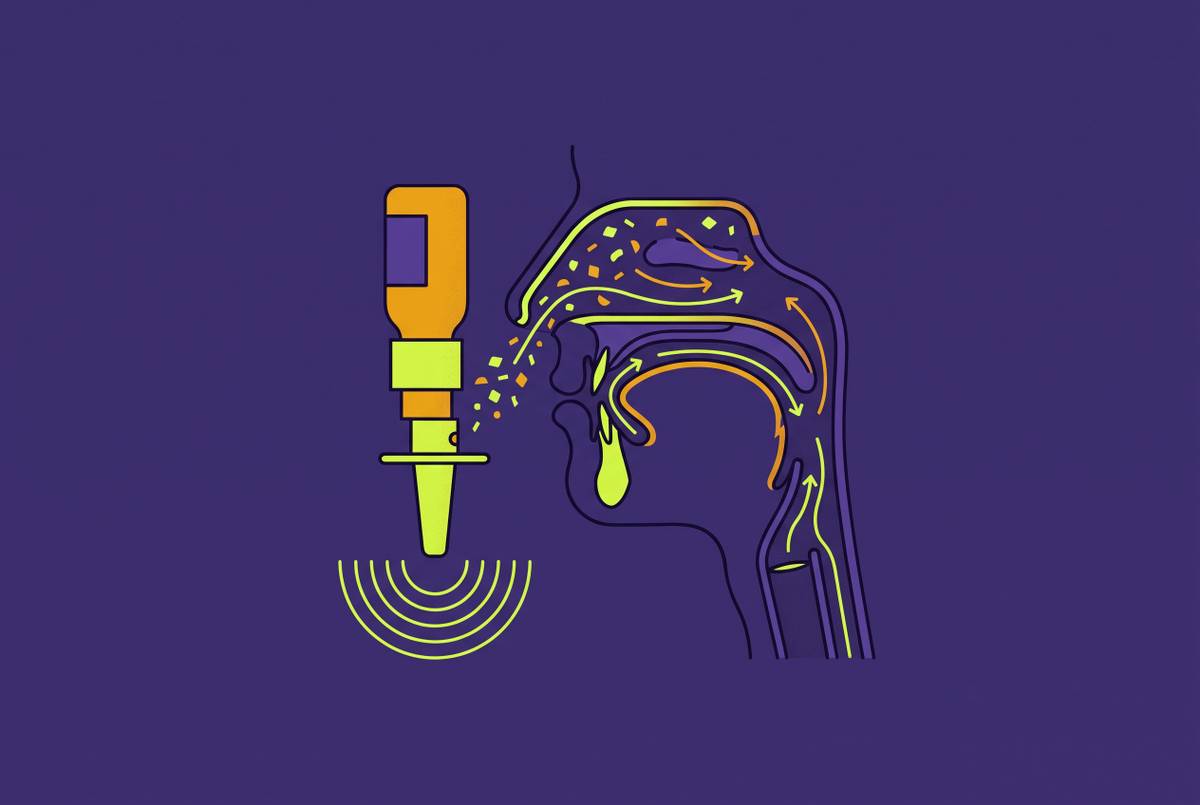
Allergic rhinitis is what's called an IgE-mediated inflammatory disease. In plain terms: pollen exposure sets off a Th2-dominant immune response, a specific branch of the immune system built to handle things like parasites and, in allergy sufferers, mistakenly aimed at ragweed and tree pollen instead.
The sequence runs as follows. Th2 cytokines, specifically IL-4, IL-5, and IL-13, signal B lymphocytes to start pumping out allergen-specific IgE antibodies. That, in turn, recruits mast cells, basophils, and eosinophils, all of which release a cocktail of histamine, tryptase, prostaglandins, and leukotrienes. This is the machinery behind sneezing and a stuffed-up nose. But it's also a lot more than that.
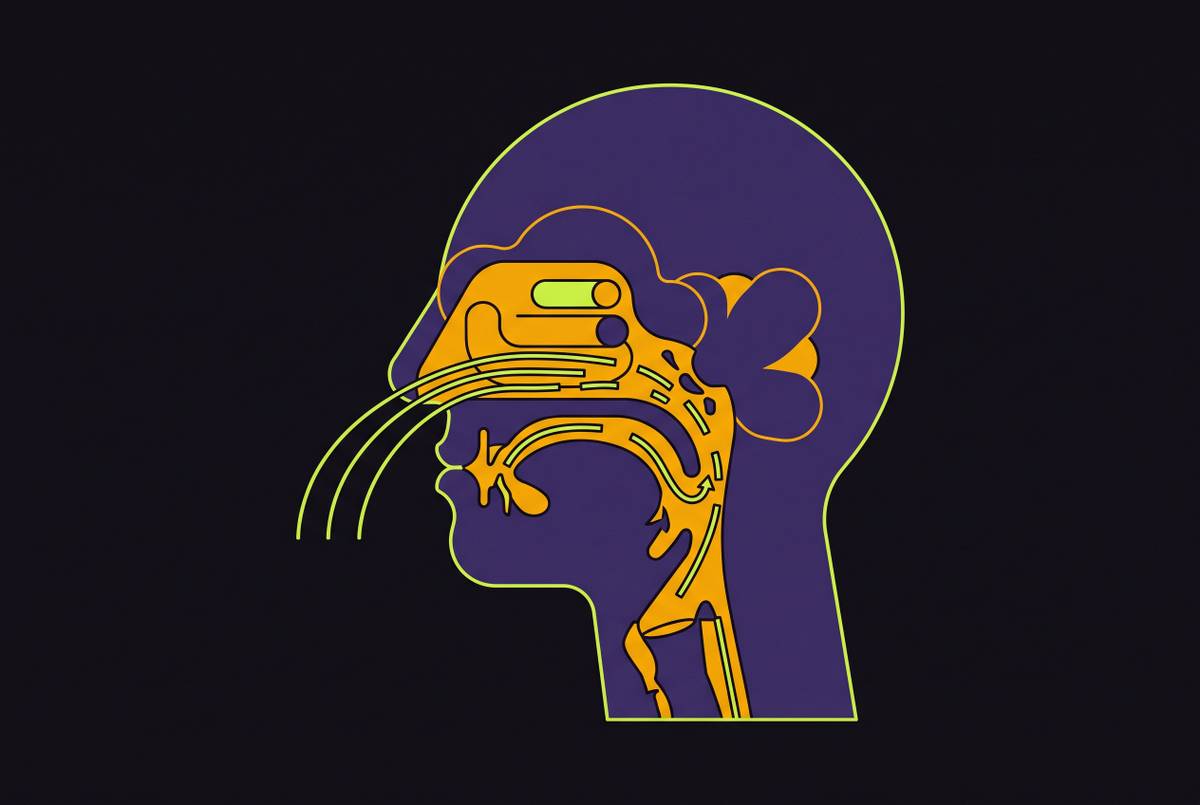
None of this stays confined to the nasal passages. It's a systemic inflammatory state, meaning those inflammatory mediators circulate through the bloodstream and reach neural circuits that regulate sleep.
Then there's histamine itself. It isn't just a symptom-causing molecule, it's a wakefulness-promoting neurotransmitter in the brain. So when the body overproduces histamine in response to pollen, it's directly fighting against the pressure to fall asleep, working against the very system trying to shut down for the night.
Nasal congestion is what a person notices. The neuroinflammation running underneath it produces less visible but arguably more consequential changes that are actually rewriting the night's sleep.
What inflammatory cytokines do to sleep stages
The counterintuitive part follows. The Environmental Research study found that allergic subjects showed increased fatigue and sleepiness during pollen season, which tracks Allergy and Asthma Foundation of America (AAFA) 2025 Climate Report. But they also showed an increased percentage of deep sleep Allergy and Asthma Foundation of America (AAFA) 2025 Climate Report. More deep sleep should mean better rest. So why do these same people feel worse?
Because more deep sleep, in this context, isn't a sign of recovery. It reflects the brain's stress response to systemic inflammation, not genuine restoration Allergy and Asthma Foundation of America (AAFA) 2025 Climate Report. The proportion goes up, but the quality degrades. Think of it as the difference between a factory running more hours and a factory running more hours badly, with parts jammed and workers pulled off task.
A clinical study provides harder data behind this. A clinical study by Thompson and colleagues, cited in a Frontiers in Allergy systematic review, found that slow-wave sleep was reduced by 38.5 minutes in patients with moderate-to-severe allergic rhinitis, and that reduction correlated directly with IL-1β levels Frontiers | The relationship between allergic rhinitis and sleep disorders and mental health Allergy and Asthma Foundation of America (AAFA) 2025 Climate Report. That's a concrete, measurable dent in the part of sleep responsible for physical recovery.
A separate functional MRI study, by Rosenkranz and colleagues in the same review, found that activation in the insula and anterior cingulate cortex increased by 32.7% during pollen season in AR patients Frontiers | The relationship between allergic rhinitis and sleep disorders and mental health. Those are brain regions tied to pain processing and emotional regulation. During sleep, when they're supposed to be quiet, they're lit up instead.
And in an animal model from Nakamura and colleagues, also cited in that review, sensitized mice showed disrupted circadian expression of Clock genes in the suprachiasmatic nucleus, the brain's master clock, along with fragmented sleep-wake cycles. That points to something bigger than discomfort: pollen-driven inflammation appears to interfere with the central circadian clock itself, not just how comfortable sleep feels.
So a wearable might show eight hours logged, deep sleep percentage even looking fine on paper Seasonal Variations in Sleep Quality and Stability Among Patients with Chronic Insomnia Allergy and Asthma Foundation of America (AAFA) 2025 Climate Report. But the internal architecture has been altered at the neurological level, and the device has no way to catch that.
The delayed exposure effect and sufferers' misreading of their own symptoms
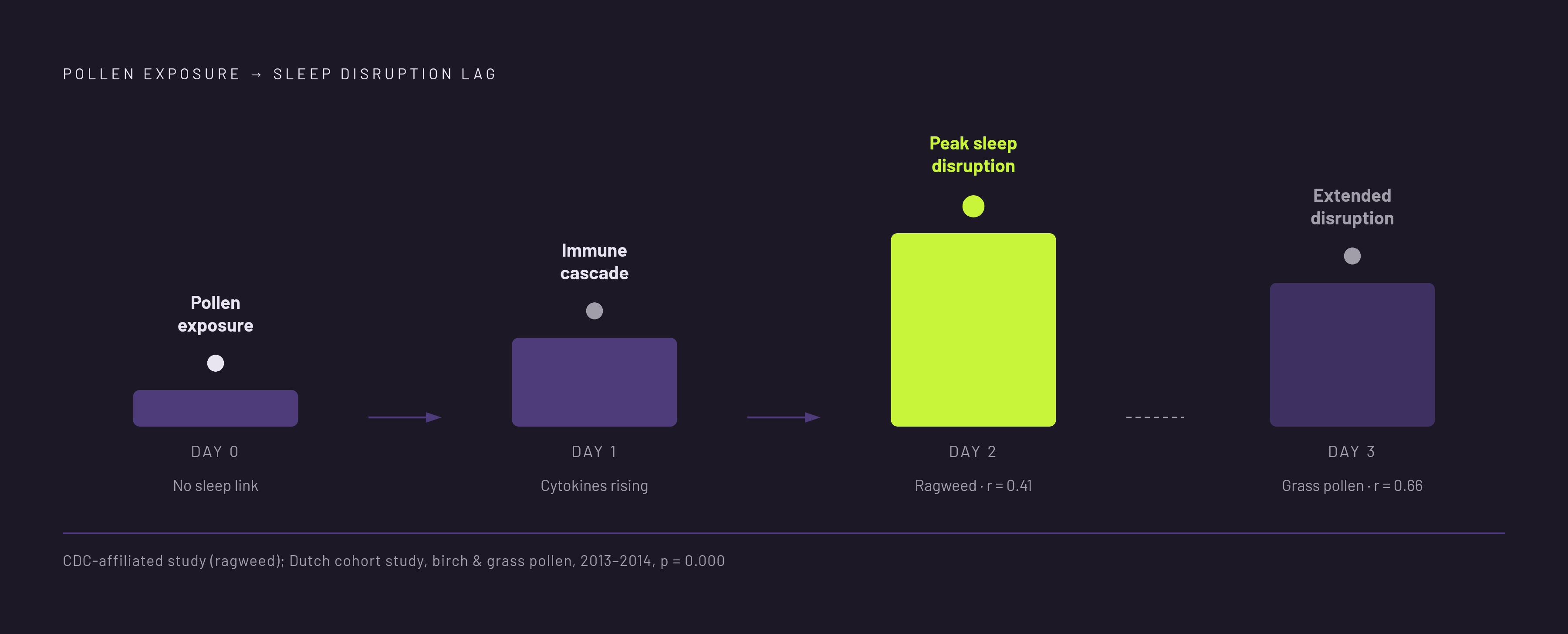
The worst effects don't always show up the same day.
A CDC-affiliated study found that sleepiness peaked two days after ragweed pollen exposure, with same-day allergy symptoms showing no significant tie to that day's pollen count stacks.cdc.gov. In other words, the pollen from Sunday hits hardest on Tuesday night.
A Dutch study of children with allergic rhinitis backs this up with more granularity. Delayed correlation between birch pollen and symptoms ran up to two days out; for grass pollen, the delay stretched to three days. And the grass pollen relationship wasn't weak or speculative: correlation coefficients came in at 0.413 in 2013 and 0.655 in 2014, both statistically significant at p=0.000 Clinical response to varying pollen exposure in allergic rhinitis in children in The Netherlands Allergy and Asthma Foundation of America (AAFA) 2025 Climate Report. Strong relationships, just offset in time.
What does that mean for someone checking a sleep app? Picture it: a poor sleep score appears Tuesday morning, and there's no obvious reason for it. No late night, no extra coffee, nothing unusual logged. The pollen count from two days earlier doesn't show up anywhere on the screen. Without knowing to look for that lag, the connection stays invisible.
This is exactly why so many allergy sufferers stay stuck treating symptoms as they appear rather than addressing the root cause. They're not seeing the pattern, because the pattern is built to hide in plain sight.
How pollen seasons are structured across the year
Nationally, the calendar runs in a fairly predictable order. Tree pollen peaks early spring, grass pollen (Timothy, Bermuda, Kentucky bluegrass among the worst offenders) takes over from late spring through mid-summer, and weed pollen, ragweed especially, runs late summer into fall, sometimes lasting into October or until the first hard frost.
But regional exceptions break that pattern in ways a lot of sufferers don't expect. In Texas, mountain cedar blooms December through February, a phenomenon locals call "cedar fever," creating a winter allergy season most people associate only with spring. In the Pacific Northwest, mild wet winters stretch tree pollen seasons out longer, with earlier starts and slower endings.
And the calendar itself is shifting. Per the Allergy and Asthma Foundation of America's Climate Report, pollen release is starting earlier and seasons are running longer, in some cases by 20 days or more Allergy and Asthma Foundation of America (AAFA) 2025 Climate Report. A 2022 Nature Communications study by Zhang and Steiner projects that pollen emission seasons across the continental U.S. will keep lengthening Allergy and Asthma Foundation of America (AAFA) 2025 Climate Report.
Climate Central's 2026 analysis of 198 U.S. cities, using NOAA data through 2025, found the freeze-free growing season had lengthened in 173 of those 198 cities Allergy and Asthma Foundation of America (AAFA) 2025 Climate Report. Longer frost-free stretches mean longer pollination windows, plain and simple. So the exposure windows driving all of this sleep disruption aren't holding steady, they're expanding, which means the cumulative inflammatory load on sleep architecture across a full year is climbing too.
How disrupted sleep architecture compounds into daytime cognitive and emotional harm
The most complete recent synthesis on this connection is a Frontiers in Allergy systematic review by Feng and colleagues at China Medical University, drawing on research through an October 2025 search cutoff Allergy and Asthma Foundation of America (AAFA) 2025 Climate Report. It's the anchor for understanding just how far this reaches beyond a groggy morning.
According to studies cited in that review, AR patients showed significantly higher risk of anxiety and depression compared to healthy controls, and a separate systematic review of 15 studies by Høj and colleagues found significantly higher risk of suicidal ideation among AR patients as well. That's a heavy finding, and it deserves to be taken seriously rather than filed under "seasonal inconvenience."
Why does this happen? Sleep deprivation doesn't act alone, it compounds the direct effects that histamine and inflammation already have on the brain. Memory consolidation, metabolic waste clearance, neurotransmitter restoration, all of that depends on deep sleep, and deep sleep is exactly what pollen-driven inflammation is degrading.
The scale here spans continents and decades. The same review found that standardized AR prevalence among Chinese adults rose 6.5% over six years, and in high-pollen grassland regions of Northern China, self-reported pollen-induced AR prevalence hit 32.4% Frontiers | The relationship between allergic rhinitis and sleep disorders and mental health. That's not a niche problem, but a population-level one.
A cycle forms from here: AR fragments sleep, poor sleep impairs daytime cognition, fatigue makes managing symptoms harder, untreated AR gets worse, and the sleep debt deepens. Nasal obstruction adds another layer, pushing people into mouth breathing overnight, which brings snoring, further fragmentation, and reduced oxygen flow on top of the cytokine damage already in motion.
Children and working adults carry this the hardest. A kid staring blankly during class, an adult who can't concentrate through an afternoon meeting during high pollen weeks, that might not be laziness or unrelated stress. It might be ongoing architecture damage, invisible on the surface. Left unaddressed long enough, the downstream complications go beyond tiredness: chronic sinusitis, worsened asthma, depression.
What wearable sleep scores and PSQI data show across seasons
Population-level data backs up what the mechanism suggests, and the numbers line up almost too neatly with the pollen calendar.
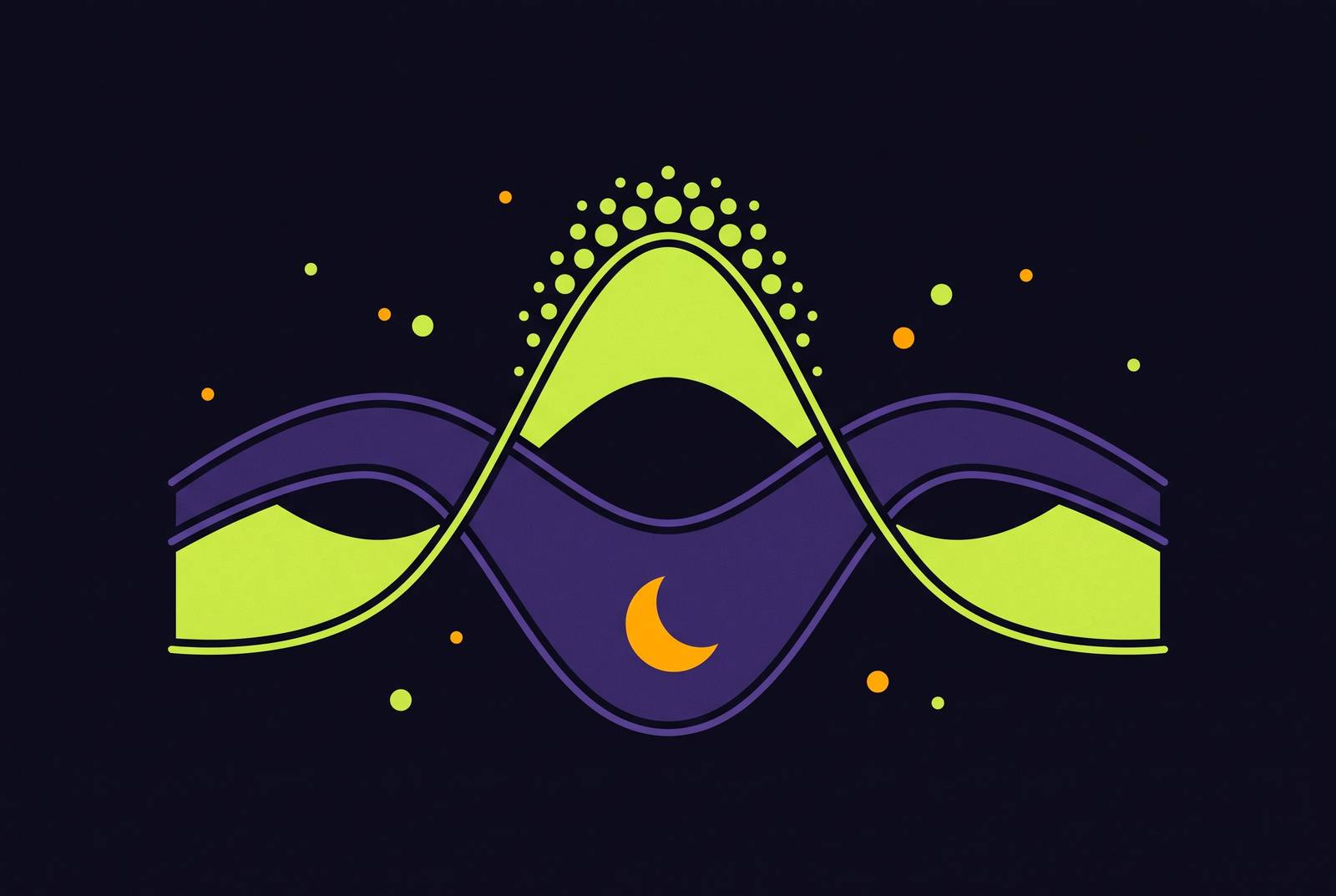
A large retrospective study out of Zhejiang University's Affiliated Mental Health Center, covering 25,428 chronic insomnia patients from 2018 to 2023 and published in Nature and Science of Sleep, tracked mean PSQI scores across seasonal periods, peaking during Grain Rain (~April 20, mean PSQI 9.53) and Cold Dew (~October 8, mean PSQI 9.48), with the best scores during Major Snow and Minor Snow (mean PSQI 8.91 and 8.96) Seasonal Variations in Sleep Quality and Stability Among Patients with Chronic Insomnia Allergy and Asthma Foundation of America (AAFA) 2025 Climate Report. Scores peaked, meaning sleep quality was worst, during Grain Rain (around April 20, mean PSQI 9.53) and Cold Dew (around October 8, mean PSQI 9.48) Seasonal Variations in Sleep Quality and Stability Among Patients with Chronic Insomnia Allergy and Asthma Foundation of America (AAFA) 2025 Climate Report. The best scores landed during Major Snow and Minor Snow, at 8.91 and 8.96 Seasonal Variations in Sleep Quality and Stability Among Patients with Chronic Insomnia Allergy and Asthma Foundation of America (AAFA) 2025 Climate Report.
Spring and early autumn. That's exactly when tree and grass pollen peak on one end, and ragweed on the other. The study didn't measure pollen directly, so this isn't proof of causation, but the alignment is hard to write off as coincidence.
That's a detail to remember if the general pattern doesn't seem to fit someone's own experience.
A separate dataset adds another angle. A cross-sectional analysis of diagnostic polysomnography (overnight sleep lab) studies from 3,965 women and 2,886 men, spanning 2003 to 2024 and published in August 2026 in Communications Health by researchers at the National Institute of Environmental Health Sciences and UNC Chapel Hill, found that the apnea-hypopnea index (a measure of breathing disruptions during sleep) peaked in March for men, and roughly a month later for women Seasonal variation in sleep apnea and other sleep parameters from diagnostic polysomnography data, 2003–2024 Allergy and Asthma Foundation of America (AAFA) 2025 Climate Report. That's right on top of peak tree pollen season.
Sleep efficiency in that same dataset ran in two annual cycles for both sexes, with troughs in early January and June for men. The June trough lines up with grass pollen's peak Allergy and Asthma Foundation of America (AAFA) 2025 Climate Report.
For anyone staring at a dip in their wearable's sleep score during spring or fall with no clear lifestyle explanation, the data pattern shows up at a population scale, which means it's reproducible, not a fluke. Women showed greater sensitivity to seasonal sleep variation than men (p<0.05), with patients aged 45–59 showing greater fluctuations, a finding important for personalizing the message.
Why symptom-masking approaches leave the sleep problem intact
Standard treatment reaches for antihistamines first, and understandably so, they work fast on the symptoms people notice. But antihistamines block histamine receptors, they don't touch IL-5, TNF-α, or the broader Th2 cytokine cascade that's remodeling sleep stages in the background. The architecture disruption keeps running even while the sneezing stops.
First-generation antihistamines carry their own complication. They're sedating, which can speed up how fast someone falls asleep, but they also suppress REM sleep. So on top of whatever inflammation is already doing to sleep architecture, the very medication meant to help adds a second layer of distortion.
Nasal sprays work at a more local level, reducing mucosal inflammation in the nose. But they don't touch the systemic inflammatory state, and they don't address the circadian clock disruption documented in the Nakamura animal model from earlier Allergy and Asthma Foundation of America (AAFA) 2025 Climate Report. The clock keeps running off pattern.
That 2026 Frontiers in Allergy review describes something important here: a circular, bidirectional relationship between allergic rhinitis, sleep disorders, and mental health Allergy and Asthma Foundation of America (AAFA) 2025 Climate Report. Treating one axis with a symptom-blocker doesn't interrupt what's happening on the other two stacks.cdc.gov.
None of this means symptom relief is pointless, daytime comfort matters. But it does mean a patient taking a daily antihistamine all spring can still wake up feeling unrestored, because the cytokine-level disruption to slow-wave sleep keeps going underneath whatever relief the medication provides.
How retraining the immune response addresses sleep disruption at its source
So what actually reaches the mechanism traced through this whole piece, from pollen exposure down to degraded sleep architecture? Sublingual immunotherapy, or SLIT, works by redirecting the immune response away from its Th2-dominant pattern and toward Th1, a shift modulated by regulatory T-cells. That's a change at the origin point of the cytokine cascade, not a block placed somewhere downstream.
The route matters here, and it's worth understanding why. The tissue under the tongue contains Langerhans cells and dendritic cells that, when exposed to gradually increasing allergen doses, teach the immune system tolerance instead of triggering an inflammatory response. Over time, repeated exposure through that specific tissue changes how the body reacts to the same pollen it used to fight.
The evidence for this holds up. That's not a seasonal patch, but a durable shift.
Follow the logic back to where this started. If IL-5, TNF-α, and the broader Th2 cytokine profile drop through immune desensitization, the actual mechanism driving sleep architecture disruption drops along with it, not just the nasal symptoms sitting on the surface.
At-home administration matters for anyone already running on a sleep deficit. Weekly in-office allergy shots add a logistical burden that's hard to manage for someone already exhausted, while a sublingual treatment can be taken anywhere, no appointment required. Telehealth allergy care, virtual consultations, at-home finger-prick testing, and treatment delivered to the door, has made this kind of immune-level intervention reachable without an in-person specialist visit, with plans starting around $99 a month and an initial consult around $49, both FSA and HSA eligible.
The chain runs from pollen to immune cascade to cytokines to degraded sleep stages to daytime cost. Somewhere in that chain, an approach either blocks a downstream symptom or it changes what set the whole thing off in the first place. Only one of those actually interrupts the cycle this piece has been tracing from the start. A Frontiers in Allergy meta-analysis found that robust RCT evidence supports clinically meaningful reductions in symptoms and medication use with grass and house dust mite SLIT tablets, with sustained benefits observed up to 1–2 years after a 3-year treatment course, per the Allergy and Asthma Foundation of America (AAFA) Climate Report Allergy and Asthma Foundation of America (AAFA) 2025 Climate Report.
Sources
- Frontiers | The relationship between allergic rhinitis and sleep disorders and mental health
- Seasonal Variations in Sleep Quality and Stability Among Patients with Chronic Insomnia: Real-World Evidence Across the 24 Solar Terms
- Seasonal variation in sleep apnea and other sleep parameters from diagnostic polysomnography data, 2003–2024
- stacks.cdc.gov
- Clinical response to varying pollen exposure in allergic rhinitis in children in The Netherlands – DOAJ
- nature.com
- climatecentral.org