Leaky Gut and Aeroallergen Sensitization Bidirectional Link
Fixing a leaky gut may break the cycle that turns pollen into lifelong allergies.

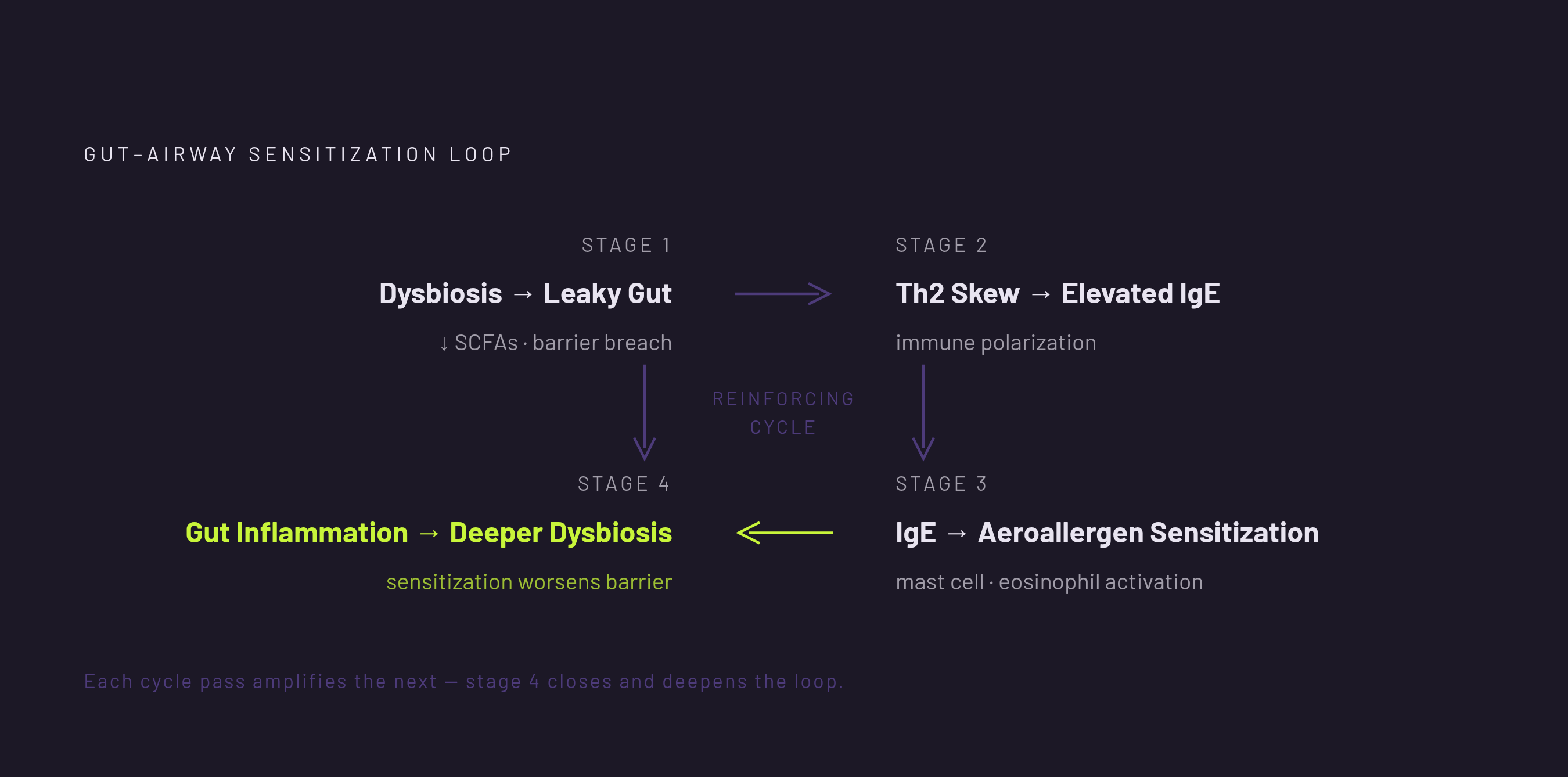
Leaky gut and aeroallergen sensitization are one system, running in a loop: a compromised intestinal barrier skews the immune system toward the exact state that lets airborne allergens trigger an IgE response, and that airway response then circles back and damages the gut further. Breaking that loop means treating the immune dysregulation that drives it, not just the sneezing it produces.
Why gut and airway are not separate allergy systems
The standard explanation for allergic rhinitis goes like this: an allergen gets inhaled, the immune system in the nose overreacts, IgE antibodies get made, symptoms follow. The standard explanation is incomplete because it skips the question of why the immune system was primed to overreact in the first place.
The gut is the largest immune organ in the body. When its bacterial population falls out of balance, a state called dysbiosis, the entire immune system tilts toward what's known as Th2 dominance. Th2 is the branch of the immune system responsible for the antibody class, IgE, that drives allergic reactions. A gut in dysbiosis doesn't just cause local digestive trouble. It changes the immune tone of the whole body, and that includes the tissue lining the nose and airway.
Research on gut microbiota and allergic disease backs this up directly: early-life gut colonization is linked to the later development of allergic disease, and gut microbiota composition measurably affects how the immune system responds to allergens. What makes this more than a one-time developmental effect is that the influence keeps moving in both directions throughout life. Mouse models studying the gut-nose axis in allergic rhinitis have documented bidirectional regulation between gut and nasal microbiota. The gut doesn't just set the stage once and exit. It's a circuit.
How a compromised intestinal barrier amplifies Th2-skewed immune responses
A healthy gut lining acts as a filter. Dysbiosis breaks that filter down, so antigens and bacterial byproducts leak into systemic circulation, and there they interact with immune cells in ways that favor Th2 activity and IgE production. This matters because not all microbial leakage pushes the immune system the same direction. Lipopolysaccharides, or LPS, from gram-negative bacteria are known to drive Th1-dominant, pro-inflammatory activation rather than Th2 skewing when they cross the gut barrier. The Th2 drift seen in allergic disease is a more specific imbalance than simple "bacteria leaking out," tied to which protective mechanisms have been lost.
The clearest piece of evidence for this comes from a 2025 study in Clinical and Translational Allergy. Researchers found that higher total IgE and a higher number of positive food-specific IgE results were associated with lower concentrations of short-chain fatty acids, specifically butyric acid, valeric acid, and acetic acid, along with elevated leaky-gut biomarkers including LBP, syndecan-4, IL-10, and IL-22. That pattern ties barrier impairment directly to the IgE sensitization state. The study was cross-sectional, showing association without establishing which came first in every case. Still, the pattern lines up with the mechanism researchers already understand.
Short-chain fatty acids, or SCFAs, are what a healthy microbiome produces when it ferments dietary fiber. They do two jobs that matter here: they promote regulatory T-cell, or Treg, differentiation, and they help maintain the integrity of the gut barrier itself. Both functions keep allergen entry low, and they keep the immune system calm. A 2025 mini-review in Frontiers in Allergy lays out how SCFAs support immune tolerance through these two channels, and it notes that when intestinal permeability rises due to dysbiosis, cross-reactive immune responses get worse.
Take the SCFA-producing bacteria away, through antibiotics, poor diet, chronic stress, or illness, and the brake comes off the Treg/Th2 balance. There's nothing left to hold the Treg/Th2 balance in place or to patch the barrier. What's left is a systemic immune environment primed to escalate. In that state, even a small amount of airborne pollen or dust mite protein can trigger or amplify an IgE response that a gut-healthy body would likely shrug off.
Gut bacteria and allergic rhinitis risk
The barrier-and-SCFA mechanism shows how a damaged gut can set up conditions that favor sensitization. A separate line of research asks a sharper question: do specific bacterial species raise the risk of allergic rhinitis on their own, independent of general gut health?
To answer that kind of question well, researchers need a method that can rule out reverse causation and confounding, the usual weak spots in studies that just compare gut bacteria levels to allergy rates. Mendelian randomization does this by using genetic variants as stand-ins for microbial abundance. Because a person's genes are fixed at birth and aren't influenced by whether they later develop allergies, a genetic variant linked to higher abundance of a given bacterial species gives researchers a cleaner signal of cause and effect than a simple snapshot comparison would.
A 2026 bidirectional Mendelian randomization study, published in Medicine (Baltimore), applied this method to allergic rhinitis and found that a one standard deviation increase in genetically predicted abundance of the gut species Collinsella aerofaciens was associated with a 23.5% higher risk of allergic rhinitis. The same study found that inflammatory proteins, specifically Fractalkine (CX3CL1), partially mediated the association between the gut genus Flavonifractor and allergic rhinitis risk.
That mediation finding carries its own weight. So the gut-to-airway signal isn't only a matter of a leaky barrier letting things through physically. Specific microbial communities appear to alter circulating inflammatory proteins directly, and those proteins then go on to influence immune activity in the airway. The barrier and the biochemistry are two separate channels carrying the same message. The study's authors call for colocalization analyses before this translates into clinical practice, so you should read the finding as strong genetic evidence pointing toward causation, but not yet as a settled clinical fact.
The return loop: how aeroallergen sensitization then damages the gut
Everything so far describes one direction of the arrow: gut dysfunction feeding airway sensitization. The loop only becomes a loop once the arrow runs the other way too, and the evidence for that direction is just as concrete.
A 2025 Frontiers in Allergy study looked at patients with IBS-diarrhea, or IBS-D, who were also sensitized to grass pollen. During pollen season, these patients showed significantly worse gastrointestinal symptoms compared to unsensitized patients and compared to patients sensitized to house dust mites instead. CUT
The mechanism the study points to involves mast cells and eosinophils, the same immune cells recruited during an allergic reaction in the airway, which are also present in gut mucosal tissue. When these cells get activated by systemic allergen exposure, they increase mucosal permeability and drive low-grade inflammation, the same categories of disruption implicated in IBS pathogenesis generally. The allergic flare and the gut flare are being driven by overlapping biology, not two coincidental problems happening at once.
A degraded gut amplifies Th2 activity and IgE production; that drives aeroallergen sensitization, which triggers gut inflammation, which degrades the barrier further and deepens the sensitization. Each pass through the loop sets up the next one. This also helps explain, at a mechanistic level, a pattern allergists have long recognized clinically: the atopic march, where allergic disease tends to progress from the gut and skin in early childhood toward airway disease later. The gut-airway axis doesn't replace that clinical pattern. It gives it a biological basis beyond simple repeated allergen exposure over time.
The hidden burden of untreated sensitization
On paper, this cycle is a set of immune pathways. In a person living with it, the cycle appears as a list of complaints that rarely get connected to each other, let alone to allergies.
On the gut side, patients with IBS-D who are also sensitized to pollen tend to see their bloating, diarrhea, and general digestive symptoms worsen during pollen season, the pattern the 2025 study documented directly. In most gastroenterology practices, that seasonal worsening doesn't get flagged as allergy-related. It gets treated as an unexplained flare of an already-diagnosed gut condition, and the actual driver goes unaddressed.
On the airway side, the consequences extend well past sneezing and a stuffy nose. Chronic congestion pushes people into mouth breathing, and that affects sleep quality and oxygenation overnight. Allergic rhinitis also disrupts sleep architecture directly, cutting into time spent in deep slow-wave and REM sleep. Lost sleep produces fatigue, irritability, and trouble concentrating the next day, the kind of daytime symptoms that get blamed on stress or a bad night's sleep rather than traced back to a nose that never fully cleared.
This isn't a small or shrinking population. A 10-year retrospective study of more than 21,000 children with allergic rhinitis in Guangzhou found dust mites, specifically Dermatophagoides farinae and D. pteronyssinus, to be the dominant sensitizers, with sensitization to pet dander rising in recent years. That scale, and that shift in what's triggering the sensitization, points to a large and changing population moving through this same gut-airway loop, often without anyone connecting the dots between a child's digestive complaints and a dust mite allergy.
And the loop compounds itself experientially, not just immunologically. Poor sleep from unmanaged allergic rhinitis affects gut motility and microbiome composition, sustaining the same dysbiosis that kept the sensitization going. A tired gut and an irritated airway end up feeding each other, day after day, long after the original trigger has stopped mattering much on its own.
Why symptom-masking treatments cannot break the cycle
Given how structural this cycle is, the standard first-line treatments for allergic rhinitis were never built to interrupt it. They work downstream of the IgE response. The Th2 bias, the barrier dysfunction, and the dysbiosis that caused the IgE response in the first place stay exactly where they were.
Antihistamines are the clearest example. They block histamine, the chemical messenger responsible for most allergy symptoms, but they don't lower IgE levels, don't shift the Th2/Treg balance, and don't repair a damaged gut barrier. Once the dose metabolizes out of the system, the underlying immune environment is unchanged. The next exposure triggers the same cascade all over again.
Nasal corticosteroids work differently, reducing inflammation locally in the nasal tissue, but they share the same limitation. They don't touch the gut-derived immune skewing that keeps systemic Th2 tone elevated or that keeps expanding the range of allergens a person reacts to over time.
The atopic march's continued appearance in patients managed primarily on symptom-suppressing medication is consistent with this. Patients progress from rhinitis to asthma, and from a single allergen sensitivity to several, in a pattern that tracks with an immune system whose underlying dysregulation was never addressed. Managing symptoms is a reasonable short-term strategy for comfort. It was never designed to be a long-term strategy for resolution.
Sublingual immunotherapy and the cycle's immune dysregulation
Allergen immunotherapy stands apart from every other allergy treatment category for one reason: it's the only approach documented to change the immune response itself, shifting Th2 tone toward Th1 and regulatory patterns, rather than working around the response after it's already underway.
Sublingual immunotherapy, or SLIT, takes advantage of a feature of the oral mucosa called tolerogenic potential. Tolerogenic dendritic cells under the tongue take up allergen and support the differentiation of Th1 cells and IL-10-producing regulatory T cells. Over time, this produces allergen-specific IgG and IgA, antibody types that block the IgE-mediated response. These changes happen locally in the mouth tissue, and they happen systemically throughout the body. That systemic reach is what makes SLIT relevant to the gut-airway cycle specifically. A real shift from Th2 toward Th1 and Treg dominance relieves immune pressure on the gut barrier and on airway reactivity at the same time, because both were being driven by the same systemic imbalance.
A 2026 Frontiers in Allergy review found robust RCT evidence for clinically meaningful reductions in both symptoms and medication use with grass and house dust mite SLIT tablets, with benefits sustained one to two years after completing a three-year treatment course. Real-world cohorts that follow patients after treatment also report a reduced risk of new asthma onset, and they show lower long-term medication use. One detail in particular stands out: a subset of patients, especially children, shows a drop in medication use without a matching drop in reported symptoms. If you read that pattern in light of the mechanism, it suggests SLIT reduces the underlying immune hyperreactivity even when the surface-level symptom score doesn't capture the full change.
A regulatory body has approved SLIT tablets for a specific set of allergens, including certain grasses, ragweed, and dust mites. Multi-allergen custom SLIT drops are used off-label in the United States, a practice backed by systematic reviews and supported by some specialty organizations, including the AAOA, though the AAAAI/ACAAI Joint Task Force practice parameters stop short of endorsing off-label SLIT drops. You should know about this real difference in professional opinion before you choose between a tablet and a drop-based protocol.
Compared to subcutaneous allergy shots, SLIT offers a meaningfully different day-to-day experience. It's taken at home, once a day, and after the first dose, which has to be taken under medical supervision with a 30-minute observation window, no further observation period is required. The risk of a systemic reaction is also substantially lower than with injections. Weekly clinic visits and observation periods are exactly the kind of friction that makes people put off starting immunotherapy indefinitely, all while the gut-airway cycle keeps running. Telehealth-based care models have emerged to close that gap further: virtual consultations, at-home finger-prick IgE testing, and personalized treatment plans shipped directly to a patient's door, with plans starting at $99 a month and an affordable initial consult, with FSA and HSA eligibility bringing the effective cost down further. For a root-cause treatment, access was always going to be the final barrier. These models are built to remove it.
What breaking the cycle requires of patients
None of this works as a one-time fix. SLIT builds immune tolerance gradually, over a treatment course that typically runs three years, with benefits that researchers have tracked for one to two years afterward. A patient who stops early, or who treats the first few months as a trial run rather than a full course, is unlikely to see the systemic Th2-to-Treg shift that actually interrupts the gut-airway loop.
It also helps to hold two things in mind at once. Immunotherapy addresses the immune dysregulation that drives the cycle, but it doesn't erase a damaged gut barrier overnight; gut health built on dietary fiber and SCFA-producing bacteria supports the same Treg balance that immunotherapy works to shift. Treating one side of the loop while ignoring the other is still an improvement, but it's a slower, more partial one.
What this body of research offers, more than anything, is a reason to stop treating gut symptoms and airway symptoms as two separate conversations with two separate doctors. If a patient's IBS flares every spring and their allergies flare every spring too, they are very likely describing the same underlying problem twice. Recognizing that connection and choosing a treatment that works on the immune system driving both sides of it finally breaks the loop before next season.
Sources
- Food Sensitization Is Associated With Atopic Dermatitis Severity, Gut‐Derived Metabolites and Leaky Gut in Adults - PMC
- Frontiers
- Gut microbiota, inflammatory proteins, and allergic diseases: A bidirectional Mendelian randomization study - PMC
- Microbiota-mediated metabolic alterations reveal bidirectional regulation of the gut-nose axis in mice with allergic rhinitis - PubMed
- Effect of seasonal exposure in aeroallergen-sensitised patients with irritable bowel syndrome-diarrhoea
- Frontiers
- Aeroallergen Sensitization Patterns and Related Factors in Children With Allergic Rhinitis in Guangzhou
- Severity of atopic dermatitis is associated with gut-derived metabolites and leaky gut-related biomarkers