Elite Athletes With Allergic Rhinitis Treatment Outcomes
Most elite athletes with allergic rhinitis never get treated for it.

Allergic rhinitis occurs in trained athletes at rates well above general-population estimates, and the age range where it peaks happens to be the same age range that fills most elite rosters. That overlap is structural. It is not a coincidence of bad luck striking a few unfortunate competitors.
Endurance sports carry a heavier share of the burden, since aerobic capacity sits at the center of what these athletes are actually competing on. A swimmer, a distance runner, a cross-country skier has less room to absorb any loss of breathing efficiency than an athlete whose sport depends less on sustained oxygen uptake.
What should concern anyone watching this problem is not just how many athletes have allergic rhinitis, but how few are doing anything about it. Only about half of athletes who report symptoms had used any antiallergic medication in the year before being asked. That gap means a large population of competitors is training and racing with a correctable deficit they have never named, let alone treated.
An athlete who does not know rhinitis is quietly suppressing output cannot weigh treatment against the alternative, because there is no alternative in view. The condition just reads as fatigue, or a bad training block, or a cold that will not quite clear. That is why screening matters before treatment ever enters the conversation. Dijkstra and Ansley recommend the Allergy Questionnaire for Athletes (AQUA), paired with skin prick or specific IgE blood testing, as the starting point for any management plan. Testing first answers a question most athletes never think to ask. Does congestion, poor sleep, or a flat training session actually trace back to an allergic trigger? Without that answer, there is no way to know whether a performance plateau has an immune cause at all.
The specific performance mechanisms allergic rhinitis disrupts in competing athletes
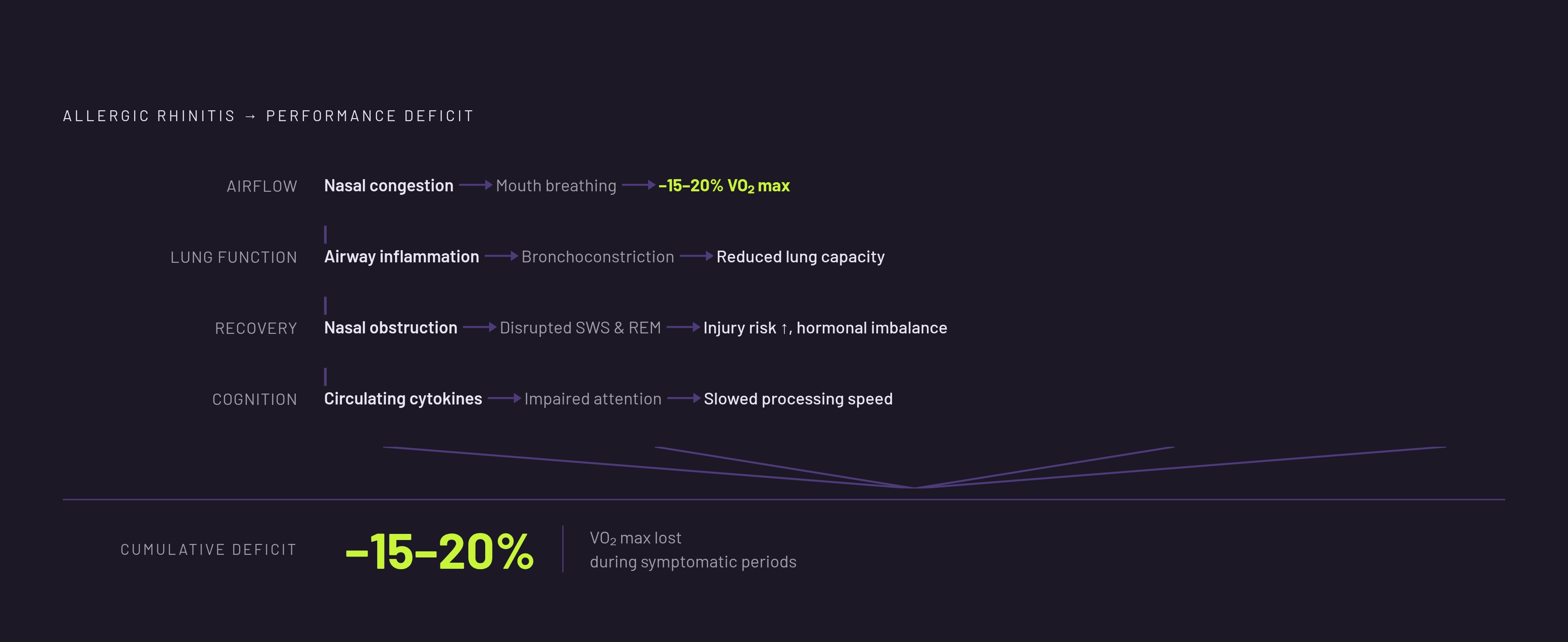
Allergic rhinitis does not cost an athlete one thing. It works through at least four separate physiological pathways, and those pathways do not operate in isolation. They stack on top of each other during the exact windows, training blocks and competition days, when an athlete can least afford the compounding effect.
The first pathway runs through the nose itself. Congestion forces mouth breathing, which skips the nasal passage's job of filtering and humidifying incoming air and reduces how efficiently oxygen gets extracted from every breath. A 2018 study cited by the 2025 ENT Society article found a 15 to 20 percent decrease in peak oxygen uptake, or VO₂ max, during symptomatic periods. For any athlete whose sport is decided by aerobic ceiling, a drop of that size during a flare means competing well under capacity instead of at it.
The second pathway extends past the nose into the lungs. Delgado and colleagues found that allergic rhinitis and sensitization to seasonal allergens is associated with exercise-induced bronchoconstriction in young adults, and in athletes specifically, with reduced quality of life and reduced athletic performance. The respiratory system does not treat nasal inflammation as a contained, local event.
The third pathway shows up at night, away from the field or the pool. Nasal obstruction disrupts sleep architecture, cutting into deep slow-wave sleep and REM sleep. The GA²LEN study identified nasal obstruction as the allergic rhinitis symptom most strongly tied to poor sleep quality. Sleep loss degrades reaction time, disrupts hormonal balance and lowers resilience to injury. All three are competitive variables.
The fourth pathway is harder to feel but no less real. Cytokines released during an allergic reaction circulate through the whole body. Research published through the NIH found that inflammatory cytokines may impair attention span and slow processing speed. In sports that demand sustained tactical awareness, split-second decisions, tracking multiple moving threats, reading a field, that kind of cognitive drag matters as much as a slower sprint time.
Put these four pathways together: an athlete ends up managing four compounding effects at once. An athlete is managing reduced oxygen uptake, constricted airways, fragmented recovery and dulled concentration, all at once, all from the same underlying immune response.
The 2019 case of Tour de France winner Chris Froome makes the stakes concrete. Khalid and colleagues describe how Froome lost control of his bike at 34 mph (54 km/h) while wiping his nose, a crash that sent him to intensive care. Nobody would call that story typical. But it is a sharp reminder that rhinitis in competitive sport is not purely a comfort problem. It can become a safety problem in the span of a single second.
Why pharmacological management cannot fully close the performance gap
Standard allergy medication works. It brings real relief to a lot of people, and dismissing it would be dishonest. The trouble, for competitive athletes specifically, is what these drugs do not fix and what they sometimes introduce in the process.
Second-generation antihistamines, cetirizine and loratadine among them, control sneezing, itching and runny nose with far less sedation than older drugs like diphenhydramine, which cross into the brain and blunt cognition. That makes them workable for someone who still has to compete that day. Intranasal corticosteroids go a step further and are recommended by Dijkstra and Ansley as the drug of choice for athletes managing this condition. But corticosteroids calm inflammation. They do not touch the immune sensitization that keeps producing that inflammation in the first place.
Decongestants raise a different kind of problem for athletes specifically. Pseudoephedrine falls under World Anti-Doping Agency regulation, which turns a routine medication choice into a compliance decision. Oxymetazoline avoids that regulatory issue but carries its own cost: rebound congestion with extended use, which can leave an athlete worse off than before they started. Even exercise-induced bronchoconstriction treatments are not exempt from this pattern. Continued use can lead to tolerance. The dose has to keep climbing just to hold the same ground, without resolving anything.
All of these drugs share one structural trait. They suppress symptoms without correcting the immune response generating them. Stop taking the medication and the rhinitis comes right back, because nothing about the underlying sensitization has changed. That turns treatment into a daily, ongoing requirement rather than a path toward resolution.
The anti-doping rules narrow the pharmacological toolkit further for athletes than for the general population. Every medication choice has to be checked against WADA's list, and some drugs that work well for non-athletes are simply off the table in competition. An effective treatment for everyone else can be the wrong treatment for someone who has to compete under those rules.
How Sublingual Immunotherapy Works
Sublingual immunotherapy, usually called SLIT, takes a different approach from anything described above. Instead of blocking symptoms after they start, it retrains the immune system that produces them.
Here is the plain version of how that happens. The tissue under the tongue is naturally built to tolerate things, rather than attack them, since it is constantly exposed to food and drink. SLIT uses that tolerant environment on purpose. Specialized immune cells in that tissue pick up the allergen placed there and steer the immune system toward a calmer response, encouraging regulatory immune cells that dial down the overreaction instead of the inflammatory cells that drive it. In practical terms, the immune system stops treating pollen, dust mites or mold spores as a threat worth mounting a full defense against.
SLIT also pushes the body to produce different antibodies, specifically IgG and IgA, which physically block the allergen from ever connecting with the IgE antibodies that trigger an allergic cascade. That interference happens upstream, before the chain reaction that causes sneezing, congestion and airway tightening ever gets started. Disarming a trigger, as this does, differs from muffling the alarm after it goes off, which is what a daily antihistamine does.
Clinical trial data back this up over meaningful stretches of time. Randomized controlled trials on grass and house dust mite SLIT tablets show clinically meaningful drops in both symptom scores and medication use, with benefits that persist one to two years after finishing a three-year course. That durability matters. A treatment that only works while someone is actively taking it is a maintenance plan. A treatment that keeps working after it stops is something closer to a cure.
Real-world data, gathered outside the tighter conditions of a clinical trial, add two findings that matter specifically for athletes. People on SLIT show a reduced risk of developing new asthma, and lower long-term use of allergy medication overall. For an athlete already managing exercise-induced bronchoconstriction, both of those outcomes speak directly to the respiratory demands of competing.
A meta-analysis of immunotherapy found a statistically significant reduction in both symptoms and medication requirements (SMD –0.42, 95% CI –0.69 to –0.15, P = 0.002). Reduced medication reliance carries extra weight in sport, given how many allergy drugs intersect with anti-doping rules. SLIT is also well tolerated. Most adverse reactions are mild, itching or tingling in the mouth or throat, and tend to fade within a few weeks. The risk of anaphylaxis is lower than with injectable immunotherapy.
Why Sublingual Immunotherapy's Format Fits an Elite Athlete's Life Better Than Allergy Shots
A reasonable question follows all of this. If allergy shots work through the same basic principle, retraining the immune system through controlled allergen exposure, why not just get the shots?
On clinical outcomes alone, the two formats are similar. Both reduce symptoms, both cut medication use, and both produce a 30 to 60 percent symptom reduction for most patients. Neither one is categorically better by that measure alone.
What separates them is logistics, and for a competing athlete, logistics decide whether treatment actually gets completed. Allergy shots require a build-up phase of frequent in-office injections stretched over several months. Every injection comes with a mandatory 30-minute observation window afterward, to watch for a systemic reaction. Severe reactions, rare but possible, need on-site medical staff to manage them, which makes a clinic visit non-negotiable rather than optional. For an athlete moving between training camps, competition travel and a calendar built around someone else's schedule, fitting in weekly or twice-weekly clinic visits for months at a stretch is not a small ask.
Sublingual drops remove most of that friction. After a single supervised first dose, every subsequent dose gets self-administered at home, in a hotel room, or wherever the season has taken the athlete that week. Daily dosing fits around an athlete's existing routine instead of forcing the routine to bend around a clinic's hours. That is possible in part because SLIT already carries a lower anaphylaxis risk than injections, which is what makes home administration medically reasonable in the first place. Lower convenience barriers tend to produce better adherence, and adherence sustained across a multi-year course is what actually produces lasting immune change.
None of this makes allergy shots a poor choice for the people they work well for. They remain an effective, well-established option. But they ask more of a patient's schedule than sublingual drops do, and for an athlete, schedule is often the deciding constraint.
The trade-offs on the SLIT side deserve equal honesty. Drops generally take longer to reach full effect than shots do, they require daily rather than weekly administration, and insurance coverage for them is more limited in some markets. Those are real costs, not footnotes. But for an athlete who is training in one country this month and competing in another next month, a daily at-home dose may be the only format that can realistically survive a multi-year treatment course without being abandoned halfway through. A treatment only works if someone actually finishes it, and for a traveling competitor, that is the whole argument in favor of the format.
Testing and Starting Treatment for an Athlete
None of this means anything without an accurate diagnosis first. Immunotherapy, by design, targets a specific allergen. Guessing wrong about the trigger means months of treatment aimed at the wrong target.
Diagnosis starts with a clinical history. When do symptoms show up relative to training cycles and the seasons? That gets paired with a physical exam and objective testing, either skin prick testing or specific IgE blood work, both of which identify IgE-mediated sensitization to common aeroallergens. Dijkstra and Ansley recommend this exact combination for every elite and professional athlete: a validated screening tool like AQUA alongside skin prick or specific IgE blood testing.
A standard allergy panel for an athlete typically covers grass, tree and weed pollens picked up during outdoor training, mold spores such as Alternaria, Cladosporium, Aspergillus and Penicillium, indoor triggers like the dust mites Dermatophagoides pteronyssinus and D. farinae, and animal dander from cats, dogs and horses. That range matters because an athlete's triggers often trace directly back to where and how they train, not just the season on the calendar.
Consumer at-home allergy kits have become easy to find, but they come with real limits. They can detect IgE antibodies in the blood, yet they cannot confirm on their own that those antibodies are the actual cause of a given symptom, and results can come back as false positives or false negatives. Physician review stays necessary to interpret the results correctly and to choose a treatment plan that actually fits them.
Telehealth has narrowed that gap considerably. Some platforms now offer CLIA-certified at-home blood draw kits paired with physician review, letting results be interpreted without an in-office visit. Low-cost initial consultations and treatment plans starting at $99 a month put this kind of care within reach without the overhead of traditional in-office allergy treatment. For an athlete balancing training blocks and travel, that model removes the last major excuse for staying undiagnosed.
Testing should also check for conditions that often travel alongside allergic rhinitis, asthma, sinusitis, sleep-disordered breathing, since the 2025 ENT Society article notes these compound the performance impact and need to be managed together rather than separately. What follows, for an athlete whose diagnosis points to a clear allergen, is the chance to pursue a treatment built to change the immune response itself rather than manage its symptoms indefinitely.
Sources
- The prevalence and current opinion of treatment of allergic rhinitis in elite athletes
- Allergic Rhinoconjunctivitis in Elite Athletes
- Allergic Rhinitis and Athletic Performance: Relationship and Correction in Elite Athletes
- (PDF) Rhinitis and Its Impact on Sports
- The Practical Management of Rhinitis in Athletes
- Efficacy and safety of sublingual immunotherapy for allergic rhinitis: A network meta-analysis