Seasonal Allergies and Exam or Work Performance Declines
Allergies can silently undermine exam grades and work performance by impairing focus and sleep.

A UK case-control study of teenagers sitting national exams found something that should change how people think about allergy season: students with allergic rhinitis symptoms during their exam period were measurably more likely to drop a grade in math, English, and science, compared to their own practice scores months earlier in winter. That is not a story about runny noses. That is a story about a condition quietly taking points off a transcript. The same pattern appears in adults at work: a 2025 cross-sectional study in the Journal of Occupational Health found that among workers with allergic rhinitis, symptom severity tracked closely with presenteeism, the state of being at your desk but unable to do the work in front of you. Most people chalk up a foggy, sluggish week in April to just feeling run down. But what if that fog has a name, a mechanism, and a measurable cost? The rest of this piece is about taking that question seriously.
How allergic inflammation reaches the brain
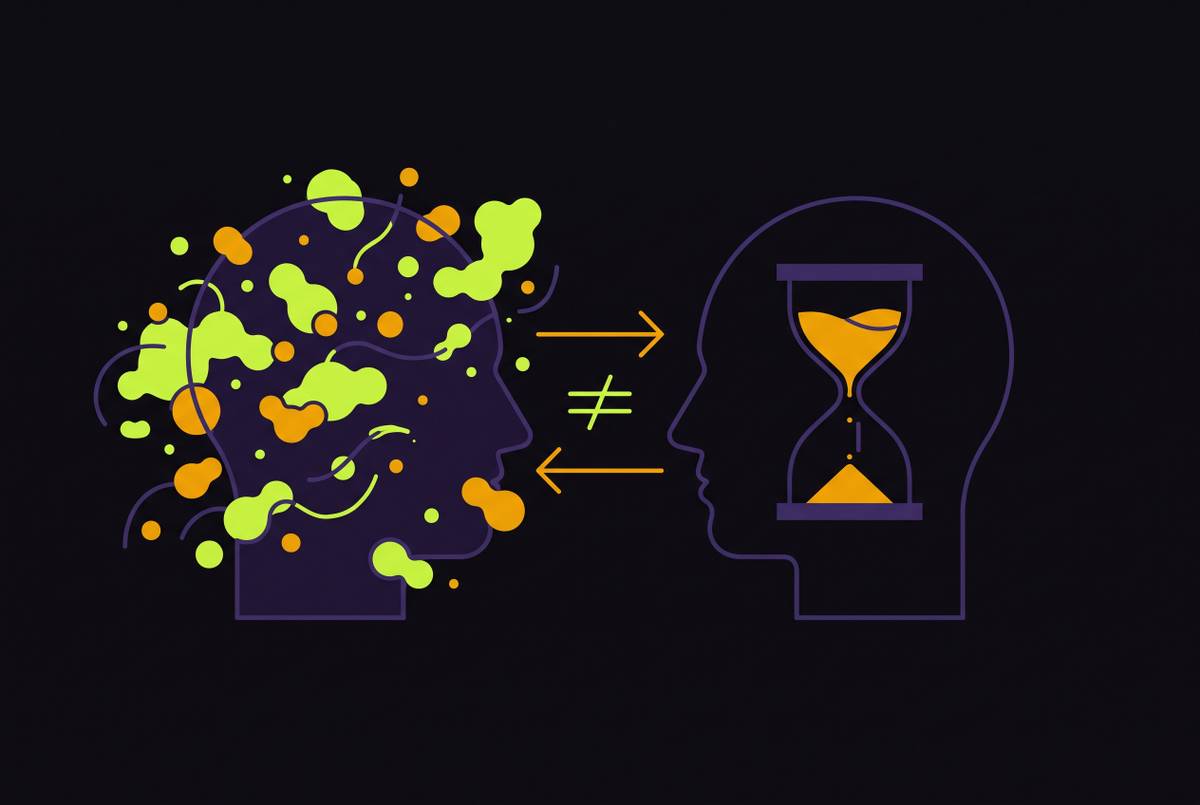
Allergic rhinitis doesn't just sit in the sinuses. It works through the whole body by two routes: inflammatory signaling and histamine disruption, and both land directly on attention and processing speed. When the immune system reacts to pollen or dust or pet dander, it releases small signaling proteins called cytokines into the bloodstream. These cytokines are built to coordinate an immune response, but they travel everywhere the blood goes, including to the brain, where they interfere with the circuits that sustain focus. Histamine adds a second hit. It's best known as the molecule behind sneezing and itching, but it also acts as a neurotransmitter, helping regulate alertness and energy in the brain. When the allergic reaction throws histamine out of balance, mental sharpness and energy drop along with it, and that happens on its own, apart from whatever drowsiness an antihistamine might later add. The cognitive decline starts before anyone opens a medicine cabinet. The immune response itself is the first thing working against concentration, not the treatment, not the fatigue of staying up late to study or finish a report. That distinction matters, because it means the fix has to start earlier than most people assume.
How disrupted sleep multiplies the cognitive cost
Inflammation in the nose doesn't stay contained to the nose. Congestion forces mouth breathing at night, mouth breathing fragments sleep, and fragmented sleep produces a daytime cognitive deficit that coffee can mask for an hour or two but never actually repairs. Most people with allergies report trouble sleeping, and of those, most wake up multiple times during the night and spend real time just trying to fall asleep in the first place, with most also reporting that they wake up tired. Lying flat makes nasal congestion worse, which can lead to snoring and sleep-disordered breathing, including sleep apnea in more severe cases, and those are exactly the conditions that crowd out the deep sleep stages where the brain consolidates memory and recovers from the day. The cycle feeds itself: inflammation disrupts sleep, disrupted sleep brings fatigue and brain fog, fatigue and brain fog reduce the ability to manage stress and hold attention, and a worse mental state makes the whole allergy experience feel even heavier. The 2025 Journal of Occupational Health study backs this up directly: its causal mediation analysis found that depressive symptoms served as a significant indirect pathway linking allergic rhinitis severity to presenteeism. In plain terms, the sleep-and-mood spiral, not the sneezing itself, is what drags down performance at work. Kids carry a version of this that's easy to misread. A child who can't breathe comfortably through the nose or sleep through the night often becomes more irritable, more reactive, and less able to sit still and concentrate in class, and a teacher watching that might reasonably assume it's a focus problem or an attitude problem. It's a physiological problem, and it starts in the same place the rest of this section does.
Why the timing of allergy season makes the performance hit predictable and preventable
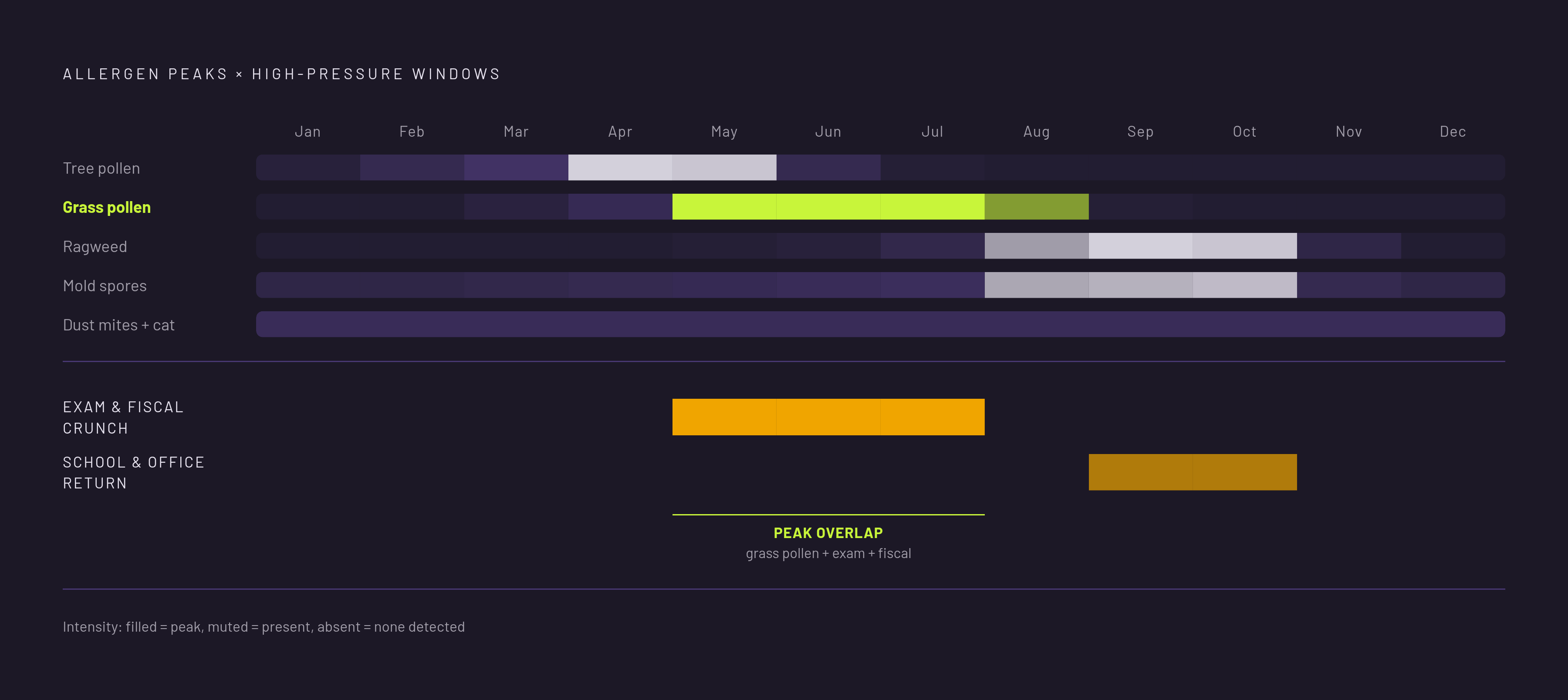
None of this arrives at a convenient time. Grass pollen peaks in late spring and summer, and that is the exact stretch when final exams happen and when a lot of industries hit their busiest, highest-stakes periods of the year. The UK exam study points this out directly: critical exams for teenagers are often scheduled in summer, right in the middle of peak grass pollen season, which is part of why the gap between practice scores in winter and final scores in summer showed the allergy signal so cleanly. The school year and the fiscal year are both built so that the worst allergy weeks and the highest-pressure weeks overlap.
Laying out the allergen calendar makes the pattern easy to see. Tree pollen peaks in spring. Grass pollen peaks in late spring and summer, lining up with most exam periods and with fiscal year-end crunches at work. Weed pollen, ragweed especially, peaks in fall, right when new school terms start and when the return-to-office push after summer tends to intensify. Mold spores, including Alternaria alternata and Aspergillus fumigatus, spike outdoors after rain or harvest season but also live indoors, stretching exposure well past any single season. Dust mites, Dermatophagoides pteronyssinus and D. farinae among them, aren't seasonal at all: they're present year-round and are among the most common sensitization triggers worldwide, which matters most for people who spend long hours indoors at a desk or a classroom. Cat dander, the protein Fel d 1, is airborne and can linger in indoor spaces for months, a relevant detail for anyone working or studying from home.
Put the perennial triggers next to the seasonal ones and a harder truth comes into view: for people heavily sensitized to dust mites or pet dander, the cognitive drag isn't confined to spring or fall. It runs all year, which is exactly why treating it as a once-a-season inconvenience falls short, and why the next question has to be about treatments that do more than get someone through a bad week.
Why symptom-masking treatments make the cognitive problem worse, not better
The first instinct for most people dealing with allergy symptoms is to reach for an over-the-counter antihistamine, but the sedating kind, the first-generation drugs, actually worsen cognitive performance. The UK exam study found that students taking sedating antihistamines had substantially higher odds of dropping a grade than students who had no allergic rhinitis symptoms at all, which puts the drug, not just the disease, in the frame as a driver of the performance loss. That's a striking result: the treatment some students took to feel better during exams was tied to worse outcomes than the allergy itself.
Second-generation antihistamines are a different story and deserve credit as a real improvement. Loratadine (Claritin), cetirizine (Zyrtec), and fexofenadine (Allegra) all cut down on sedation while still calming nasal inflammation, making them a far better choice for anyone who needs to stay sharp through the day. Nasal corticosteroid sprays work well for symptom control with very little of the drug reaching the rest of the body, and antihistamine nasal sprays, because they act locally rather than systemically, carry a lower sedation risk too. Both are reasonable tools to lean on during a high-stakes week.
But none of them change the disease causing the symptoms. Every spring, the immune system runs the same inflammatory script over again, and the person dealing with it has to manage the symptoms from zero, year after year, with no cumulative benefit carried forward. Montelukast, sold generically as Singulair, carries an FDA boxed warning for serious neuropsychiatric effects and is no longer considered a first-line option under the 2023 ICAR guidelines. It's still widely prescribed, and the risk attached to it deserves more attention than it tends to get.
What poor allergic rhinitis control costs at work
Poorly controlled allergic rhinitis doesn't just make someone feel bad. It cuts directly into the output they can produce while sitting right there at their desk, and that loss scales with how severe the symptoms are. Presenteeism, not missed days, is where almost all of the damage hides. Workers with allergic rhinitis mostly still show up. They just operate at a fraction of their normal capacity, and that gap is close to invisible to employers and often goes unrecognized by the workers themselves.
The 2025 Journal of Occupational Health study adds a layer of nuance. Across a general working population that includes plenty of mild cases, the overall productivity gap between workers with allergic rhinitis and workers without it wasn't statistically significant. But inside the group with allergic rhinitis, severity was the variable that decided everything, and depressive symptoms accounted for a meaningful share of the presenteeism gap. Mild, well-managed allergies may cost someone almost nothing in terms of output. Moderate to severe, poorly controlled allergies cost a lot, and that cost tends to grow as the season wears on without any treatment aimed at the root cause. So if symptom control alone only gets partway there, the next question is unavoidable: what actually addresses the source of the problem rather than papering over it for a few hours at a time?
How sublingual immunotherapy addresses the immune mechanism, not just the symptoms
Sublingual immunotherapy, SLIT, is the one category of treatment built to work on the immune mechanism driving all of this. Allergen immunotherapy as a whole is classified as the only treatment with the potential to modify the course of antibody-mediated respiratory allergy, and SLIT specifically works by normalizing how immune cells respond, restoring a signaling pattern present in people without allergies and absent in those who have gone untreated. That's a meaningful difference from an antihistamine or a nasal spray: those manage a symptom in the moment, while SLIT retrains how the immune system responds to the allergen in the first place.
The evidence backing grass and house dust mite SLIT tablets is strong. A 2026 overview in Frontiers in Allergy points to solid randomized controlled trial evidence for real reductions in symptoms and medication use, with benefits that hold up for one to two years after a three-year course of treatment ends. The immune system keeps behaving differently well after the last dose. A five-year real-world surveillance study published in 2025 found that nasal symptom scores in a SLIT group stayed significantly and consistently lower than baseline across the full five years, while a control group managing symptoms the usual way showed smaller improvement and a visible rebound over time. A 2025 overview of systematic reviews and meta-analyses found SLIT meaningfully improved quality of life, especially in emotional functioning, daily activities, and nasal and eye discomfort, which happen to be the exact domains that sustained focus at work or in school depends on.
None of this makes SLIT a one-time cure. It's a years-long commitment with evidence of durable change. But durable immune change is a different category of outcome than symptom suppression that resets every spring, and that's the distinction that makes it the logical next step after everything laid out above.
Why sublingual drops at home are a practical option for people who cannot afford to lose performance time
An effective treatment that nobody can fit into their schedule isn't much of a treatment, a practical objection that tends to stop people from pursuing immunotherapy at all and deserves to be taken seriously. Traditional allergy shots, subcutaneous immunotherapy or SCIT, call for more than fifty clinic visits over the full treatment course, with a waiting period built into every single appointment because of the risk of a serious allergic reaction. For a student juggling exams or a professional managing a demanding job, that schedule is hard to sustain for the years a course of treatment requires.
Sublingual drops carry a much lower risk of a serious allergic reaction than injections, which is exactly why they can be taken at home without a clinician present for every dose. The difference appears clearly in adherence numbers from clinical practice: one allergist practice reported shot patients sticking with treatment at a rate of roughly a third to two-fifths, compared to near-total adherence among patients using drops. That gap matters enormously, because skipping doses on an immunotherapy course means giving up the disease-modifying benefit the treatment is supposed to deliver in the first place.
On clinical outcomes, the two approaches hold up about equally. A 2022 meta-analysis of seven head-to-head randomized trials found no significant difference between SCIT and SLIT in symptom scores or medication use. The outcomes are comparable. The burden of getting there is not.
There's a real structural catch. Custom liquid SLIT drops are not FDA-approved and typically aren't covered by insurance, while allergy shots are FDA-approved and often are covered. FDA-approved SLIT tablets do exist, but only for a limited set of allergens, which leaves a real gap for anyone whose sensitivities fall outside that list. For many people, a pre-tax medical spending account can bridge that gap, making a treatment with a strong durability record and a far easier adherence profile financially workable even where insurance doesn't reach.
Sources
- Association between allergic rhinitis and work productivity in a nonclinical setting: a cross-sectional study - PMC
- Seasonal allergic rhinitis is associated with a detrimental effect on examination performance in United Kingdom teenagers: case-control study - PubMed
- Clinical efficacy of sublingual immunotherapy for allergic rhinitis and atopic cough: 5-year real-world surveillance - ScienceDirect
- Efficacy and safety of sublingual immunotherapy for allergic rhinitis: A network meta-analysis