Allergy Brain Fog Versus Chronic Fatigue Syndrome Differential
Allergen exposure triggers brain fog differently than ME/CFS does, and spotting which one matters.

Allergy-driven brain fog and ME/CFS can look like the same illness from the inside: trouble concentrating, memory that slips, a tiredness that sleep doesn't fix. They come from different biological processes, and telling them apart starts with one question: does the fog track with allergen exposure, or does it track with exertion? That single distinction, more than any symptom checklist, is what separates a treatable immune reaction from a chronic illness still waiting on a confirmed cause.
Why allergy brain fog and ME/CFS look alike
Someone sitting across from a doctor describing trouble concentrating, a memory that keeps dropping things, and fatigue that doesn't trace back to any obvious physical cause could be describing either condition. Allergy-driven cognitive impairment and ME/CFS feel the same from the inside, and that overlap isn't a coincidence. Both involve immune system activity that reaches the brain, so you can't tell them apart from a list of symptoms alone.
ME/CFS is marked by persistent fatigue, sleep problems, and cognitive trouble with attention, memory, and concentration. During a bad allergy season, though, that lift doesn't always come, and weeks of constant exposure can make a reactive condition look like a chronic one.
That resemblance carries real clinical risk. Without obvious sinus symptoms pointing to allergies, a clinician has every reason to chase thyroid imbalance, depression, or another diagnosis before an inflammatory trigger ever enters the conversation.
How allergic inflammation produces cognitive symptoms
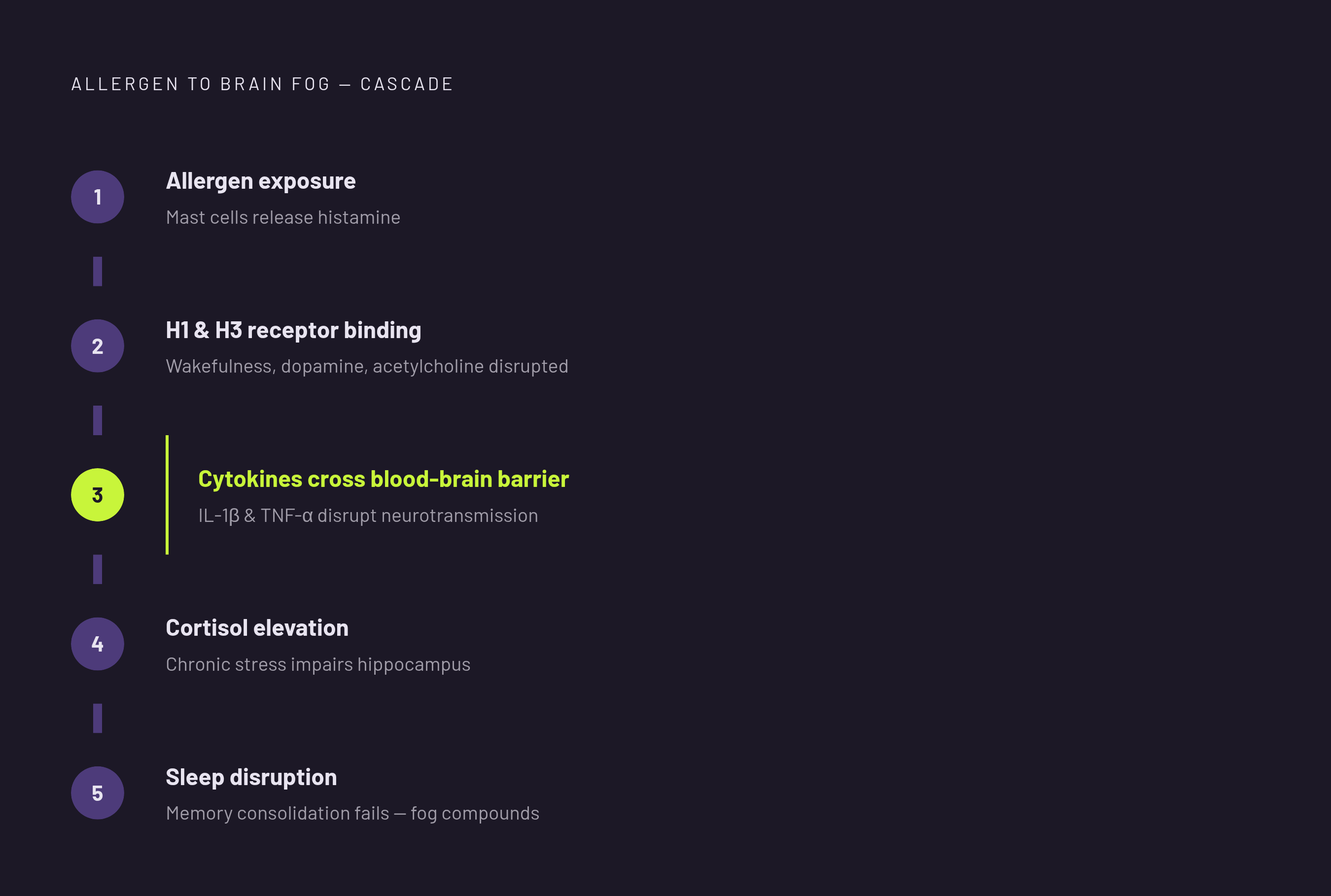
Allergy brain fog isn't vague unwellness. It follows a specific, well-documented chain of events inside the immune system, and tracing that chain explains why something that starts with pollen or dust ends up affecting memory and focus.
The process begins when allergens trigger mast cells to release histamine. That histamine binds to two types of receptors in brain tissue. H1 receptors normally promote wakefulness and alertness, so when histamine activity there gets disrupted, drowsiness and reduced alertness follow. H3 receptors regulate the release of dopamine, norepinephrine, and acetylcholine, three chemicals central to attention and mental sharpness.
At the same time, the allergic reaction releases cytokines, including interleukin-1β and tumor necrosis factor-α, that cross the blood-brain barrier and interfere with how the brain communicates with itself. The result shows up as slower processing speed, weaker working memory, and trouble with planning and decision-making. These cytokines disrupt neurotransmitter production and synaptic transmission directly, redirecting the brain's resources toward immune defense.
A second pathway compounds the first. Chronic allergic stress raises cortisol, and elevated cortisol impairs the hippocampus, the brain region responsible for forming and retrieving memories. Deep sleep is what the brain uses to consolidate memory and recover mentally, so a few nights of fragmented sleep stack on top of the histamine and cytokine effects until the daytime fog starts to look permanent.
Understanding that histamine directly impairs neurotransmitter production, and that inflammatory cytokines cross the blood-brain barrier, makes clear that allergy brain fog isn't a psychological complaint.
What is happening in ME/CFS at the biological level
ME/CFS produces a cognitive picture that can feel identical to allergy brain fog, but it arrives through a different, and still only partly mapped, biological route. The cause of ME/CFS remains unknown. Studies point to impairment across the nervous system, the immune system, and energy production, but no single mechanism is confirmed.
What immunology research has found is a distinct pattern: changes in cytokine subsets, reduced natural killer lymphocyte activity, detectable autoantibodies, and unusual T lymphocyte activation. That's a signature of systemic immune dysregulation, and it looks nothing like the allergen-triggered cascade described above.
The cognitive deficits themselves are measurable, not just reported. Neurocognitive studies in ME/CFS show real deficits in processing speed, attention, concentration, and working memory. fMRI research adds an interesting wrinkle: people with ME/CFS sometimes need more cortical and subcortical activation to complete the same mental task a healthy brain handles with less effort. That pattern suggests the brain is compensating for something, working harder to produce the same output, rather than simply running out of energy the way fatigue alone might suggest.
Autonomic nervous system dysfunction also appears, including reduced parasympathetic reactivation after physical exertion, and newer research is looking at a possible role for altered gut microbiota. Many cases of ME/CFS also begin after an infection, such as infectious mononucleosis, a triggering pattern that allergic disease simply doesn't have.
None of this adds up to a settled explanation of ME/CFS. What it does show is a biological fingerprint that looks nothing like an allergic reaction, even when the two conditions produce similar fog and fatigue on the surface.
The diagnostic criteria that separate ME/CFS from allergy brain fog in practice
One clinical feature does more work than any other in separating these two conditions: post-exertional malaise, or PEM. It's a defining feature of ME/CFS, and allergy brain fog doesn't reliably produce it. Recognizing PEM is often what keeps a patient from spending years in the wrong diagnostic lane.
The 2015 IOM diagnostic standard for ME/CFS sets out a specific checklist. It requires a substantial reduction in the ability to do pre-illness activities for more than six months, with fatigue that's often profound, newly started, not caused by unusual exertion, and not helped by rest. It also requires PEM, unrefreshing sleep, and either cognitive impairment or orthostatic intolerance.
PEM is the hallmark of ME/CFS. It's a worsening of illness that can start immediately or appear days after even minor physical or mental activity, and it can last hours, days, or months. That pattern runs opposite to allergy fog, which rises and falls with allergen exposure. About a quarter of people with ME/CFS can't leave their bed or home, a severity level that allergy-driven cognitive impairment, even at its worst, doesn't typically reach.
Because the symptoms are so general, the ME/CFS differential is broad. Doctors need to rule out infectious diseases such as Epstein-Barr virus and Lyme disease, neuroendocrine disorders including diabetes and hypothyroidism, blood disorders such as anemia, and rheumatological conditions such as fibromyalgia, Sjögren's syndrome, and lupus. Allergies sit somewhere inside that same broad list, and they're often not the first thing considered. A Kaiser Permanente Northern California study covering 2022-2023 found that ME/CFS-like illness is substantially underdiagnosed within a large integrated healthcare system, so a sizable number of people carrying a vague fatigue or cognitive complaint have never been formally evaluated for either condition.
A simpler heuristic can help before any formal workup starts. Symptoms that get worse during high pollen counts, or that improve after antihistamine treatment, point toward an inflammatory trigger. Checking the timing of symptoms against exposures is the first place to look, though it's a starting point for a conversation with a doctor, not a substitute for one.
Why allergy brain fog goes undiagnosed
Allergy brain fog isn't rare. It stays unrecognized because its cognitive symptoms are easy to blame on stress, poor sleep, or getting older, while the actual cause keeps compounding quietly through several overlapping pathways.
For a lot of people, congestion and sneezing barely register. Cognitive sluggishness and fatigue are the complaint that actually brings them in, and that combination points a clinician toward depression, thyroid issues, or burnout well before an immune trigger comes up. That means a large share of people are attributing migraines, runny nose, poor sleep, and brain fog to causes that will never respond to allergy treatment, because allergy treatment was never tried.
The sleep pathway described earlier deserves a second look here, because it's so easy to miss. Since deep sleep is what the brain needs for memory consolidation and recovery, each disrupted night adds to the next day's fog.
A chronic stress loop runs alongside this. These pieces together show a pattern: people cycle through explanations that treat the symptom but never the cause, often for years, before anyone tests for an allergic trigger. Allergy brain fog is reactive, rising and falling with allergen exposure, so testing for environmental triggers early is often the fastest way to rule out a chronic systemic illness. Telehealth allergy providers like Wyndly offer at-home testing paired with a virtual consultation specifically to check whether cognitive symptoms track with particular allergens, which can settle part of the diagnostic picture before a more invasive ME/CFS workup is even needed.
Why medications don't resolve allergy-driven cognitive problems
Standard allergy medications are built to quiet the inflammatory signal once it's already firing. That's why the fog lifts only while the drug is active and comes back with the next exposure.
Antihistamines and nasal sprays don't produce lasting benefit once a person stops taking them. Second-generation antihistamines are generally non-sedating, but they still don't touch the root cause.
Decongestant nasal sprays carry a specific risk: using them for more than three days can cause rebound congestion, which can worsen the nasal obstruction and sleep disruption driving the cognitive problems described earlier.
ME/CFS sits in a much more limited treatment landscape by comparison. No therapies or medications are currently approved to treat the cause of the condition. Management focuses on relieving symptoms, pacing activity to avoid triggering PEM, and counseling for coping. Allergic disease has an intervention that addresses the root cause, and ME/CFS doesn't.
How sublingual immunotherapy addresses the root cause
Sublingual immunotherapy, or SLIT, works by retraining the immune response that produces allergy brain fog in the first place, rather than suppressing its downstream effects. That makes it a different category of treatment than anything discussed so far.
SLIT takes advantage of the oral mucosa's tolerogenic environment, the tissue under the tongue that's naturally built to avoid overreacting to foreign substances. Allergen placed there contacts antigen-presenting cells, and mucosal Langerhans cells capture it and carry it to nearby lymph nodes. That process favors T lymphocytes that suppress the allergic response, with help from blocking IgG4 antibodies and mucosal B cells.
Over a course of treatment, SLIT promotes production of allergen-specific IgG and IgA antibodies. Emerging research also points to SLIT restoring broader immune balance: regulating the Treg/Th17 cell ratio, affecting gut microbiota, and turning down pathways that activate inflammatory cells. That's a wider mechanistic picture than researchers had even a few years back, and it's still being filled in.
A 2026 evidence review in Frontiers in Allergy found solid randomized controlled trial evidence for clinically meaningful reductions in symptoms and medication use with grass and house dust mite SLIT tablets, with benefits lasting one to two years after a three-year treatment course. A separate network meta-analysis on SLIT for allergic rhinitis backs up its effectiveness for symptom scores and medication use, with a safety profile researchers describe as generally acceptable.
Set next to ME/CFS, where no approved treatment touches the cause, this difference matters enormously for anyone whose fog turns out to be allergy-driven. Addressing the root immune dysregulation through an approach like sublingual immunotherapy targets the allergen sensitivity directly, instead of spending years managing the cognitive symptoms it produces downstream.
At-home allergy testing as the practical first step for someone who suspects allergies are the cause
For someone wondering whether allergies are behind the fatigue and fog, the first useful step is confirming whether an allergic trigger is actually present, and that's gotten a lot simpler than most people expect.
At-home allergy testing works by detecting allergen-specific IgE antibodies in a blood sample. Kits typically screen for particular pollen types, tree, grass, and weed among them, which makes it possible to line up cognitive symptoms against a seasonal calendar and see if the fog follows a pattern.
At-home allergy testing offers preliminary insight, not a definitive diagnosis, since it has a real limit. IgE antibodies can be present without ever causing symptoms, so you need clinical context to interpret a result correctly, and a consultation with a physician who knows the patient's full history still matters for building a treatment plan. Testing works best paired with clinical judgment, not read as a yes-or-no answer on its own.
Wyndly runs a finger-prick test mailed directly to the patient, and it screens for more than 40 common indoor and outdoor allergens. For someone who suspects allergies are driving their fatigue and brain fog, testing first and treating the confirmed cause looks very different from continuing daily medication indefinitely or waiting on a diagnosis to arrive on its own.
Using this differential with a doctor
None of this is meant to replace a doctor's evaluation. It's meant to walk into that evaluation better prepared, so the conversation moves past vague fatigue and toward a workup aimed at an actual mechanism.
Before the appointment, it helps to work through whether symptoms track with allergen exposure, since improvement that follows reduced allergen load is a sign an inflammatory trigger is in play.
For a possible ME/CFS picture, bring the IOM criteria into the conversation directly, especially PEM.
For a possible allergy picture, ask for allergy testing if it's never been done, whether at-home or in-office, and ask specifically about sublingual immunotherapy if testing points toward an allergic trigger. That conversation should also cover whether sublingual drops or tablets make sense given a patient's lifestyle and access to care.
If both possibilities remain open after the first evaluation, the reasonable path is pursuing workup for both at the same time. The two conditions can coexist, and the allergy component is treatable even if ME/CFS is also present. Allergy brain fog has a root-cause treatment that can change the immune response over a multi-year course. ME/CFS management currently centers on pacing and symptom support, not a cure. Knowing which one is driving the symptoms sets the realistic goal, recovery or long-term management, and that is worth the effort of chasing down.
Sources
- Underdiagnosis of myalgic encephalomyelitis/chronic fatigue syndrome-like illness in a large integrated healthcare system — Kaiser Permanente Northern California, 2022-2023
- Caught in the thickness of brain fog: exploring the cognitive symptoms of Chronic Fatigue Syndrome
- Special Issue “Chronic Fatigue Syndrome/Myalgic Encephalomyelitis: Diagnosis and Treatment”
- Frontiers
- Immune Mechanisms of Sublingual Immunotherapy
- Efficacy and safety of sublingual immunotherapy for allergic rhinitis: A network meta-analysis