Allergy-Driven Snoring Without Sleep Apnea
Allergies can trigger chronic snoring even when sleep apnea tests come back normal.
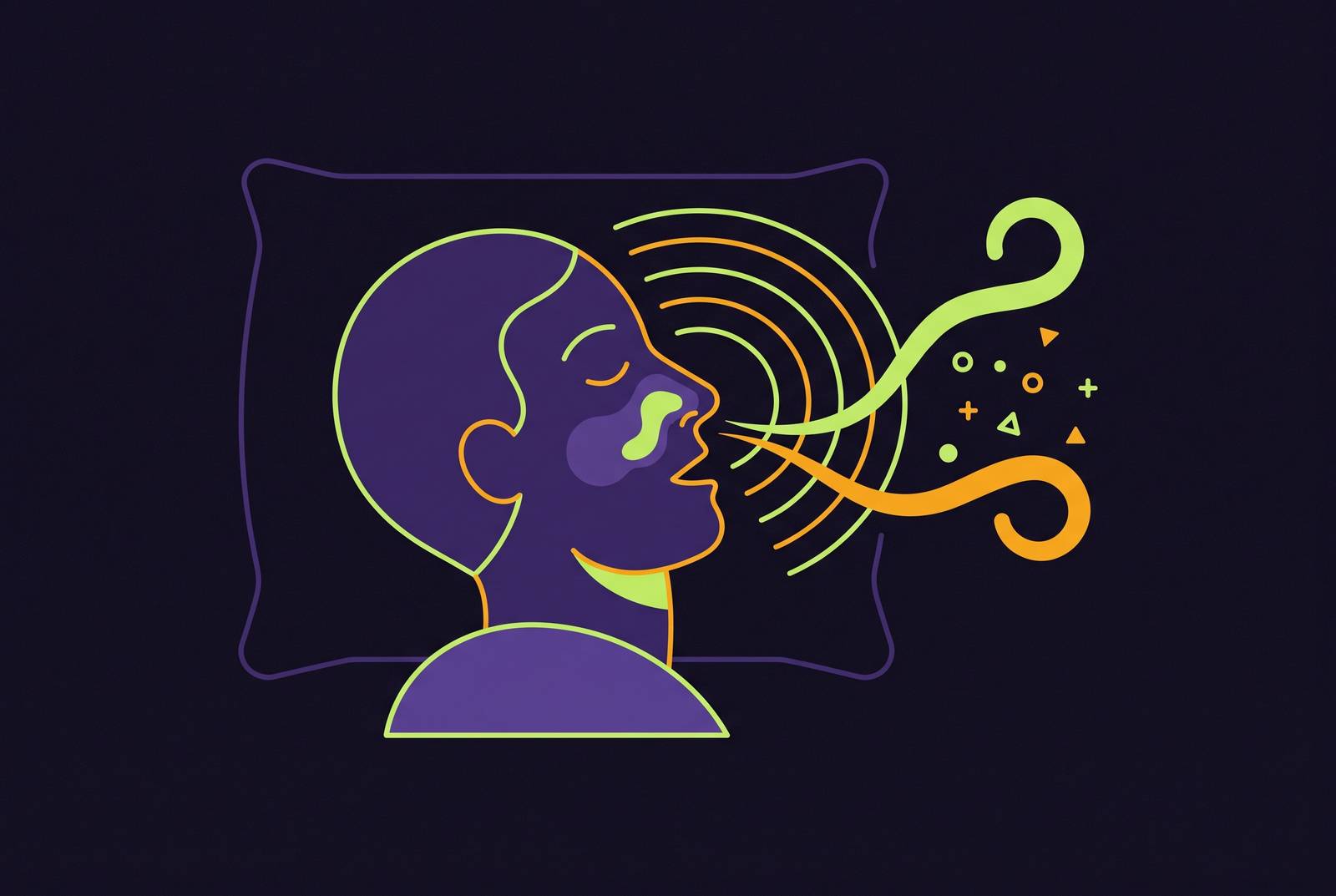
Allergic inflammation can narrow the airway enough to cause loud, chronic snoring, even when a sleep study comes back clean for apnea. This piece traces the mechanical chain from swollen nasal tissue to nighttime noise, and makes the case for a treatment approach that has nothing to do with breathing machines or similar devices.
Sleep-disordered breathing is an umbrella term covering obstructive sleep apnea, snoring, and mouth breathing: three separate problems, three separate causes, three separate fixes. Someone can snore every night, keep a partner up for years, and still score normal on the standard apnea test. A clean AHI score rules out one possible cause. It doesn't rule out the others, and for a lot of chronic snorers, the real driver is sitting one layer down, in the immune system.
How allergic inflammation narrows the airway during sleep
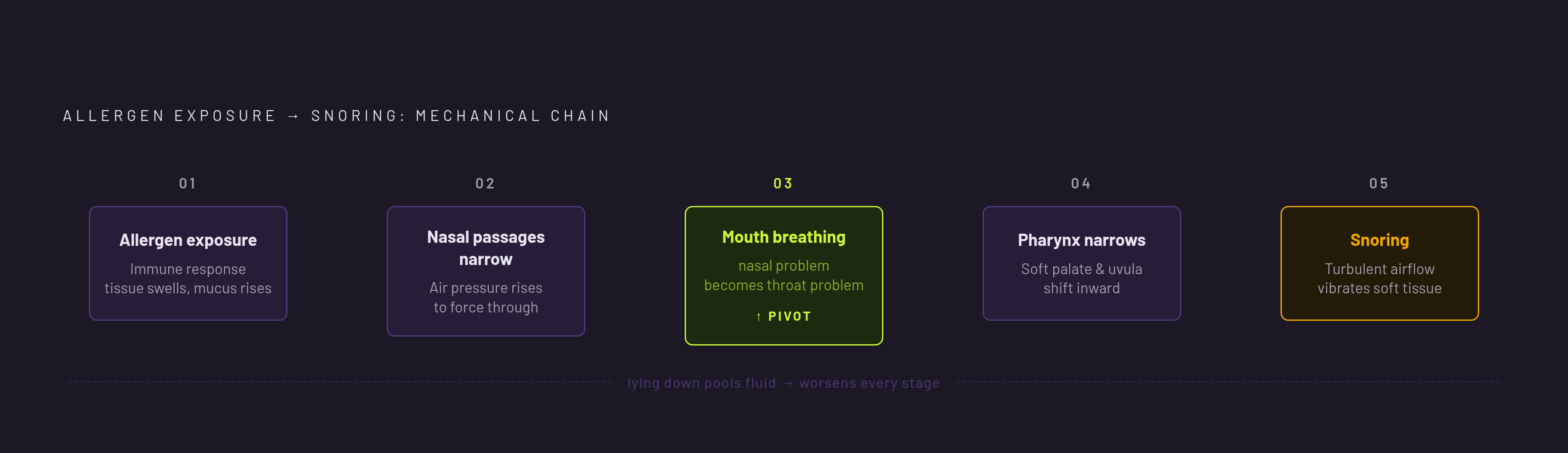
Start with the immune system. Exposure to an allergen, dust mite droppings, pet dander, pollen, triggers an inflammatory response in the nasal lining. Tissue swells, mucus production ramps up, and the nasal passages that normally move air freely get physically smaller. Air has to push harder to get through.
That's step one. Step two follows almost on its own: when the nose can't move enough air, the body switches to the mouth. Mouth breathing at that point isn't a habit, it's a release valve. But breathing through the mouth changes the shape of the upper airway. The soft palate and uvula shift and relax in a way that narrows the pharynx, the muscular tube at the back of the throat.
Air moving through that narrower channel stops moving smoothly and starts moving turbulently. That turbulence vibrates the soft tissue lining the pharynx, and that vibration is the sound of snoring.
Lying down makes it worse. Gravity, which drains the sinuses during the day, works against the body at night instead. Fluid pools, swollen tissue settles lower into the airway, and a passage that was merely tight while upright turns significantly tighter once horizontal. Research into sublingual immunotherapy for house dust mite-driven allergic pharyngitis, studied alongside allergic rhinitis, backs up what's called the unified-airway concept: the nose and throat aren't separate systems. Inflammation in one raises the odds of dysfunction in the other.
Studies tracking AHI severity against allergic rhinitis severity have found a real correlation between the two. Even well below the apnea threshold, allergy-driven airway narrowing raises AHI severity in proportion to allergic rhinitis severity. It makes it a measurable problem in its own right, separate from a "real" diagnosis.
Why people miss the allergy connection behind this kind of snoring
Someone living with this doesn't wake up thinking "allergies." They think "bad night." The symptoms sit scattered across the night, easy to explain away one at a time:
- Waking with a dry mouth or scratchy throat, a signature of mouth breathing overnight
- Feeling tired despite logging what should be enough hours in bed
- A partner noticing the snoring gets worse in certain months, or in certain rooms of the house
- Morning congestion or post-nasal drip that clears up an hour after getting up
Each symptom alone looks minor. Stacked together, night after night, they point at one mechanism. But almost nobody connects the dots, because snoring carries baggage that has nothing to do with the immune system. It gets blamed on weight, on age, on sleeping position. Snoring is rarely explained by histamine, and the most common explanations for snoring are also the ones least likely to be checked against an allergy panel.
When sleep-disordered breathing and allergic disease occur together, they weigh on physical, emotional, and cognitive health harder than either one does alone, and clinicians rarely walk patients through that gap. Allergy-related nasal congestion affects roughly 30% of children and adults in the country studied. That's a large enough share of the population to say a meaningful chunk of "unexplained" snorers are dealing with an allergic driver nobody's named yet.
The downstream effects on sleep quality, cognition, and daily function
Snoring caused by allergic inflammation doesn't just make noise. It fragments the structure of sleep itself. Research into untreated allergic rhinitis has documented this pattern: more nighttime awakenings, less time spent in deep sleep.
Deep sleep is where memory consolidation happens, and where the body does its heaviest repair work. Lose it night after night, and the next day shows it: slower recall, shorter patience, a kind of mental static coffee doesn't fully clear.
There's a mechanical reason the fog feels the way it does. Histamine inflames the sinus lining, breathing efficiency drops, and oxygen exchange during sleep takes a small hit. That matters more for the brain than for most organs. The brain makes up a small fraction of total body weight but burns close to 20% of the body's oxygen supply, which makes it unusually sensitive to even modest overnight dips in oxygenation.
The cognitive research backs this up on both ends of the age range. Children with untreated allergies score worse on learning tasks. Adults with active seasonal allergies show measurable trouble with new word recall and finishing tasks that would otherwise go smoothly. Some adults, notably, kept showing these deficits even after the allergy season had technically ended, which says the damage doesn't reset the moment pollen counts drop.
Why symptom medications don't resolve the snoring
Antihistamines do real work. They block histamine's effects and calm the symptoms it causes. What they don't touch is the immune sensitization producing the histamine response in the first place, so the inflammation driving the airway narrowing keeps running in the background, medicated or not.
First-generation antihistamines like diphenhydramine bring their own complication. They're sedating, which can make someone feel like they slept fine, since they were unconscious for eight hours. Sedation isn't the same as good sleep quality, and it can mask a snoring problem rather than solve it.
Second-generation options, cetirizine, loratadine, fexofenadine, get marketed as non-drowsy. Plenty of users still notice some sedation in practice, just a milder version of the same tradeoff.
Decongestant nasal sprays carry a different trap: overuse itself. Oxymetazoline and phenylephrine work fast, but overuse triggers rebound congestion once the medication wears off. For someone spraying before bed, that rebound tends to arrive well before morning, right when the airway is already prone to narrowing. None of this is a knock on the medications doing their job. They were built to manage a histamine reaction for a few hours, not to touch the sensitization causing it, so the snoring comes right back the next night, on schedule.
How immunotherapy addresses the airway inflammation at its source
Immunotherapy works differently. Instead of blocking symptoms after the fact, it retrains the immune system so it stops overreacting to the allergen. Small, repeated doses build tolerance gradually, over months, not overnight.
Sublingual immunotherapy, SLIT, follows a specific, well-mapped sequence:
- The allergen, placed under the tongue, binds to epithelial cells within minutes and crosses the oral mucosa within 15 to 30 minutes
- Langerhans cells and myeloid dendritic cells in the mucosa and lamina propria capture it
- Those dendritic cells, now carrying allergen-derived peptides, travel to the cervical lymph nodes within 12 to 24 hours
- There, they steer naive CD4+ T cells toward Th1 and T-regulatory differentiation over the following 2 to 5 days
- Regulatory cytokines, IL-10 and TGF-beta, suppress the allergic response a little more with each dose
One structural detail explains SLIT's safety record: oral tissue holds a limited number of submucosal mast cells, the cells that trigger severe allergic reactions. Fewer mast cells means fewer chances for a serious reaction to take hold locally, let alone spread systemically. That's most of why SLIT's track record leans so heavily toward mild, local reactions instead of anything more dangerous. Published literature (Moingeon and Mascarell, Journal of Allergy) puts the number of SLIT doses given worldwide at roughly 2 billion. That's not a small sample size to draw a safety conclusion from.
The clinical evidence base for SLIT across the allergens most relevant to nighttime snoring
This isn't resting on one study. Multiple meta-analyses confirm SLIT meaningfully reduces allergic rhinitis symptoms and cuts the need for anti-allergic medication. That's the standing consensus across the field, not an outlier result someone cherry-picked.
House dust mite SLIT tablets (12 SQ-HDM) went through a phase III randomized, double-blind, placebo-controlled trial in children, covering kids with allergic rhinitis or rhinoconjunctivitis, with or without co-occurring asthma. Tree pollen SLIT tablets have followed a similar clinical development path, with phase III trial data in children supporting efficacy and tolerability.
Across allergen types, SLIT brings symptom reduction in the range of 30% to 60% for most patients. That range is wide enough to reflect real variation in allergen type, dosing, and individual immune response, but it's tight enough to count as a genuine, repeatable clinical effect rather than noise.
SLIT versus allergy shots for someone whose main complaint is nighttime snoring
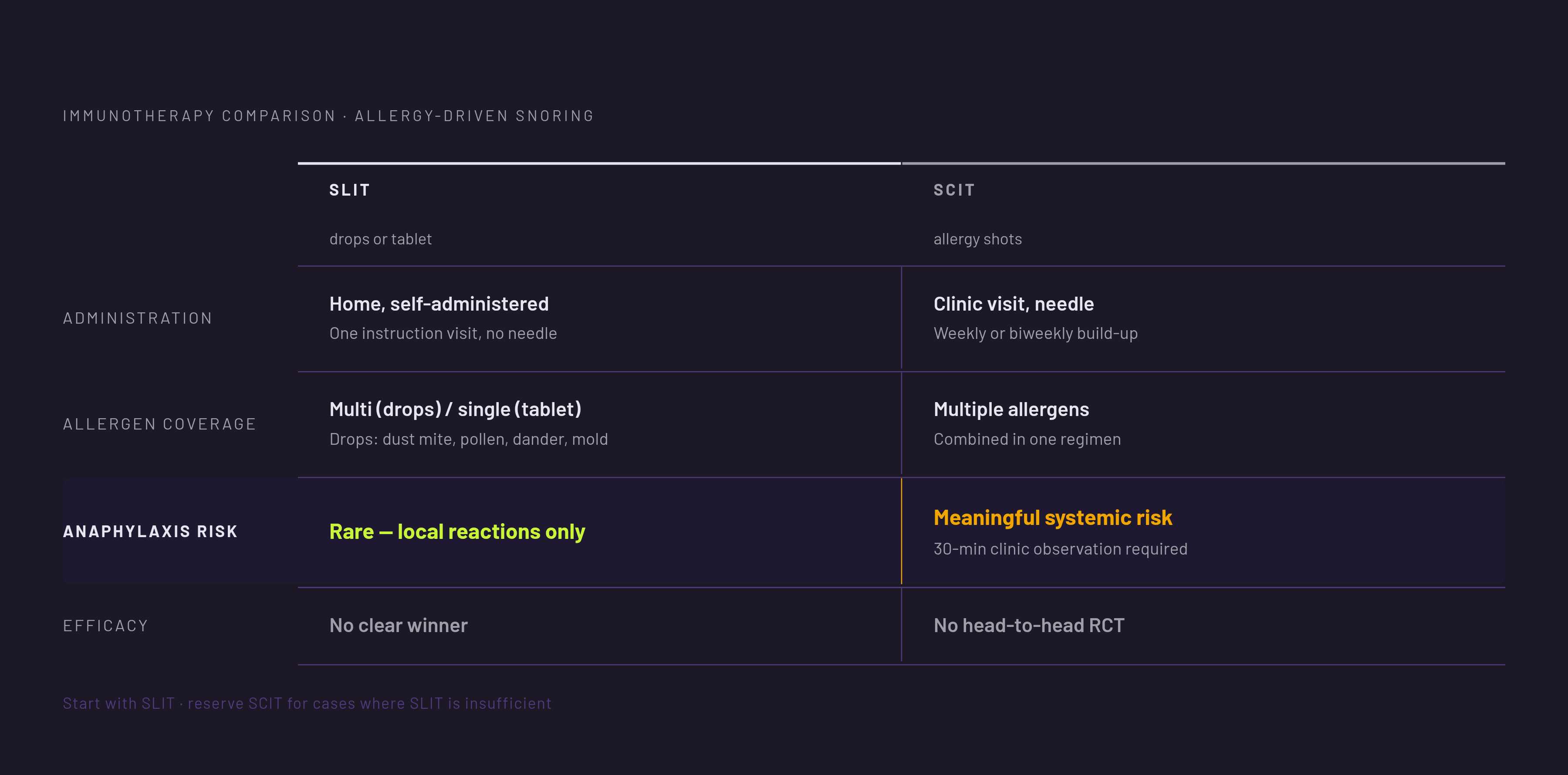
Both SLIT and subcutaneous immunotherapy (SCIT, the allergy shot most people picture) go after the same target: the immune root cause. From there, the two split hard on logistics. For someone whose real problem is fragmented sleep, the choice between SLIT and SCIT comes down to how treatment fits into daily life: where it's administered, how often, and what monitoring it requires.
Shots require a clinician and a needle, usually on a weekly or biweekly schedule during the build-up phase. That's a real scheduling burden to stack on top of a body that's already running on broken sleep. SLIT, by contrast, gets self-administered at home as drops or a tablet after one initial instruction visit. After an initial instruction visit, it's a routine handled without a clinic appointment, which matters more than it sounds like it should when the person doing the treatment is already exhausted most mornings.
SLIT drops carry one more practical edge for allergy-driven snoring specifically: they can combine multiple allergens (dust mite, pollen, pet dander, mold) into a single regimen. SLIT tablets, by comparison, only cover one allergen at a time and can't be combined.
On raw efficacy, published comparative reviews have found no clear evidence that either modality consistently beats the other, and no definitive head-to-head randomized trial has settled the question. Allergy shots carry a meaningful risk of anaphylaxis, the exact concern that drove the development of SLIT, while SLIT's safety record is built on a far more local, milder reaction profile. For someone whose only complaint is snoring, with no life-threatening allergy history to weigh against it, that risk profile is reason enough to start with SLIT and reserve shots for cases SLIT doesn't cover.
Practical steps for someone who suspects their snoring is allergy-driven
Snoring that tracks with the seasons, or gets worse in one room of the house, or eases up temporarily after an antihistamine, is telling a specific story. That pattern is the first clue, and it deserves a closer look before anyone reaches for weight, age, or sleep position as the default explanation.
From there, the next move is finding the specific allergen. Identifying the specific allergen, whether dust mite, mold, pet dander, or pollen, shapes which treatment formulation actually makes sense.
While waiting for treatment to take effect, allergen-proof covers on the mattress and pillows, regular washing of bedding, and pets kept out of the sleeping space cut the nightly allergen load directly. None of this touches the underlying immune sensitization, but it can ease symptoms during the early weeks of treatment, while the slower work of building tolerance is still underway.
The step that actually changes the trajectory is immunotherapy. Medication has a place for a rough night here and there, but as a long-term strategy it manages a symptom instead of resolving what's causing it. Immunotherapy, through SLIT or SCIT, is the only approach with evidence behind it for producing a lasting change in how the immune system responds to the allergen, and between the two, SLIT is the one most people chasing quieter nights should try first.