Mouth Breathing and Prefrontal Cortex Oxygenation
Chronic nasal obstruction forces mouth breathing that starves the prefrontal cortex of oxygen.

Brain fog, daytime exhaustion, and the inability to think clearly often have a cause doctors rarely check: nasal obstruction from allergies that forces a person to breathe through the mouth. Mouth breathing alters the brain's oxygen supply at a measurable level, placing strain on the prefrontal cortex. The fix, when allergies are the cause, is treating the immune reaction that's blocking the nose, not just managing the fatigue it produces.
The prefrontal cortex's reliance on oxygen supply
The prefrontal cortex, and in particular a region called the dorsolateral prefrontal cortex (DLPFC), runs the mental processes people notice first when something's off: staying focused, holding information in mind, switching between tasks, thinking fast, and following through on a goal. When any of these functions falters, the first thing a person usually blames is stress, poor sleep, or getting older.
The DLPFC runs on a tight balance between how much work it's being asked to do and how much oxygen it's getting to do that work. When demand on the brain stays high but oxygen delivery falls short, performance drops, and the brain reads that mismatch as fatigue or mental fog. That disconnect matters because it means the cause can hide in plain sight. Whether air enters through the nose or the mouth turns out to shape how well this part of the brain can function, not as a small anatomical quirk but as a working variable with consequences for how clearly a person thinks.
The counterintuitive oxygen pattern mouth breathing produces in the prefrontal cortex
Mouth breathing doesn't just cut the oxygen that reaches your brain. It pushes the brain into a strange state where it demands more oxygen than usual while receiving no more of it, a pattern visible in how blood moves through the prefrontal cortex.
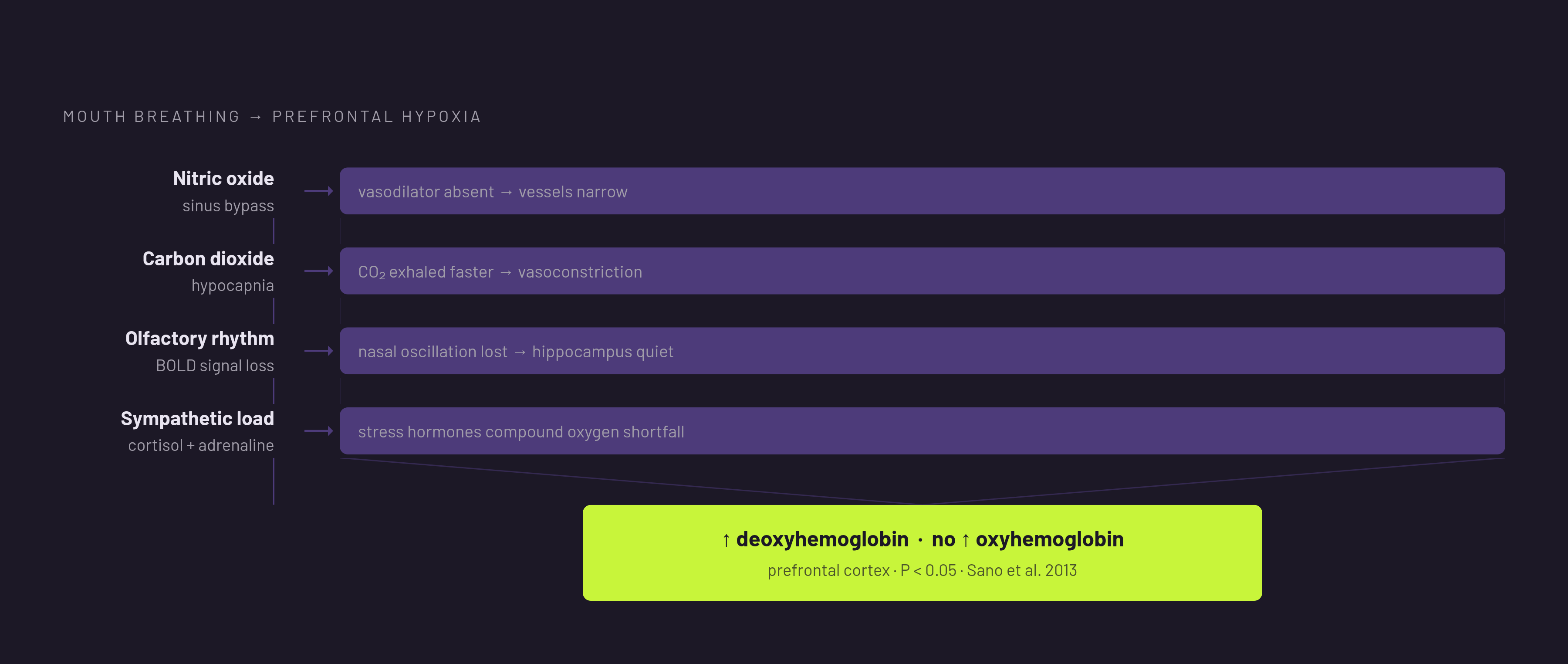
A study by Sano and colleagues, published in NeuroReport in 2013, tested this directly. Healthy adults breathed through the nose, then through the mouth, while a technique called vector-based near-infrared spectroscopy tracked oxyhemoglobin (oxygen-carrying blood) and deoxyhemoglobin (oxygen-depleted blood) in the prefrontal cortex in real time. When people breathed through the mouth, the oxygen-exchange angle rose significantly (P<0.05), so the brain had to put a heavier oxygen load on itself.
Deoxyhemoglobin rose significantly during mouth breathing, but oxyhemoglobin did not rise to match it. The same research links this pattern to central fatigue, noting that oxygen tension in the brain tends to drop when fatigue sets in, and that mouth breathing has been tied to lower transcutaneous oxygen tension than nasal breathing, which makes excess oxygen consumption in the cortex a plausible driver of that fatigue. That strain, measured directly in the brain, matches what chronic mouth breathers describe as brain fog and persistent mental exhaustion.
Three biological reasons nasal breathing protects the brain that mouth breathing bypasses
Nasal breathing helps the brain through at least three separate physiological channels, and mouth breathing shuts off all three at once, not one at a time.
The first channel involves nitric oxide, a gas produced in the paranasal sinuses. Nitric oxide widens blood vessels, which increases blood flow throughout the body, including to the brain. Mouth breathing skips the sinuses completely, so this entire contribution disappears.
The second channel involves carbon dioxide. Mouth breathing pushes out a certain gas faster than nasal breathing does, and lower levels of that gas cause blood vessels in the brain to narrow, cutting cerebral blood flow. The lungs might be moving plenty of air, but the brain can still receive less blood than it needs.
The third channel runs through the nose itself. Airflow through the nasal cavity creates a rhythmic pattern that the olfactory bulb passes along to the brain, activating regions tied to sharper cognitive performance compared to breathing through the mouth. One fMRI study found that during mouth breathing, the BOLD signal (a marker of brain activity) dropped significantly in the hippocampus and brainstem, while other motor regions grew more active, so the brain seems to shift its activity elsewhere. Switching to mouth breathing removes this signal.
A fourth factor compounds all three. Mouth breathing triggers the sympathetic nervous system, raising cortisol and adrenaline. Because this appears as an inability to concentrate rather than as obvious anxiety, most people never connect it back to how they're breathing. These four effects don't operate on their own. They stack on top of each other and converge on the same outcome Sano's study measured directly: a prefrontal cortex working harder while running on less.
The link between allergic rhinitis and mouth breathing in adults
For most adults who breathe through their mouth as a chronic pattern, the cause isn't habit or jaw structure. A blocked nose is usually behind it, and allergic rhinitis is the condition that most often does the blocking, so undiagnosed or undertreated allergies are the reason oxygen levels drop as described above.
When allergic rhinitis swells and congests the upper airway, nasal breathing stops working efficiently, and the body switches to the mouth out of necessity rather than choice, a framing the Sano research states directly. That's a population-level exposure, not a rare condition tucked into a corner of allergy medicine.
Habitual mouth breathers show higher rates of sleep disorders and attention deficit hyperactivity disorder than nasal breathers, a pattern that lines up with the oxygen burden the research describes. What makes allergic rhinitis especially easy to miss as a cause is how it presents. Allergies rarely come up as a root cause behind cognitive complaints, so people reach for antihistamines, more coffee, or a sleep aid while the nasal obstruction driving the whole pattern stays exactly where it was.
The downstream health consequences that follow when nasal obstruction goes uncorrected
Chronic mouth breathing doesn't stop at tired thinking. Left uncorrected, it sets off a chain that reaches sleep quality, heart health, lung function, and the body's stress load.
Sleep is often where the damage starts. Mouth breathing at night is a leading cause of loud snoring, snoring is a known precursor to sleep apnea, and sleep apnea raises the risk of heart attack, a chain established directly in the research. Poor sleep from mouth breathing then feeds back into the next day's cognitive strain, adding to a prefrontal cortex already running short on oxygen.
The cardiovascular and respiratory effects follow a similar pattern. Low blood oxygen is linked to high blood pressure and heart failure. In people with asthma, mouth breathing can reduce lung function and make symptoms and flare-ups worse. Every consequence on this list traces back to the same starting point: a blocked nose.
The gap between symptom-masking medications and nasal obstruction's neurological consequences
Antihistamines and nasal sprays bring down allergy symptoms, but they rarely clear nasal obstruction well enough to bring back full nasal breathing, and some older antihistamines add a separate cognitive cost on top of the one allergies already cause.
First-generation antihistamines, diphenhydramine among them, cross the blood-brain barrier easily because of how fat-soluble they are, which causes sedation and cognitive slowing. For someone already dealing with oxygen strain in the prefrontal cortex from mouth breathing, that adds a pharmacological layer of impairment directly on top of a biological one.
Second-generation antihistamines, loratadine being a common example, don't cross into the brain as readily, cause far less drowsiness, and perform close to placebo on cognitive side effects in study data. Antihistamines calm the allergic response for as long as the dose lasts, but they don't retrain the immune system that produces that response, regardless of which generation a person takes. Once the medication wears off, congestion returns, and the mouth breathing comes back with it.
Intranasal corticosteroids occupy a stronger position. Current AAAAI and ACAAI practice guidelines recommend sprays like fluticasone or mometasone as the preferred first-line treatment, with second-generation antihistamines used as an alternative or add-on. A 2024-2025 revision to the ARIA-EAACI guidelines now favors a combined intranasal antihistamine and corticosteroid, such as azelastine-fluticasone, as first-line care for moderate to severe symptoms. Across every one of these options, the problem stays the same: they manage how a sensitized immune system expresses itself, leaving the sensitization that causes the obstruction unchanged.
Sublingual immunotherapy and the immune cause of nasal obstruction
Sublingual immunotherapy, known as SLIT, is built to change the immune response that causes nasal obstruction, and its clinical evidence shows benefits that last well after treatment stops.
SLIT works because it uses the immune environment inside the mouth, which is uniquely tolerant. Over the course of treatment, the allergic Th2 immune response (the one that drives allergic reactions) shifts toward a Th1 profile (associated with protection rather than allergy), and regulatory T cells and tolerogenic dendritic cells step in to quiet down the immune system's reaction to specific allergens, both locally in the mouth and throughout the body. SLIT also drives production of allergen-specific IgG and IgA antibodies, which block the IgE antibody complexes responsible for triggering inflammation. Quieter symptoms don't just sit on top of an unchanged immune system. The immune system itself is being retrained.
The clinical record backs this up. Randomized controlled trials show meaningful, lasting drops in symptoms and medication use from grass and house dust mite SLIT tablets, with benefits that persist for one to two years after a three-year course of treatment ends. Real-world patient data adds to this: people treated with SLIT show a lower risk of developing new asthma and use less medication over the long run, outcomes that symptom-focused treatments simply don't produce. SLIT has even been shown to bring on disease remission after treatment stops and may stop new sensitivities from developing.
That sets up a direct chain back to where this article started. SLIT lowers how reactive the immune system is to specific allergens. Nasal inflammation and obstruction go down. Nasal breathing comes back. The nitric oxide, carbon dioxide, and olfactory-oscillation pathways described earlier in this piece start working again. Oxygen delivery to the prefrontal cortex returns to normal. Sano's team measured more deoxyhemoglobin without a matching rise in oxyhemoglobin, and that hemodynamic signature is the neurological fingerprint of the brain fog chronic mouth breathers report, pointing to a cause that no amount of symptom management alone can resolve.
At-home sublingual treatment versus in-office allergy shots: what determines whether people complete treatment
Allergy shots and sublingual drops produce similar clinical results, but shots demand so much time and clinic access that a lot of patients quit before they reach the immune tolerance needed to restore normal nasal breathing.
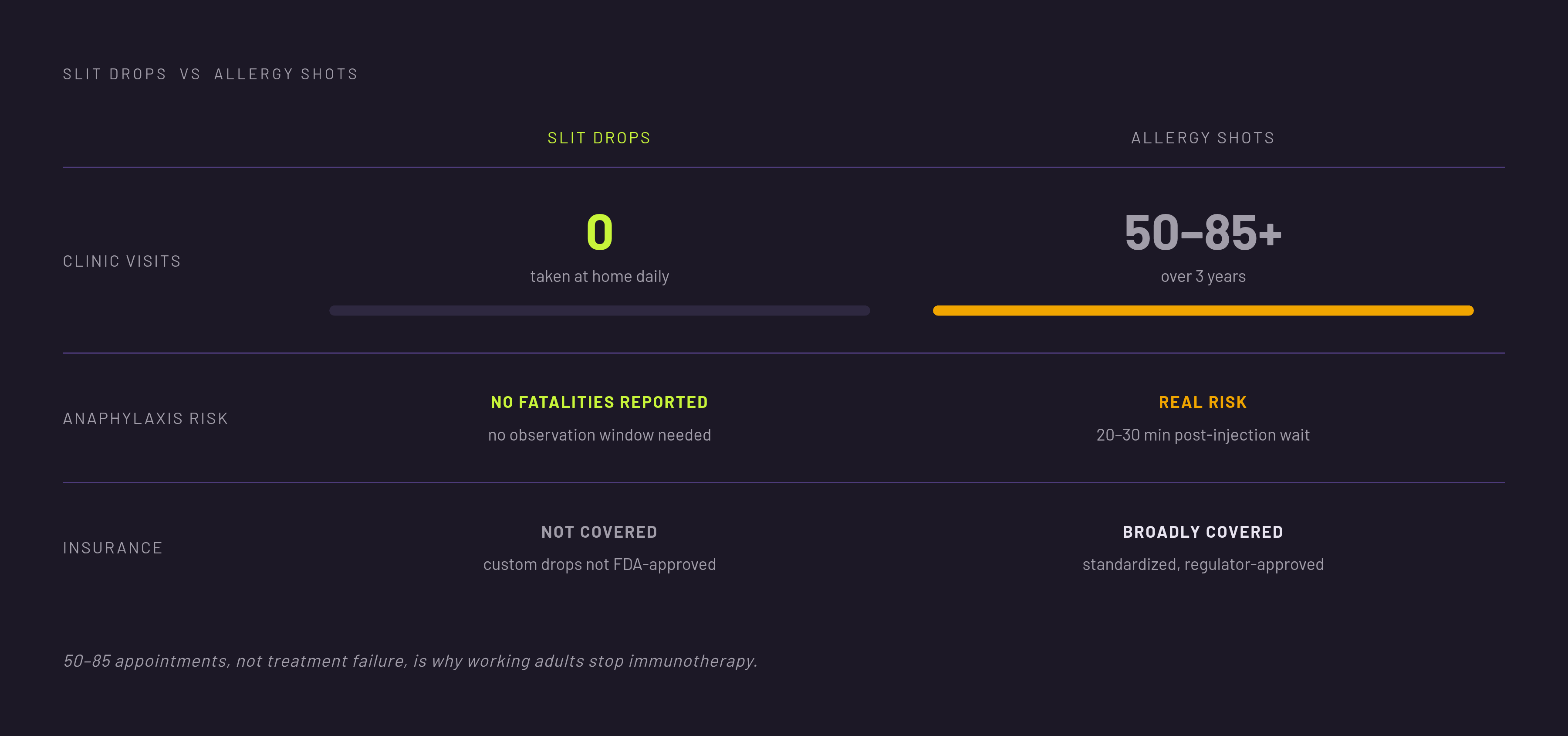
On safety, Johns Hopkins Medicine notes that dangerous reactions like anaphylaxis are very rare with SLIT drops, and no fatalities from allergy drop treatment have ever been reported. Shots carry a small but real anaphylaxis risk. That's why clinics require 20 to 30 minutes of observation after each injection. Drops carry no such requirement.
Time is where the two paths diverge most sharply. A full three-year course of allergy shots calls for 50 to 85 or more clinic visits. SLIT drops are taken at home, once a day, in under a minute. For a working adult who can't carve out a weekly slot for a clinic appointment, that visit schedule becomes a real barrier to finishing a three-year course of shots, and treatment abandonment, not treatment failure, ends up being the most common reason immunotherapy doesn't work out for this group.
Cost follows a similar split. One limitation deserves mention here: custom multi-allergen SLIT drops aren't yet approved by the relevant regulatory agency and aren't covered by the major public insurance program or most commercial insurance. FDA-approved SLIT tablets for specific allergens like grass and house dust mite do exist, and some carry pharmacy benefit coverage.
Each path has a real strength. Shots offer a standardized, regulator-approved dosing schedule, and you get direct clinical supervision throughout treatment. Drops cut the time commitment drastically and remove the anaphylaxis risk that makes in-clinic observation necessary, so a person with a full schedule can realistically finish a three-year course.
Next steps for suspected allergy-driven mouth breathing
Finding out exactly which allergens are driving it is what turns that suspicion into a treatment plan.
A full history, a physical exam, and testing for specific allergen sensitization are the standard path to diagnosing allergic rhinitis. Skin testing remains the reference standard for that diagnosis, but at-home blood testing through telehealth providers now offers another route to the same answer: a sensitization profile detailed enough to build a personalized immunotherapy plan around.
Telehealth allergy providers now offer certified, at-home IgE blood tests covering a wide range of allergens, with results that are often billable through insurance and treatment subscriptions that qualify for tax-advantaged health spending funds. The sequence tends to run in a simple order: a finger-prick test taken at home, a virtual visit with a board-certified physician, then a personalized sublingual immunotherapy plan shipped directly to the door, the model Wyndly runs, with consultations starting at $49.99 and treatment plans starting at $99 a month.
Getting tested and treated does more than managing symptoms season after season with over-the-counter remedies. The goal is retraining the immune system so nasal breathing comes back and the oxygenation cascade described throughout this piece runs in reverse, not suppressing an allergic reaction for one more allergy season. The fatigue, the fog, and the broken sleep don't have to be treated as a fixed cost of daily life when a treatable cause produces them.