Allergic Rhinitis and VO2 Max Reduction in Endurance Athletes
Untreated nasal allergies cost endurance athletes up to twenty percent of their aerobic capacity.
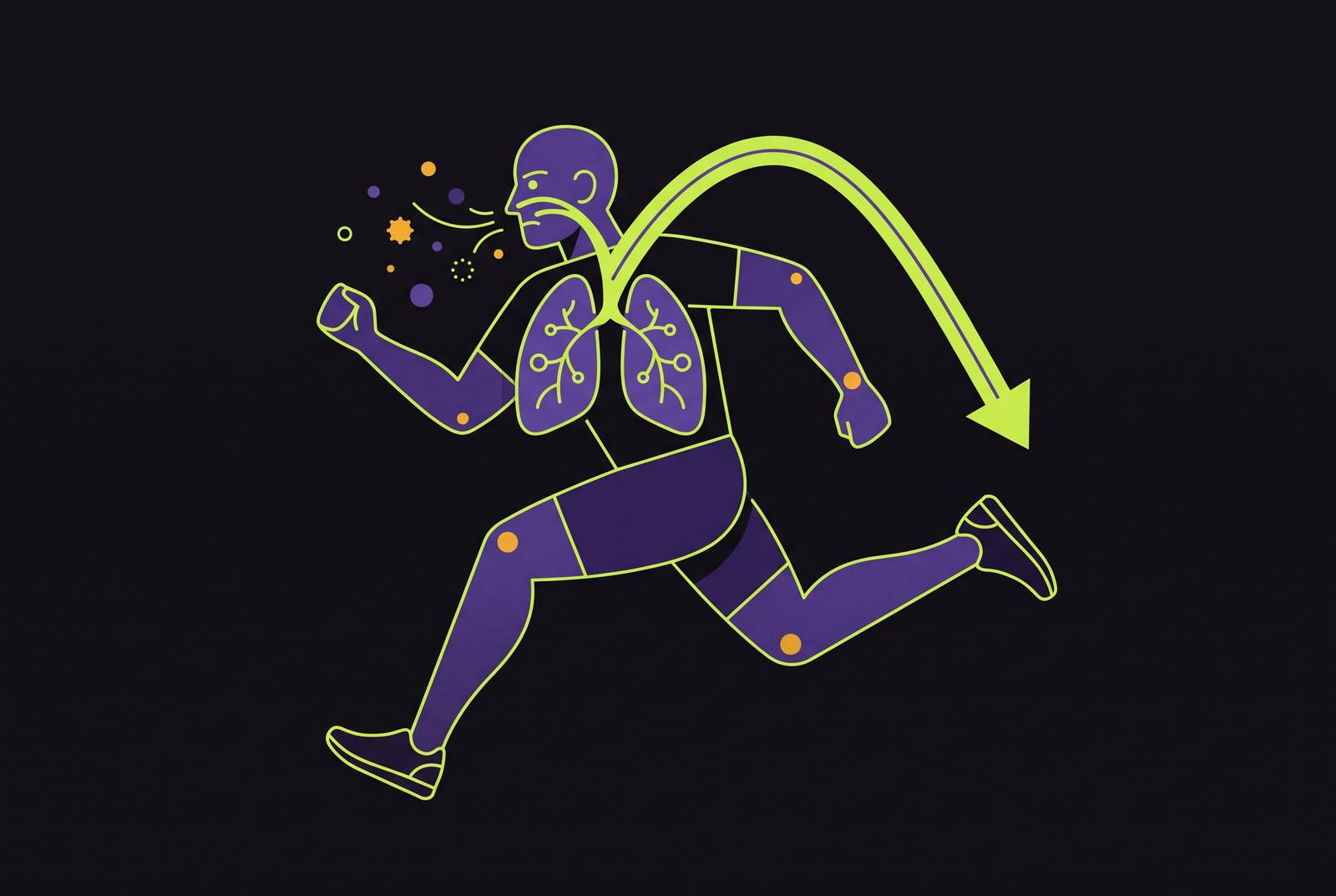
A large Finnish study found that physician-diagnosed allergic rhinitis appears at meaningfully higher rates in endurance athletes than in other athletes, with other athletes reporting it more often than people who don't compete at all. That's not a random pattern. Sustained aerobic effort means pulling in much higher volumes of air than normal breathing does, and all that extra air carries pollen, dust, and mold spores deeper into the airway than a walk to the mailbox ever would.
Where an athlete trains matters too. Marathoners, soccer players, and cyclists deal with pollen counts that swing by season and by region, while athletes training indoors, think wrestlers, swimmers, gymnasts, get a steadier diet of dust mite and mold sitting in the air of a gym that maybe hasn't had its filters changed in a while. Altitude adds a third pressure point: thinner air demands more ventilation, and the dry mucosal environment up there tends to aggravate allergic symptoms right when athletes are trying to bank fitness at camp.
None of this would matter as much if athletes were managing it well. They mostly aren't. In the Finnish data, only around half of athletes carrying a diagnosed allergic rhinitis label had used any antiallergic medication in the previous year. The performance cost detailed in the next section occurs in athletes who go untreated, as the data show. It's a cost that a large share of affected athletes are simply eating, season after season, without treatment.
The specific mechanisms through which allergic rhinitis degrades aerobic capacity
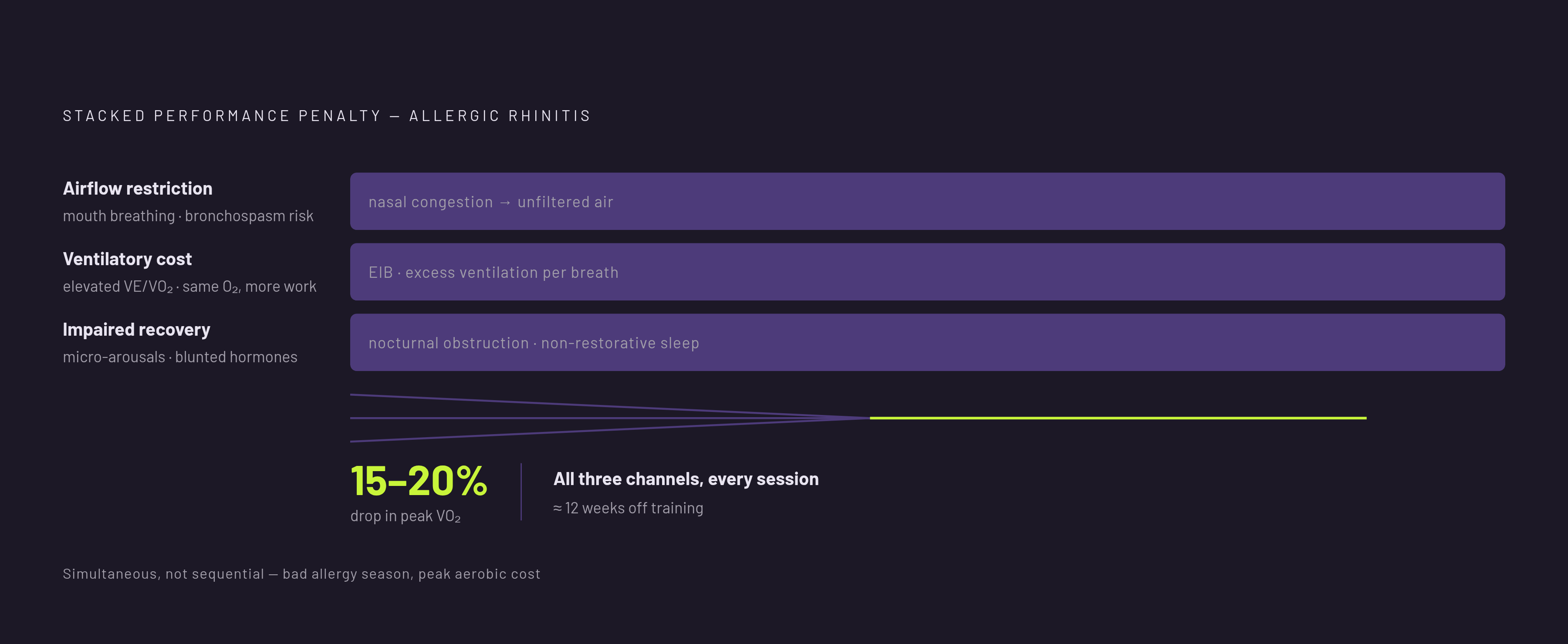
The mechanism starts with basic plumbing. Nasal congestion narrows the airway, and once breathing through the nose gets hard enough, the body switches to mouth breathing. That bypass skips the nose's job of filtering and humidifying incoming air, so the lungs end up handling air that's drier and rougher than what they're built for.
Mouth breathing during exercise doesn't just feel less comfortable, it raises the odds of airway irritation and bronchospasm, adding a second layer of friction on top of the first. Zoom into the immune system and a more durable process drives the surface symptoms, producing the cycle of injury and repair described next. In athletes with elevated circulating IgE (the antibody tied to allergic reactions), the airway lining goes through repeated cycles of injury and repair. Researchers believe this cycle creates something close to "passive sensitization" of the smooth muscle lining the bronchi, which raises the risk of airway hyper-responsiveness over time.
That hyper-responsiveness during exercise is called exercise-induced bronchoconstriction, or EIB, a condition closely tied to allergic rhinitis in athletes who already run atopic. The University of São Paulo's 2025 research measured exactly what EIB costs an athlete in ventilatory terms. Athletes with EIB showed a higher VE/VO2 ratio, both at the aerobic threshold and at peak effort, having to move more air just to pull in the same amount of oxygen. Picture two runners at identical paces: one is breathing efficiently, the other is working harder just to breathe, before either of them accounts for leg turnover or lactate.
There's also a fatigue channel that has nothing to do with mechanics. During symptomatic periods, histamine and other inflammatory mediators circulate through the body, and that raises perceived exertion, the sense that a given pace feels harder than it should, while chipping away at how much training an athlete can actually tolerate. Then there's sleep. Nocturnal nasal obstruction brings snoring, micro-arousals, and non-restorative sleep, all of which blunt hormonal recovery, slow reaction time, and limit how well the body adapts to training load. Worse sleep, in turn, tends to worsen nasal symptoms the next day, according to research published in Nature and Science of Sleep in September 2024, so the cycle feeds itself rather than resolving on its own.
Put the three channels together, mechanical airflow restriction, a higher ventilatory cost for the same work, and impaired recovery, and they're not taking turns. During a bad allergy season, they're stacking on top of each other, all at once, every session.
How large the aerobic penalty is: the evidence on VO2 max reduction
Given all three mechanisms firing together, what does that actually cost in VO2 max, the number that most directly tracks aerobic fitness? Research cited in the Journal of Allergy and Clinical Immunology, and referenced again in a December 2025 Canadian Society of Otolaryngology review, documents a 15 to 20 percent drop in peak oxygen uptake during symptomatic periods of allergic rhinitis.
Sit with that range for a second. That's a measurable performance penalty showing up as symptoms." That's showing up to interval work and not being able to hit the numbers that were routine a month earlier.
A comparison puts the number in sharper focus. A bad allergy season can impose nearly the same aerobic cost as a full 12-week training cessation, which per the 2022 masters athlete review (Burtscher et al., International Journal of Environmental Research and Public Health) produces a VO2 max decline of as much as 20%. That's a strange kind of parity: an athlete can be training every single day and still be losing fitness at close to the rate of someone on the couch, simply because the airway is compromised.
And this is where the Finnish data closes the loop uncomfortably. Only a small minority of the athletes tracked in that study were using intranasal corticosteroids, which happens to be the treatment with the strongest evidence behind it for symptom control. Most athletes carrying this VO2 penalty are not using the intervention most likely to fix it. For a competitive marathoner or cyclist, a VO2 max reduction of this size during a high-pollen training block is not a minor inconvenience, it is the difference between race-fit and unable to complete quality sessions at target intensity.
What treating airway dysfunction recovers: the São Paulo trial results
The clearest recent evidence on this penalty comes from a prospective controlled trial out of the University of São Paulo, published in August 2025 in the International Journal of Sports Physical Therapy. The trial actually tested exercise-induced bronchoconstriction, the airway-narrowing condition closely tied to allergic rhinitis, not allergic rhinitis symptoms directly. And it's a small study, so the numbers should be read as a strong signal rather than a settled verdict.
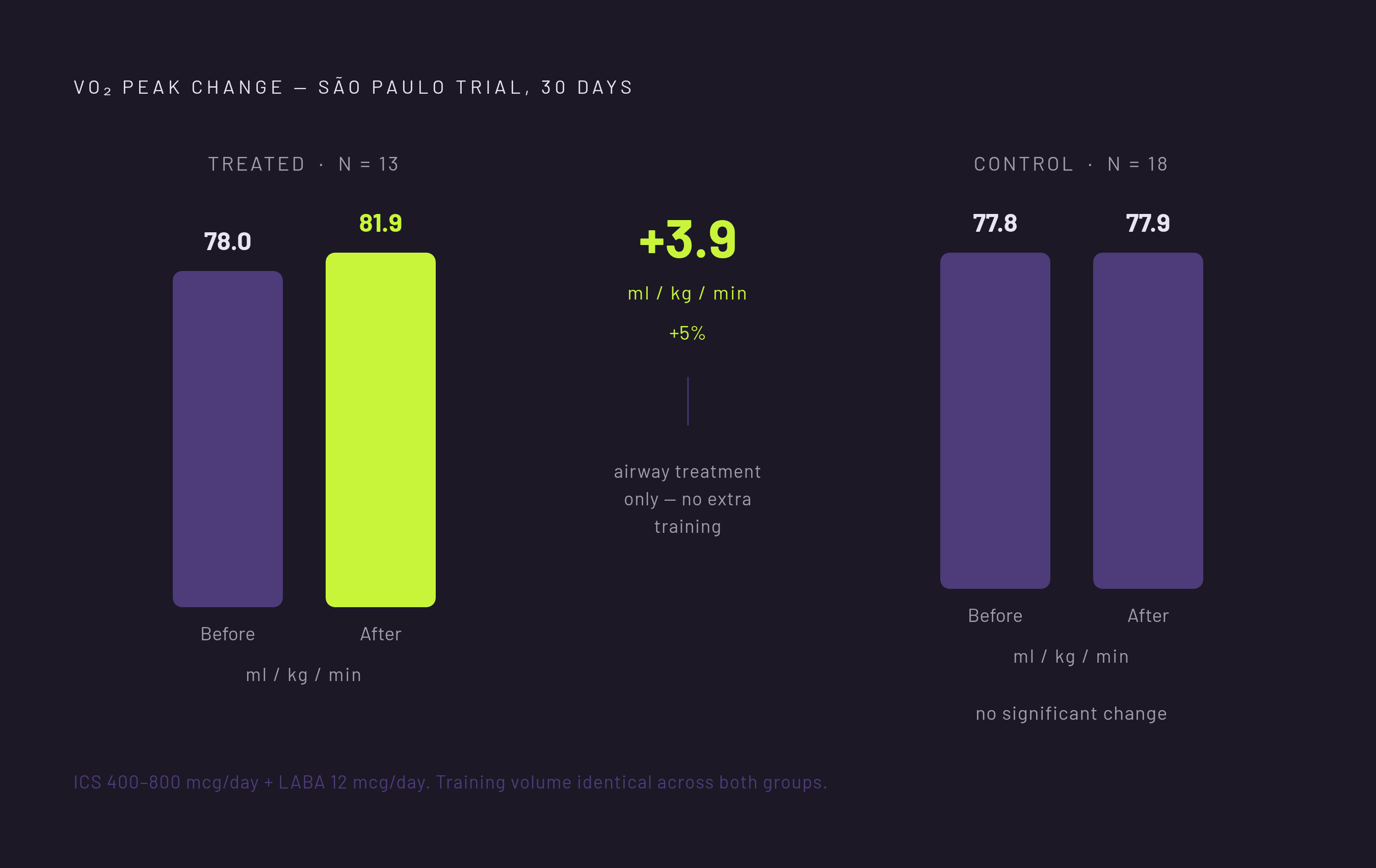
The design follows. Marathon runners went through eucapnic voluntary hyperventilation screening to identify who actually had EIB. Thirteen runners who met the criteria became the treatment group; eighteen who didn't became the control. Both groups kept training exactly as they had been, no volume changes, no intensity changes.
The result: only the treated group showed a significant jump in VO2 peak, a gain of 3.9 ml per kilogram per minute (give or take 3.67), which works out to roughly a 5 percent increase in 30 days, with zero change to training volume. That same group also ran significantly faster during cardiopulmonary exercise testing, both compared to their own baseline and compared to the untreated group.
The researchers didn't find a significant shift in inflammatory mediator expression. So the gains likely came from opening up mechanical airway obstruction, not from some deeper immunological reset. Which raises a fair question. If a month of airway treatment can produce a 5 percent aerobic gain without a single extra training session, what's actually being left on the table by athletes who never get tested for this in the first place? The EIB+ group received inhaled corticosteroids (400–800 mcg/day) and long-acting bronchodilators (12 mcg/day) for 30 days.
Why allergic rhinitis goes undiagnosed or undertreated in athletes for so long
Given a 5 percent gain sitting there for the taking, why isn't every athlete getting tested? Part of it is that allergy symptoms hide in plain sight. Nasal congestion, fatigue, a scratchy throat, these get chalked up to overtraining, seasonal tiredness, or "just getting over something," because the symptom picture overlaps so heavily with ordinary training fatigue.
The Finnish numbers back this up from a different angle. Roughly half of diagnosed athletes hadn't used any antiallergic medication in the past year, and only a small fraction had used intranasal corticosteroids, the option with the best evidence behind it. So this is largely a follow-through problem. It's a follow-through problem. 65.3 percent of female athletes with diagnosed rhinitis used medication, compared to 47.8 percent of male athletes, a gap that isn't fully explained by the data.
Some of the hesitation is structural rather than personal. Competitive athletes have to think about Therapeutic Use Exemptions and sport-specific rules around prohibited substances, and that friction alone is enough to make some athletes avoid treatment entirely rather than navigate the paperwork. Add to that a population that's already trained to push through discomfort, and it gets genuinely hard to tell whether a rough training week is allergic impairment or just a hard week. None of this reflects negligence. It reflects a set of overlapping symptoms, structural barriers, and a culture built around tolerating discomfort, and the outcome is a group of athletes who are both unusually susceptible to allergic rhinitis and unusually likely to leave it untreated, absorbing the VO2 cost quietly, year after year.
The hierarchy of treatment options
Once the diagnosis is confirmed, what actually works, and how far does each option go toward fixing the underlying problem rather than just muting the symptoms?
Start with the basics. Environmental control costs nothing pharmacologically and forms the foundation: training indoors when pollen counts spike, running HEPA filtration in the gym or bedroom, rinsing the nasal passages with saline after outdoor sessions, and showering right after exposure. All of it reduces allergen load, none of it carries drug-related risk. It's just not enough on its own for most athletes with a real diagnosis.
From there, intranasal corticosteroids sit at the top of the pharmacological options, the treatment with the best evidence for controlling symptoms, and given how underused this category is in the Finnish data, it stands out as a gap that's easy to close. Antihistamines are the more familiar option, but they come in two very different generations. First-generation formulas bind H1 receptors in the brain and cause sedation, foggy concentration, and disrupted memory formation, a real liability for anyone trying to train or compete sharp. Second-generation antihistamines carry a much better side-effect profile, but neither generation touches the underlying immune dysregulation driving the reaction. They manage symptoms. They don't retrain anything.
That distinction is the whole point of allergen immunotherapy, delivered either as allergy shots (subcutaneous immunotherapy, SCIT) or under-the-tongue drops and tablets (sublingual immunotherapy, SLIT). It's the only category on this list that works on the root cause, retraining the immune system to tolerate allergens instead of reacting to them. SCIT has decades of clinical evidence behind it and produces 60 to 90 percent symptom reduction in studies, plus a faster build-up phase. The tradeoff is logistics: it requires regular in-office injections, which is a real structural barrier for an athlete juggling travel, competition, and training camps.
SLIT delivers comparable long-term immune retraining without the clinic visits. Mechanistically, the mouth's lining creates a tolerogenic environment where dendritic cells take up the allergen and push immune differentiation toward a Th1 response along with IL-10-producing regulatory T cells, a shift confirmed by 2024 AAAAI research showing rising protective IgG, falling IgE, and more regulatory T cell activity.
Early symptom relief can start showing up in 4 to 24 weeks, though full immune tolerance takes roughly 3 years to fully build, and a comprehensive September 2025 overview of systematic reviews and meta-analyses on SLIT efficacy, published in European Archives of Oto-Rhino-Laryngology and drawing on PubMed, Embase, Cochrane Library, Web of Science, CNKI, VIP, WANFANG, and CBM through June 2025, backs up SLIT's clinical standing. For an athlete whose season doesn't leave room for a weekly appointment, telehealth-guided SLIT programs offer physician-supervised, personalized treatment that fits the actual constraints of a competition schedule. SLIT (drops and FDA-approved tablets) delivers comparable long-term immune retraining at home; the FDA has approved four SLIT tablets (Odactra (house dust mite), Grastek (Timothy grass), Oralair (5-grass mix), and Ragwitek (short ragweed)), and custom aqueous drops are used off-label in the U.S. and are prepared by allergists using FDA-approved allergen extracts.
What athletes should do now: testing, timing, and getting ahead of the next season
So where does an athlete actually start? Testing, not guessing. A skin prick test or a serum-specific IgE blood test identifies exactly which allergens are triggering the reaction, and without that information, any treatment plan is a shot in the dark. At-home finger-prick testing has made this first step easier to access than it used to be, which removes one more excuse for putting it off.
Timing matters almost as much as the test itself. Starting immunotherapy before peak allergen season, not once symptoms are already flaring, gives the immune system time to build tolerance while things are still manageable. An athlete who starts treatment mid-season is playing defense the whole way through, managing symptoms in real time instead of getting ahead of them.
The sport itself should shape the conversation with a clinician. Outdoor endurance athletes are dealing with seasonal pollen loads that shift by geography and time of year, while indoor athletes are facing a steadier year-round load of dust mite and mold. Both situations call for identifying the actual allergen, not a one-size-fits-all approach.
The São Paulo trial is the clearest argument for acting now: 30 days of targeted treatment produced a 5 percent VO2 peak gain with zero change to training. That's a real, fast, and free performance gain in the sense that it doesn't cost a single additional training session.
Athletes already spend enormous time and money dialing in training, nutrition, and recovery. Allergic rhinitis can impose a 15 to 20 percent VO2 max penalty that no amount of training discipline will fix on its own. Treating it belongs in the performance plan itself, addressed with the same urgency as training or recovery. It's part of the performance plan, the same as sleep, fueling, or a well-built training block, and for athletes whose schedules make in-person visits hard to pin down, at-home sublingual immunotherapy guided by telehealth offers a way to treat the root cause without reshaping the entire season around it.
Sources
- Effect of Pharmacological Treatment on Exercise-Induced Bronchoconstriction and Allergic Inflammatory Response in Endurance Athletes - PMC
- Allergic Rhinitis and Athletic Performance: Relationship and Correction in Elite Athletes
- Sports Performance Bulletin - Endurance health & lifestyle - Allergic rhinitis in endurance athletes
- Comparative Analysis of Acute Effects of Different Aerobic Exercises on Clinical Symptoms and Cytokine Levels in Patients with Allergic Rhinitis: A Randomized Crossover Study | Physical Activity and Health
- Respiratory health of elite athletes – preventing airway injury: a critical review - PMC
- Efficacy and safety of Sublingual immunotherapy for allergic rhinitis: an overview of systematic reviews and meta analyses | European Archives of Oto-Rhino-Laryngology | Springer Nature Link
- How does sublingual immunotherapy work? - Journal of Allergy and Clinical Immunology
- Impaired sports performance of athletes suffering from pollen-induced allergic rhinitis: a cross-sectional, observational survey in German athletes - PubMed