Th1 and Th2 Immune Balance in Allergy and Autoimmunity
Regulatory T cells, not competing T-helper lineages, hold the key to both diseases.

Allergy and autoimmunity both trace back to the same fork in the road: a decision the immune system makes about how to treat an antigen, long before any symptom appears. That decision happens when antigen-presenting cells show an antigen to naive CD4+ T cells for the first time. The cytokine environment surrounding that handoff determines which T-helper lineage those cells commit to, and that commitment carries lasting consequences for how the immune system will treat that same antigen on every future encounter.
Two major lineages come out of that fork. Neither lineage is good or bad on its own. Each is suited to a different kind of threat, and the body needs both available.
What tips a naive T cell toward one lineage over the other is not left to chance. Th1 commitment runs through a separate transcriptional program. These are actively built through a dedicated transcriptional program, cell by cell, decision by decision.
But a two-lineage story leaves something out. What keeps either lineage from running unchecked once it's switched on? Regulatory T cells, chemokines, and STAT6 signaling all weigh in on where the Th1/Th2 balance finally settles, and among those regulators, one population does more work than the rest. The next section looks at why treating Th1 and Th2 as simple opposites misses that work, and the section after builds out what regulatory T cells actually do to hold the balance in place.
Why Th1 and Th2 are not simply opposites
The textbook version of this story is tidy: autoimmune disease comes from too much Th1 and Th17 activity, allergic disease comes from too much Th2 activity, and the two sit on opposite ends of a seesaw. That framing captures something true about which cytokines show up in which disease. It misses the deeper pattern that produces both: a shared loss of regulation that lets either lineage run unchecked.
Look at the numbers across populations. Th1/Th17-driven autoimmune diseases, multiple sclerosis and type 1 diabetes among them, along with rheumatoid arthritis, which draws on both Th1 and Th17 pathways, have climbed over recent decades. A true seesaw model predicts that more of one arm should come with less of the other. Instead, both arms have risen together, which is not what opposition looks like.
The same pattern holds inside individual patients. That's a strange finding if Th1 and Th2 are supposed to be rivals. It makes much more sense if both are symptoms of something else failing.
What that something else might be is a loss of the regulation that should be keeping either lineage in check. They converge on the same underlying failure, caused by a loss of regulation, and that failure appears differently depending on which antigen the immune system has lost patience with. That raises the obvious next question of what is supposed to prevent that failure.
Regulatory T cells as the immune system's tolerance enforcer, in both allergy and autoimmunity
Regulatory T cells carry the transcription factor Foxp3, and they act as the immune system's standing brake. Their job is peripheral tolerance: keeping activated T and B cells from attacking things they shouldn't, whether that's a patient's own pancreas or a piece of ragweed pollen. When Tregs work the way they're supposed to, you're far less likely to get either autoimmunity or allergy. When they don't, both become far more likely. That single fact is the thread running through this entire article.
Tregs suppress effector immune responses through several mechanisms at once. Block CTLA-4 in a lab dish and Treg-mediated suppression falls apart, which shows how load-bearing that one pathway is.
In autoimmune disease, this brake fails through fewer Tregs, Tregs that can't suppress as effectively, or Tregs that never make it to the inflamed tissue where they're needed. In allergic disease, the failure looks different but comes from the same place: diminished Treg activity or a shift in which Treg subsets are present lets Th2 responses run past what they should, and that excess drives the IgE overproduction, mast cell degranulation, and eosinophil buildup that define allergic inflammation.
The genetics make the overlap concrete. Polymorphisms in the FoxP3 gene and the IL-10 gene raise a person's risk for both autoimmune and allergic conditions. That's the same regulatory machinery, failing toward different endpoints depending on which antigens happen to be in play for that person. And IL-10 itself deserves a second look here: it was first described as a Th2 cytokine, but it's now understood as a core suppressive signal that Tregs use to dial down both Th1 and Th2 cytokine production.
If Treg dysfunction is the shared failure point behind both disease categories, then restoring Treg function becomes the shared target for treatment. For allergy specifically, that idea has a direct clinical path, and it starts with understanding what happens when the Treg brake doesn't hold.
What Th2 dominance does in the allergic person, from sensitization to symptoms
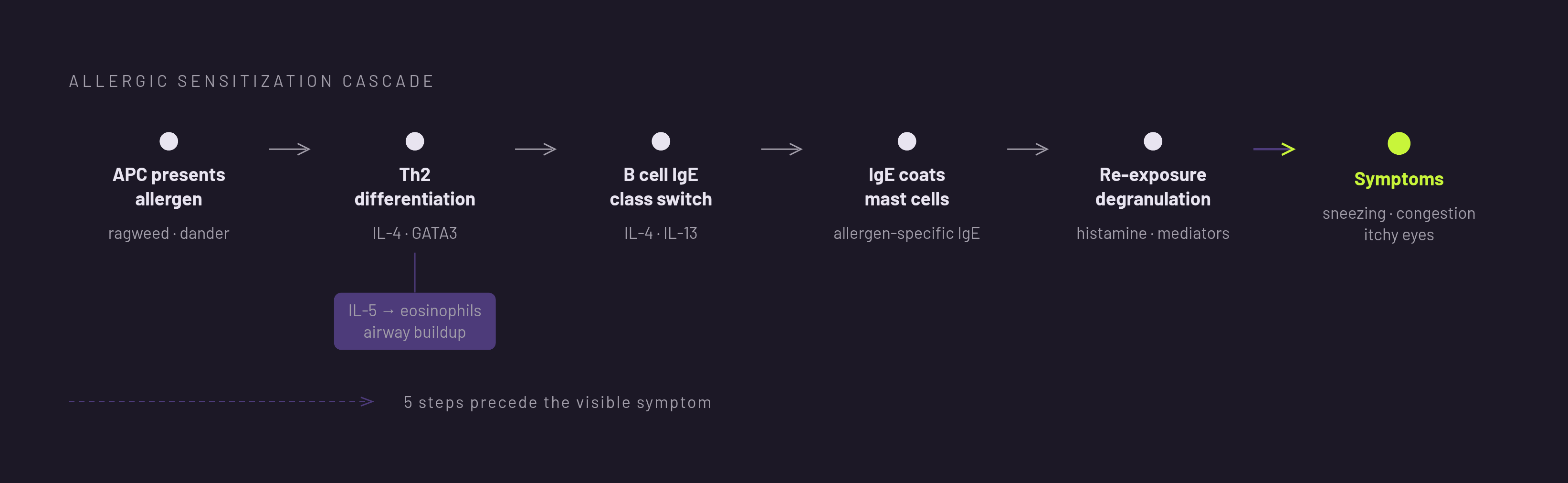
When Treg suppression isn't strong enough to hold the line, allergen exposure pushes the Th1/Th2 balance toward Th2. That shift, not the allergen itself, is what produces the disease a patient actually experiences.
The cascade runs in a predictable sequence. Antigen-presenting cells show the allergen, say, ragweed pollen or cat dander, to naive CD4+ T cells. In the presence of IL-4, those T cells differentiate into Th2 cells, directed by GATA3. The resulting Th2 cytokines, IL-4 and IL-13, instruct B cells to switch their antibody production to IgE. That allergen-specific IgE then coats mast cells and basophils throughout the body. The next time the allergen shows up, those primed cells degranulate, releasing histamine and a cascade of other inflammatory mediators. The sneezing, the itchy eyes, the congestion: those are the visible endpoint of a process that started several steps earlier at the T-cell level.
IL-5, riding along in that same Th2 cascade, governs the growth and activation of eosinophils. That's why allergic airway inflammation involves eosinophil buildup specifically, not just a histamine flare. And the whole balance isn't fixed at birth. DNA methylation acts as a molecular switch on the Th1/Th2 balance, meaning environmental exposures and lifestyle factors can shift that balance over a lifetime, not only at the moment of allergen contact. So as environments and lifestyles have changed, allergy rates have climbed too.
The consequences of sustained Th2 dominance reach further than the sinuses. That reach is a direct effect of allergy, not a side effect of it. It is the direct, traceable output of the same Th2 cascade described above, appearing in systems well beyond the nose. Allergy, looked at this way, is a chronic systemic condition, not a seasonal inconvenience to tough out.
Why symptom-masking medications leave the Th1/Th2 imbalance untouched
Antihistamines and nasal corticosteroids work downstream of everything described so far. They block histamine, dampen inflammatory cytokines, and reduce mucosal swelling. None of that touches the Th2-skewed T-cell programming that produced those symptoms, and none of it restores the Treg function that should have kept the programming in check to begin with.
That has a plain consequence: stop the daily antihistamine, and the Th1/Th2 imbalance sits exactly where it was before the first dose. The immune system hasn't learned anything new about the allergen in the meantime. There's no mechanism by which taking an antihistamine, for a week or for ten years, could produce lasting tolerance, because tolerance is a T-cell and Treg phenomenon, and antihistamines never reach that level.
These drugs also aren't free of their own costs. First-generation antihistamines like diphenhydramine were built for short-term relief, not daily long-term control, and the sedation and cognitive effects they cause during use are well documented.
Intranasal corticosteroids fare better on side effects but face the same structural limit. ICAR 2023 guidelines name them the first-line recommendation for allergic rhinitis, and they reduce mucosal inflammation effectively. They can also cause nasal irritation, nosebleeds, and headaches, and they leave the Th2 bias driving the disease completely intact. All of these tools have a real place in managing a bad symptom day. None of them touch the Th1/Th2 imbalance that drives it. Understanding that difference points to an approach that actually engages the Treg and GATA3 pathways: sublingual immunotherapy is built to close that gap.
Can switching from allergy shots to at-home sublingual drops work without restarting treatment?
Sublingual immunotherapy, or SLIT, operates at the same level as the problem. Delivered under the tongue, it uses the oral mucosa, a naturally tolerance-friendly tissue, to re-engage the exact regulatory pathways that failed in the first place: anti-inflammatory signaling and Treg induction. For someone weighing a move from weekly injections to a daily at-home drop or tablet, the relevant fact is that both approaches work through the same underlying immune mechanism, repeated allergen exposure that re-trains T-cell behavior, so switching formats doesn't mean abandoning the progress already made toward tolerance.
The mechanism starts small. A tiny amount of antigen gets taken up by dendritic cells sitting in the oral mucosa. That signaling then drives production of the same anti-inflammatory signaling molecules that functional Tregs use to enforce tolerance elsewhere in the body. That mechanism builds an anti-inflammatory environment right at the point where the allergen enters.
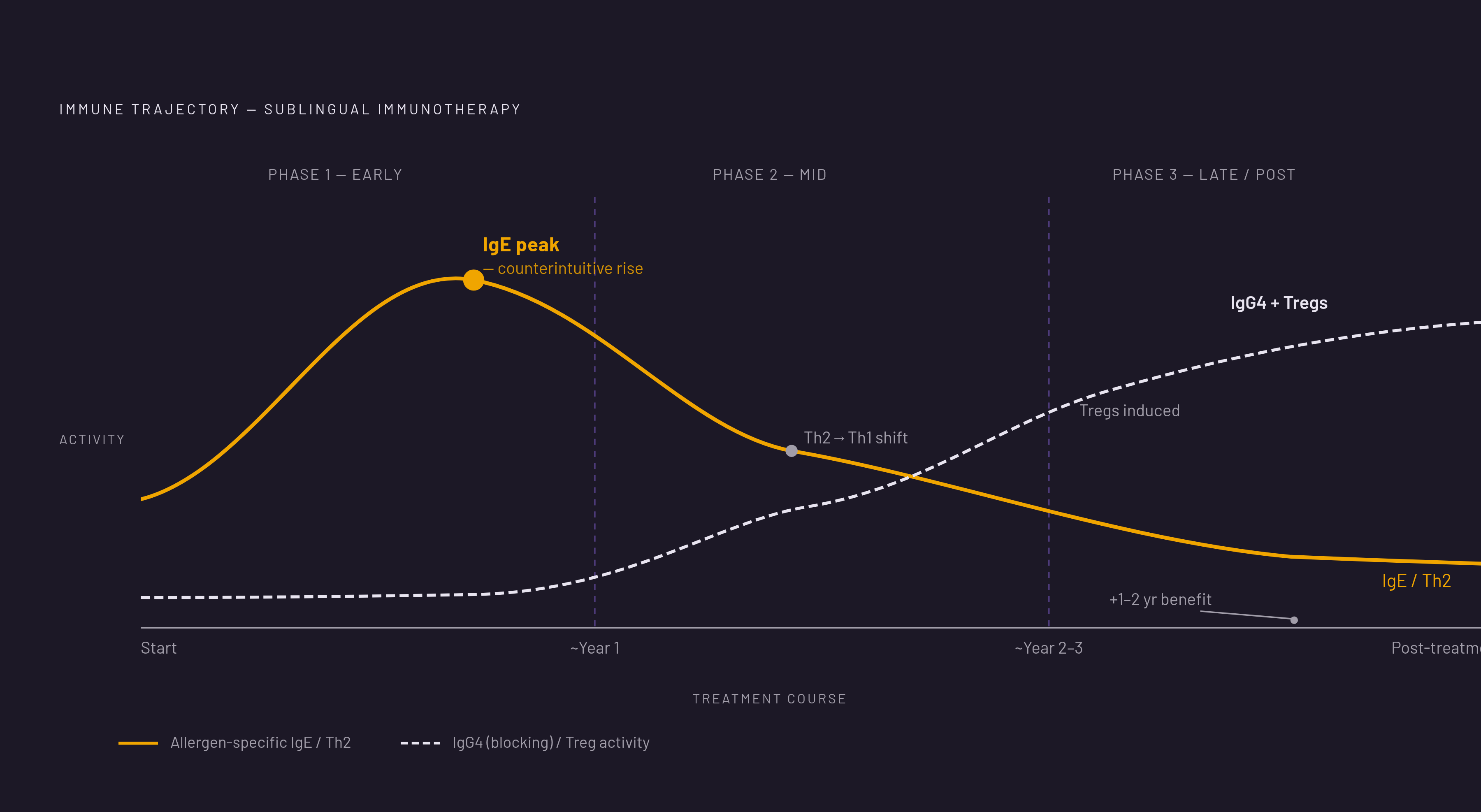
Over a full treatment course, the immune shift follows a sequence you should know in advance, because the early phase can look counterintuitive. Th2 responses and serum allergen-specific IgE actually rise briefly at the start. Later, that trend reverses: the balance shifts from Th2 toward Th1, allergen-specific IgG4 (a blocking antibody) increases, and Tregs get induced in meaningful numbers. Timing matters here too. If you start earlier, before symptoms get severe, the Treg response seems to get more room to build.
The endpoint of all this is a CD25+, IL-10-producing regulatory T cell subset that allergen immunotherapy specifically induces. That's the exact suppression that was missing in the allergic state to begin with, restored through the same cells and the same signals, not substituted with something new. Antihistamines intercept symptoms after the fact. SLIT re-teaches the underlying T-cell decision described at the start of this article, which is the structural reason it can produce a durable result that a daily pill cannot.
What the evidence shows about switching to at-home SLIT
Randomized controlled trials back this up with outcomes, not just mechanism. Grass and house dust mite SLIT tablets cut symptoms and medication use in clinically meaningful ways, and in key trials those benefits held for one to two years after a three-year course ended. Neither outcome is something a purely symptomatic medication could produce, since neither depends on blocking histamine in the moment. Both depend on the immune trajectory actually changing.
If you're considering a switch from allergy shots, the comparison comes down to mechanism versus logistics. Where SLIT pulls ahead is in what it asks of a patient's week. Allergy shots require frequent clinic visits, and that's especially demanding during the initial build-up phase. On safety, SLIT carries a markedly lower risk of anaphylaxis than injections, by a margin spanning multiple orders of magnitude per dose, and no fatality has ever been reported in association with allergy drop treatment. That matters because the entire method depends on repeated allergen exposure.
There's a real limitation you should know about if you're making this switch. SLIT in drop form isn't approved by regulators for every allergen. FDA-approved tablets cover a narrower, specific set. If you have a complex, multi-allergen profile, you should talk through formulation options with a physician rather than assume drops cover everything a shot regimen did. But SLIT's at-home administration, lower anaphylaxis risk, and FSA/HSA eligibility are real advantages if your schedule doesn't easily accommodate a standing clinic appointment every week.
How Wyndly translates this immunological framework into a practical treatment path
Everything in this article points toward one practical conclusion: lasting allergy relief depends on restoring Treg-mediated Th1/Th2 balance, not on blocking the mediators downstream of it. So you need treatment personalized to your actual allergen profile, overseen by a physician, and sustained long enough for the Treg-induction sequence described earlier to happen.
Wyndly builds its process around that sequence. Care starts with a virtual consultation with a board-certified doctor to review allergy history and map out a likely trigger profile. From there, an at-home finger-prick blood test screens for more than 40 common indoor and outdoor allergens, covering pet dander from cats, dogs, and horses; grass and shrub pollens including Timothy grass, ragweed, mugwort, and Johnson grass; tree pollens including oak, birch, cottonwood, and mountain cedar; molds including Alternaria, Aspergillus, Cladosporium, and Penicillium; and dust mites including B. tropicalis, D. far, and D. pter. These are largely the same perennial, hard-to-avoid triggers responsible for year-round Th2 skewing in a lot of patients, so testing for the full range matters more than guessing from symptoms alone.
A positive IgE result on that test doesn't automatically mean clinical allergy. A physician needs to correlate sensitization on the blood test with the patient's actual symptom history to separate true allergy from asymptomatic sensitization, since treating a reaction that isn't actually happening doesn't help anyone.
Pricing is straightforward. The initial consult runs $49. Set against the cost of repeated in-office visits over a multi-year shot regimen, that structure is built to be more accessible, not just cheaper on paper.
The timeline matches the biology, so it doesn't promise what biology can't deliver. Wyndly's treatment course is built around that timeline. For anyone currently weighing allergy shots against a switch to an at-home option, that's the question worth starting with: get tested, find out the actual trigger profile, and let a doctor map out what a Treg-restoring treatment plan looks like from there.
Sources
- Frontiers
- Regulatory T cells and their role in allergic disease - Conrad - 2025 - Allergy - Wiley Online Library
- Th1 Th2 Balance - an overview
- Synergistic Effect of Various Regulatory Factors in Th1/Th2 Balance; Immunotherapeutic Approaches in Asthma
- Immune Mechanisms of Sublingual Immunotherapy
- Frontiers