HRV and Recovery Metrics During High Pollen Season
Allergies suppress HRV over days through sleep disruption, not acute stress response.
Your HRV score during pollen season is registering something real, just not what most athletes assume. It is not a verdict on your training. It is a read on the total load your autonomic nervous system is carrying, and allergies add to that load in ways that unfold over days, not hours.
What HRV actually measures and why it registers more than exercise stress
Heart rate variability is best understood as a whole-body stress integrator. The number your wearable reports, usually rMSSD, the root mean square of successive differences in heartbeat intervals, responds to training stress, sleep quality, and illness alike. It does not care which one of those is pulling it down. It just reports that something is.
Resting heart rate gives you a slower-moving parallel signal. It rises in response to the same systemic loads that suppress HRV, so when both move in the wrong direction at once, you have a reasonably confident read that the body is under strain. What you rarely know from the numbers alone is the source.
That ambiguity matters more than most users realize. One endurance athlete tracking morning HRV continuously across five years, while logging 10 to 15 hours a week of running, cycling, and swimming, saw near-flat rMSSD across four stable years. Meaningful drift only appeared when multiple stressors or protocol changes coincided. The metric is sensitive less to any single input than to how inputs compound. High pollen season is exactly the kind of hidden input that stacks on top of training stress and muddies the picture.
Why acute allergen exposure produces a counterintuitive HRV response
Here is the part that catches wearable users off guard. When the body first encounters an allergen, controlled-lab evidence shows HRV markers of parasympathetic activity stay stable or actually rise. The initial response looks like the opposite of what you would expect from a stressor.
The pattern shows up elsewhere in physiology. Cold-water immersion triggers vasoconstriction that initially raises blood pressure and heart rate. Then a parasympathetic rebound kicks in, slowing the heart and lifting HRV. But a higher HRV in that context does not mean better recovery. It means the nervous system is reacting, not restoring.
The practical consequence is that a wearable user who checks their HRV within hours of heavy pollen exposure may see a misleadingly favorable reading. The number can look fine, even improved, right before the real cost shows up. Acute-to-chronic extrapolation is the error most wearable users make. What happens in the first hour of exposure does not predict what happens over the following day or two. Your data can look healthy right before it gets worse.
How sustained pollen exposure shifts from an acute blip to a chronic autonomic load
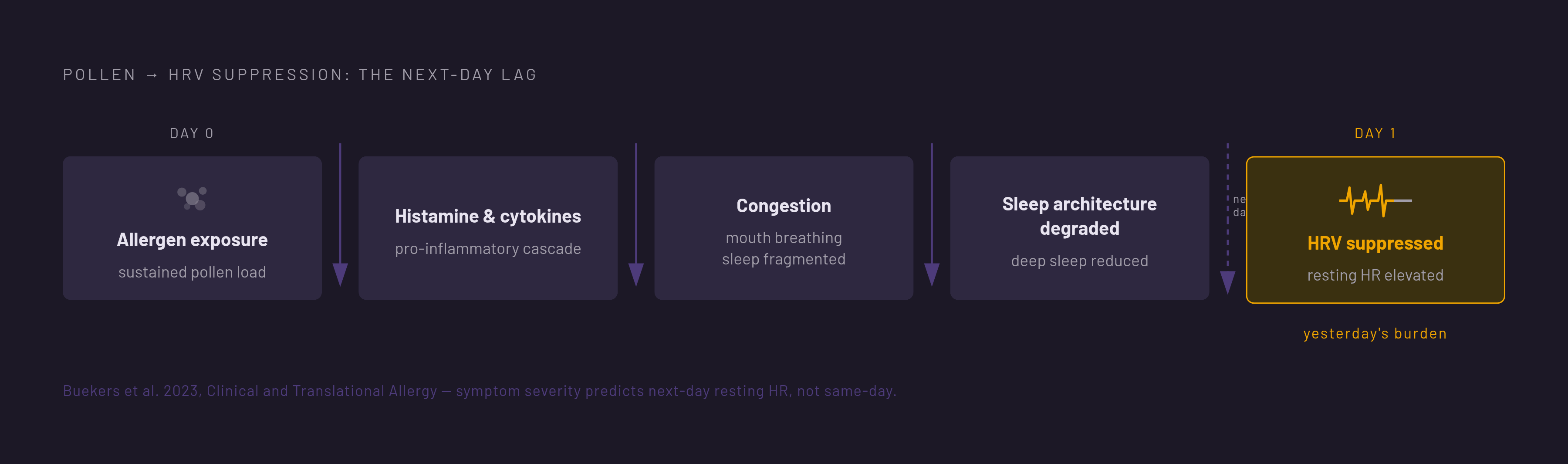
Beyond the acute phase, sustained allergen exposure creates a state of systemic inflammation and sleep degradation. That is when the HRV pattern athletes actually experience emerges: elevated resting heart rate and suppressed recovery scores. The immune response to allergens releases histamine and pro-inflammatory cytokines. These circulate systemically and place continuous low-grade demand on cardiovascular regulation. Nasal congestion from persistent allergic rhinitis forces mouth breathing, which disrupts breathing rhythm and compounds autonomic imbalance overnight. But sleep disruption is the key transmission mechanism. Poor sleep independently suppresses HRV and elevates resting heart rate. Inflammation and congestion do not need to act on the autonomic nervous system directly. They degrade sleep, and sleep does the rest.
The strongest evidence for this chain comes from a 2023 study in Clinical and Translational Allergy. Buekers and colleagues tracked adults with tree pollen allergy using a wristwatch across two full pollen seasons, covering thousands of participant-days. They found that higher daily symptom severity was associated with elevated resting heart rate the following day. The lag is the finding. The same research group reported at a respiratory medicine conference in 2022 that better mood was associated with healthier, more irregular heart rate patterns on the same day. Symptom burden carries a psychological load, and that load shows up in autonomic flexibility.
The next-day lag in the Buekers data has direct implications for training decisions. An athlete checking their recovery score in the morning is seeing yesterday's symptom burden in today's number. Seasonal allergies can be treated as an additive load, similar in kind to travel fatigue, acute illness, or psychological stress. They compound with training stress rather than operating independently. The body does not process them as separate invoices.
What inflamed, sleep-deprived nights do to the metrics athletes track most
Allergic inflammation degrades not just HRV readings but the underlying physiology those readings are meant to protect: sleep architecture, cognitive sharpness, and daytime readiness. A suppressed HRV score is not a detached data point. It is a signal that the body is losing access to its recovery machinery.
The mechanism runs through several channels at once. Histamine causes congestion, sneezing, and itching, all of which interrupt sleep onset and continuity. Bedroom allergens like dust mites and pet dander can intensify symptoms specifically at night. Histamine in the brain also interferes with normal sleep architecture. The sedation that first-generation antihistamines produce is not the same as restorative sleep. Under drug-induced sedation, the brain cannot consolidate memories, regulate emotions, or restore cognitive function the same way.
Inflammatory cytokines cross the blood-brain barrier and impair neural function, reducing processing speed, working memory, and executive function. That is the brain fog many allergy sufferers describe but rarely attribute to their allergies. From a training standpoint, athletes during peak pollen season may be running on nights of fragmented, non-restorative sleep without recognizing that allergy burden is the cause. Their wearables record it as low readiness scores or elevated strain without an obvious explanation. Untreated allergic rhinitis has been associated with chronic sleep loss sufficient to affect mental health. The fatigue compounds. Poor sleep worsens immune sensitivity, which worsens symptom load, which worsens sleep. A loop, not a line.
How to read a pollen-season HRV suppression without misinterpreting it as overtraining
A drop in HRV during pollen season is a real physiological signal. It most likely reflects allergic load rather than training error. Conflating the two leads to wrong decisions in both directions. The standard mistake is seeing a suppressed HRV score and either adding a rest day unnecessarily or dismissing the reading as noise and pushing through training the body is genuinely not ready for. Both reactions misread the data.
The better move is to treat pollen season as a context flag, the same way a traveler flags jet lag or a sick athlete flags illness. Downgrade the training stimulus accordingly while addressing the underlying cause. Wearable context-tagging makes this practical. Logging high pollen day, poor sleep and congestion, or allergy symptoms on days of abnormal readings makes the data interpretable in retrospect. Over time, the tags help you distinguish allergy-driven suppression from training-driven suppression.
Research into personalized, context-aware wearable prediction points in the same direction. Work from Harvard and Princeton on intervention-anchored physiological forecasting shows that the same intervention produces meaningfully different physiological outcomes depending on the user's context. Pollen load is exactly the kind of contextual variable that shifts what a given HRV reading means. The HRV reading is not wrong during pollen season. It is correctly detecting a stressor. The error is assuming the stressor is always training. And the earlier point still applies: an HRV increase during acute exposure is not a green light. It may reflect parasympathetic hyperactivity from the allergic response, not improved readiness. Context resolves the ambiguity.
Why managing symptoms with antihistamines does not restore normal HRV
Antihistamines reduce the surface symptoms of allergic rhinitis. They do not address the underlying immune activity driving inflammation, sleep disruption, and HRV suppression. The distinction matters, because relief can look like recovery when it is not.
First-generation antihistamines such as diphenhydramine cross the blood-brain barrier and block histamine receptors that regulate alertness. They also block muscarinic acetylcholine receptors, impairing memory, focus, and mental clarity. That adds drug-induced cognitive impairment on top of inflammation-driven brain fog. The sedation these drugs produce does not replicate restorative sleep architecture. Users may fall asleep faster but miss the memory consolidation and emotional regulation that genuine sleep provides. The HRV cost of poor sleep is not recovered. It is deferred.
Second-generation antihistamines are a reasonable short-term tool for mild symptoms. They carry fewer cognitive side effects and remain the recommended first-line treatment for mild allergic rhinitis. But all antihistamines, regardless of generation, suppress symptoms without changing the body's underlying sensitization. When the drug wears off, the allergic burden resumes, and so does its downstream effect on sleep and HRV. For an athlete trying to restore training readiness during pollen season, a medication that masks congestion while doing nothing for the immune response underneath may produce a wearable reading that looks marginally better without any real physiological improvement.
How addressing the immune cause — rather than its symptoms — restores the recovery signal
The only treatment that can eliminate the downstream HRV suppression of pollen season is one that reduces the immune system's response to pollen itself. Not one that mutes the symptoms those responses produce. Desensitization therapy is the only treatment category described in the literature as potentially disease-modifying for antibody-mediated respiratory allergy. It gradually reduces the immune system's sensitivity to specific allergens rather than blocking their symptomatic effects. Sublingual immunotherapy, or SLIT, delivers allergen to oral mucosal dendritic cells, the Langerhans cells, which promote a tolerogenic immune response. This leads to increased production of allergen-specific IgG4 and reduced recruitment of pro-inflammatory cells in the nose, eyes, skin, and airways.
The clinical evidence for SLIT rests on a large body of randomized controlled trials and meta-analyses. It demonstrates clinically meaningful reductions in symptom scores and medication use for allergic rhinitis. The benefit extends up to two to three years after a three-year treatment course, and it includes protection against new sensitizations. From an HRV perspective, the logic is direct. If pollen-driven HRV suppression runs through inflammation and sleep disruption, then reducing the immune response to pollen reduces the inflammation. That reduces the sleep disruption. Which allows HRV to reflect training load accurately again.
The practical barriers have also shifted. That removes the clinic-visit burden that makes traditional allergy shots incompatible with training schedules. The safety profile of SLIT makes home use appropriate, with systemic reactions being extremely rare. Telehealth platforms now make it possible to get a physician-guided diagnosis, at-home allergen testing, and a personalized SLIT plan without an in-office visit. For athletes whose schedules or geographies prevent regular clinic attendance, the option is now accessible. FSA and HSA funds can be applied, which further reduces the cost barrier. The recovery signal your wearable reports every morning is downstream of choices you make about the immune system, not just the training plan. Pollen season makes that visible.
Sources
- Personalized and Context-Aware Transformer Models for Predicting Post-Intervention Physiological Responses from Wearable Sensor Data
- Daily heart rate characteristics, allergy symptom severity and mood in adults with allergic rhinitis
- Frontiers
- Daily allergy burden and heart rate characteristics in adults with allergic rhinitis based on a wearable telemonitoring system - Buekers - 2023 - Clinical and Translational Allergy - Wiley Online Library
- How does sublingual immunotherapy work? - Journal of Allergy and Clinical Immunology
- Efficacy and safety of sublingual immunotherapy for allergic rhinitis: A network meta-analysis