Grass Pollen Allergy in Outdoor Sport Athletes
Unmanaged grass pollen allergies undermine athlete performance beyond visible symptoms.

Grass pollen allergy in outdoor sport athletes is more than a cause of sneezing. It can restrict breathing, disrupt sleep and add inflammation to the stress of training, creating a cascade that reduces performance even when symptoms seem manageable.
Why grass pollen hits outdoor athletes harder than most people realize
Grass pollen allergy is disproportionately common among outdoor athletes, yet many do not recognize it as a reason their performance drops. Symptoms are often brushed off as a seasonal cold, so the athlete keeps training without knowing what is wrong. Reduced perceived training capacity and lower sports participation are associated with pollen exposure during exercise. The problem matters not just because athletes feel worse, but because it can change how much training they can sustain.
Outdoor exercise also changes the exposure itself. Higher breathing rates pull more pollen deeper into the airway than breathing at rest, so the activity an athlete wants to protect increases contact with the trigger. This is not the same exposure problem faced by someone who spends little time exercising outside. The respiratory system is working harder at the same time that it encounters more allergen.
Climate change adds to the problem by extending the grass pollen season and raising pollen counts. As a result, the window for low-risk outdoor training shrinks. For an athlete whose schedule depends on regular outdoor sessions, pollen becomes less of an occasional interruption and more of a recurring constraint.
The physiological cascade that grass pollen triggers in an exercising body
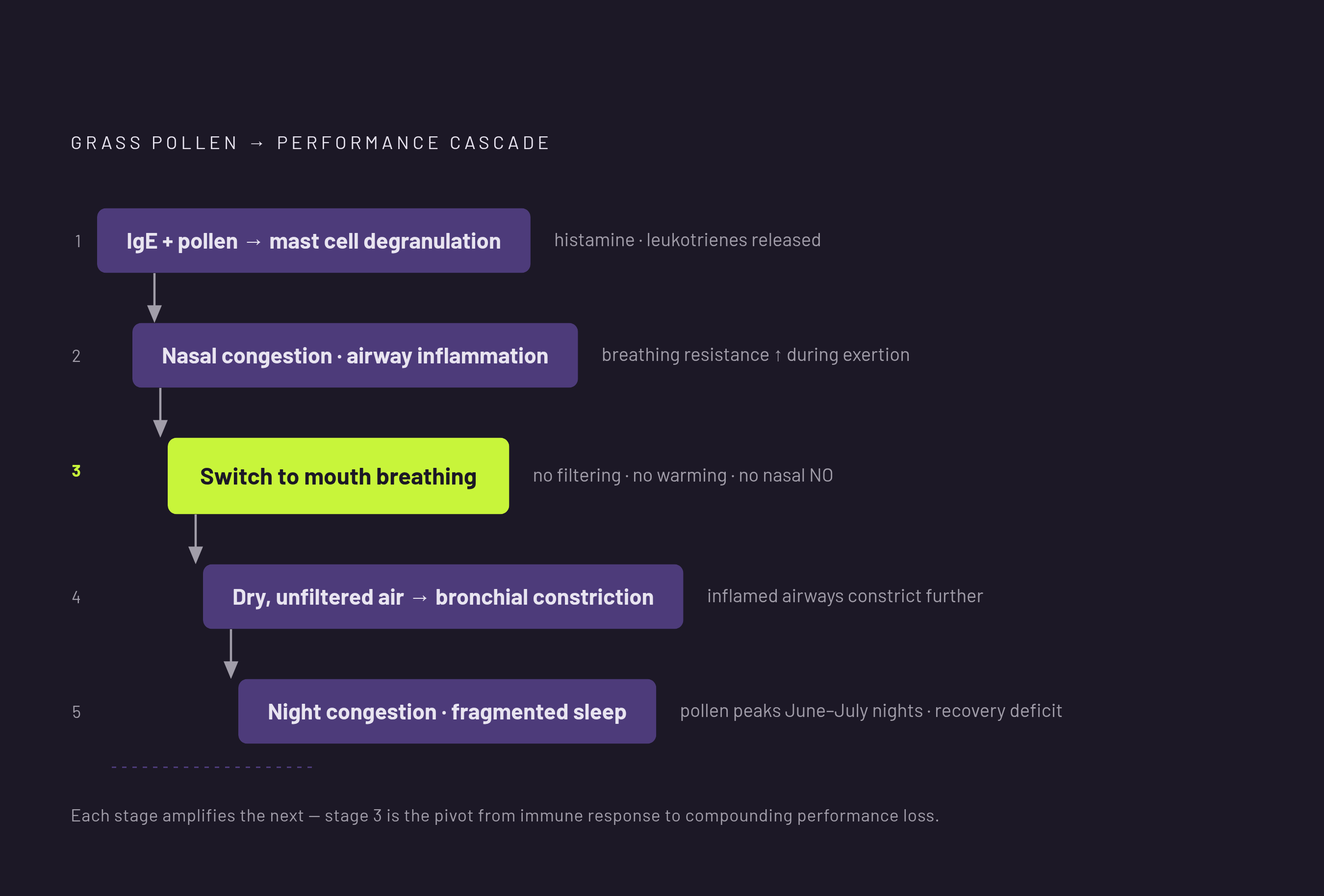
The response begins when grass pollen binds to IgE antibodies on mast cells in the airway lining. Those cells release histamine and leukotrienes through a process called degranulation. Nasal congestion, airway inflammation and increased breathing resistance follow while exertion is already taxing the respiratory system. These responses happen at the same time.
Congestion then forces a switch toward mouth breathing, which bypasses the nose’s filtering, warming and humidifying functions. Drier, less-filtered air reaches airways that are already inflamed, while slight constriction of the bronchial passages raises resistance further. Losing nasal breathing also bypasses the contribution of nitric oxide from the nasal passages, which plays a role in oxygen delivery. The cascade is self-reinforcing because obstruction changes the route of breathing in ways that add to the burden on working airways.
Athletes at WorldTour level often report losing leg power during allergy season, and sports pulmonologists who work with elite cycling teams recognize this pattern. The mechanism is not yet understood, so it would be wrong to present a settled chain from pollen exposure to weaker legs. The inflammation that builds up over a high-pollen week also puts low-grade stress on the body on top of training stress. Mild symptoms therefore do not necessarily mean that the body is carrying a mild total load.
How nasal obstruction leads to disrupted sleep and compounded recovery deficits
Grass pollen concentrations are highest at night during June and July, so there is a high allergen load just when athletes may open windows to sleep in warm weather. The recovery period is therefore not automatically a break from exposure. Congestion that began during the day can persist into the night and interfere with nasal breathing. A difficult pollen day can then affect not only the completed session, but also the recovery needed for the next one.
When congested nasal passages force mouth breathing during sleep, breathing becomes less efficient and snoring can worsen. Sleep architecture can fragment, leaving an athlete unrefreshed despite enough hours in bed. Mouth breathing also bypasses the contribution of nasal nitric oxide and can raise the risk of sleep apnea and cardiovascular strain. Morning headaches are a common consequence. Time spent in bed can therefore look adequate while the quality of recovery is not.
This is why sports pulmonologists working with elite cyclists treat nighttime nasal breathing as a performance variable. Their pre-emptive treatment aims to help athletes sleep as well as feel more comfortable. Degraded sleep compounds the losses caused by daytime congestion and airway inflammation. Hypoxia and systemic inflammation can interact with sleep disruption to undermine cardiovascular function, cognition and immune resilience. Across repeated sessions, this is the route by which a bad pollen day can become a bad training week.
Why the performance impact is real even when symptoms seem minor
Being able to finish a session is reassuring, but it is not the same as training without impairment. Salem et al.’s German athlete survey, published in J Sports Med Phys Fitness in 2019, found that performance impairments were reported in more than 80% of allergic subjects. Many were still competing despite their symptoms. Continued participation therefore did not mean that the allergy had no performance cost.
Athletes often respond intelligently by adjusting pace, shifting intensity or rescheduling sessions around pollen peaks. Adapting a session leaves the allergic response that made adaptation necessary unchanged. When the adjustment means reducing pace or intensity, the completed training is less than originally planned. Over a pollen season, those compromises can add up to lost fitness gains, even if no single session feels like a big setback.
The same distinction applies to symptoms themselves. Seasonal pollen exposure is associated with reduced post-exercise lung function and impaired quality of life, including when athletes are not acutely symptomatic. How little an athlete sneezes or seems to struggle says little about the full burden on the body. The useful distinction is between tolerating that burden and reducing it. Treatment can therefore help before symptoms become bad enough to stop an athlete from taking part.
What common allergy medications actually do — and what they leave unresolved for athletes
Symptom medications can help, but their benefits and costs differ in ways that matter during sport. First-generation antihistamines, including diphenhydramine, cross the blood-brain barrier and can cause sedation, psychomotor impairment and anticholinergic effects. Coordination, concentration and reaction time are measurably affected. A medicine that reduces allergy discomfort can therefore introduce a separate performance penalty. That makes these antihistamines a poor choice for training or competition.
Intranasal corticosteroid sprays have a different role. ICAR 2023 guidelines endorse them as first-line treatment, and they can help manage congestion. They are a legitimate short-term tool, particularly when blocked nasal breathing is central to the problem. However, they must be used continuously for their effect to persist and do not retrain the immune system. Montelukast also warrants a brief safety distinction because it carries an FDA boxed warning for serious neuropsychiatric effects and is no longer a first-line recommendation under ICAR 2023 guidelines.
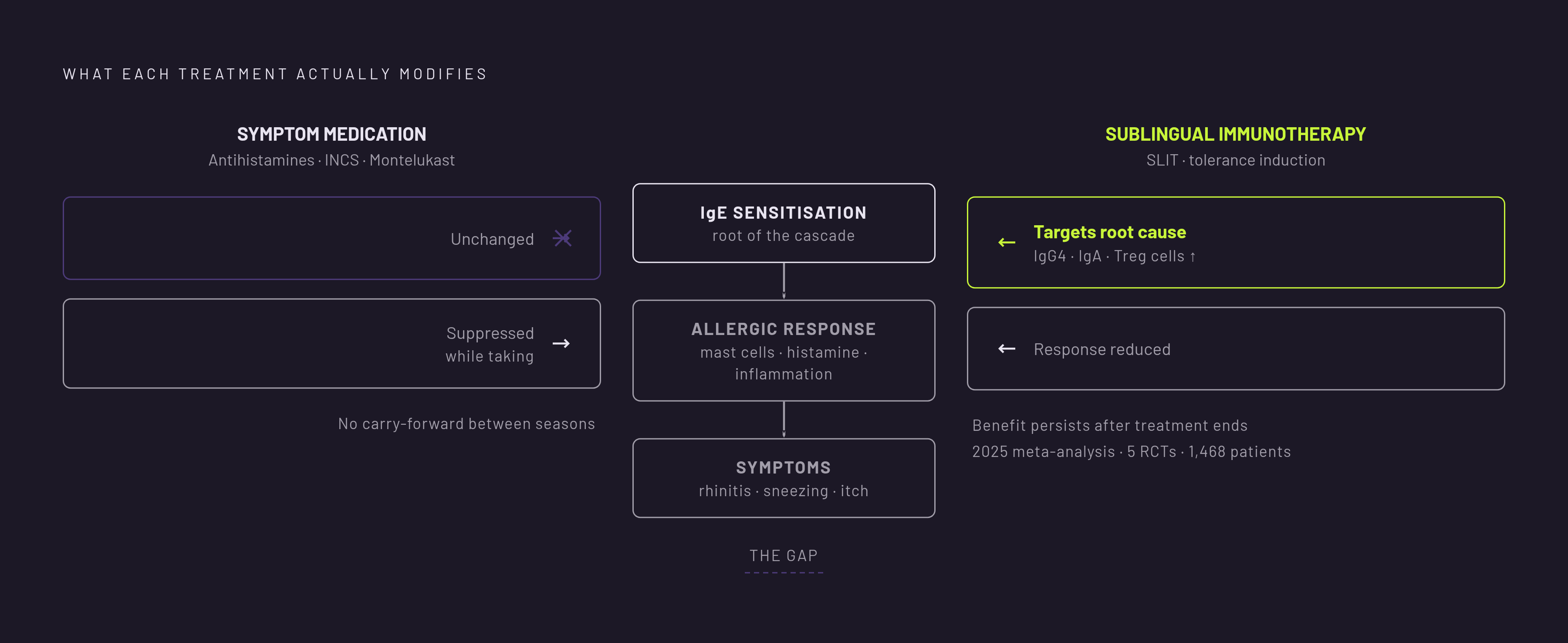
The shared limit of symptom medications is that they suppress parts of the response without changing the underlying sensitivity to grass pollen. When treatment stops, that sensitivity remains, and there is no carry-forward benefit between seasons. For an athlete, effective symptom relief and an unchanged immune response can exist at the same time.
How sublingual immunotherapy addresses the immune mechanism that medications bypass
Allergen immunotherapy modifies the immune response. Sublingual immunotherapy, or SLIT, works by inducing tolerance to the allergen involved in IgE-mediated sensitization. It is associated with increases in sublingual regulatory immune cells and allergen-specific IgG4 and IgA. These changes reflect a shift in how the immune system responds to grass pollen. The aim is therefore to alter the response that starts the cascade.
Five randomized controlled trials of the 300 IR 5-grass pollen SLIT tablet, which included 1,468 patients and were analyzed together in 2025, found that symptom and medication scores fell by statistically significant amounts compared with placebo. The treatment worked as well across age groups, whether patients had asthma or not, and wherever they lived. Those findings concern the studied tablet formulation. The evidence for drops comes from a clinical trial of the drops themselves.
The 2026 RHAPSODY Phase III trial studied 26 months of continuous treatment with 5-grass-pollen SLIT drops in adults with moderate-to-severe grass-pollen-induced allergic rhinoconjunctivitis. It found a statistically significant advantage over placebo on its primary efficacy endpoint, the average daily total combined score. RHAPSODY was described as the first well-powered trial to establish a positive risk-benefit ratio for these drops in this population. Salem et al.’s athlete survey also found fewer impaired training bouts among athletes using immunotherapy than among those using symptomatic or alternative therapies. That observational finding links immunotherapy use directly to training outcomes, though it is not the same kind of evidence as a randomized trial.
The practical limitation is perseverance. Treatment typically requires three to five years, and adherence is associated with better patient-reported outcomes. Forgetfulness is the most frequently reported reason for discontinuing grass pollen SLIT. A treatment that works through sustained use therefore needs a place in the athlete’s routine throughout treatment.
Sublingual drops versus allergy shots — what the practical differences mean for an active person
Sublingual drops and allergy shots both work by building immune tolerance, but they fit into daily life in different ways. Shots mean frequent trips to the office, and patients must wait after each injection to be checked for anaphylaxis. For an athlete balancing an early-morning training block, midday coaching and an evening race, that is a real scheduling constraint. Over the years, the trips, appointments and waiting add to the burden of treatment. The biological goal may be shared, but the route to sustaining treatment is not.
At-home sublingual treatment avoids that repeated injection-visit schedule, making it more compatible with a training-centered life. Systemic reactions with sublingual immunotherapy are extremely rare, occurring in less than one percent of patients. That low risk is an important practical distinction from the monitoring attached to every shot visit. Convenience also matters because missed treatment and discontinuation can undermine a long-term plan.
Cost can change which option is more workable. Without insurance, shots cost more per year, including the fees for repeated visits, while sublingual drops cost less. However, drops are generally not covered by insurance as a class, whereas commercial plans and Medicare Part B frequently cover shots. A lower yearly price before insurance can still leave the athlete paying more. The meaningful comparison depends on both coverage and the time required to keep treatment going.
How athletes should think about timing treatment relative to pollen season
Treatment timing follows from the mechanism. Mast cell degranulation is triggered by re-exposure, so by the time sneezing starts, the allergic response is already running. Sports physicians who advise elite cycling teams describe starting symptom medications a week or two before racing in the allergen-risk window as a basic step in care. Immunotherapy needs a much longer lead time, measured in months to years.
Grass pollen season runs from May–July in most of the Northern Hemisphere. An athlete deciding in June to begin addressing the root response is therefore planning principally for next year. That does not make symptom treatment pointless in June. Starting before the season matters because a long-term treatment cannot be compressed into the days before an important race.
The multi-season commitment also needs to fit a competitive calendar that does not stop. A manageable routine, enough lead time and sustained adherence are part of the treatment decision itself. Most athletes with allergic rhinitis are undertreated, partly because of reservations about allergy treatment, and those reservations can carry an accumulating performance cost. The central choice is whether to keep absorbing the effects on breathing, sleep and training, or plan ahead to address the response that connects them.
Sources
- Impaired sports performance of athletes suffering from pollen-induced allergic rhinitis: a cross-sectional, observational survey in German athletes - PubMed
- Five‐Grass‐Pollen Sublingual Immunotherapy Drops Are Efficacious and Well Tolerated in Adults: The RHAPSODY Phase III Trial - Didier - 2026 - Allergy - Wiley Online Library
- Impact of Pollen Exposure on Health and Exercise Performance: A Scoping Review - PubMed
- Medium-Term Increases in Ambient Grass Pollen Between 1994-1999 and 2016-2020 in a Subtropical Climate Zone
- Frontiers