Mast Cell Priming and the Allergic Threshold Concept
Immunotherapy resets immune tolerance rather than simply suppressing allergic symptoms.

At-home sublingual immunotherapy drops can be an alternative to clinic-based allergy shots, with a switch guided by a physician’s assessment of allergens, safety, access, and cost. Both approaches aim to build immune tolerance, going beyond symptom relief that lasts only a short time. A model of allergic activation explains why that distinction is important, because allergic reactions depend on a shifting activation threshold.
Why allergic reactions are not fixed events but threshold-dependent responses
The familiar picture of allergy is a simple switch. Someone encounters pollen, dust mites, or cat dander, and symptoms begin. Why can a familiar exposure seem tolerable at one point and overwhelming at another? The amount of allergen is only part of the answer, because the immune cells responding to it can also become easier or harder to activate.
Mast cells sit at the center of this response. Their surfaces hold IgE antibodies on high-affinity receptors called FcεRI. When an allergen links enough of those receptors, the cell lets out the inflammatory substances it has stored, in a process called degranulation. Histamine, leukotrienes, prostaglandins, and cytokines help produce the symptoms people recognize as an allergic reaction. Mast cell activation contributes to conditions including allergic rhinitis, allergic conjunctivitis, asthma, urticaria, and atopic dermatitis.
The threshold describes how readily that release begins. A cell already poised for activation may respond to less allergen than a cell in a quieter state. This makes sensitivity more than a stable personal trait, although it does not mean reactions are predictable from symptoms alone. To understand why the threshold shifts, the next question is what makes a mast cell more ready to fire.
How mast cell priming lowers the threshold and sets off a self-reinforcing cycle
Allergies that seem worse after a respiratory infection or stressful period can feel like a new problem arriving without warning. Sometimes the exposure has changed, but the responding cells may have changed too. That shift has a name, mast cell priming. It means the cells have moved from a resting state into one in which less allergen is needed to activate them.
Halova et al., 2018 described how pro-inflammatory cytokines, chemokines, bacterial and viral products, and certain drugs can lower the threshold for allergen-mediated activation. Crucially, a priming agent need not cause degranulation by itself. It can instead make the next encounter more potent. Respiratory infections and stress-related cytokines thus help explain how events that are non-allergic can change allergic symptoms.
The response can also reinforce itself over time. Cytokines released during one reaction can leave mast cells more responsive during the next, creating a self-amplifying loop. Multiple priming stimuli can compound one another, and cumulative activation may contribute to symptoms without an obvious immediate allergen exposure. The absence of a visible trigger does not necessarily mean the inflammatory response has settled.
A lowered threshold can also make previously subclinical reactivity noticeable. Someone with dust mite allergy may start reacting when around a cat, even if that once seemed harmless. However, making an existing sensitivity clinically apparent is not the same as proving that priming created a new sensitization. Threshold drift helps explain an expanding symptom pattern, but it should not turn the complex progression called the “allergic march” into an inevitable sequence for every patient.
What a lowered threshold does to sleep, cognition, and daily function
Waking up groggy, struggling to concentrate, and living with constant congestion may not feel like parts of the same condition. They often get attributed to stress or poor sleep. Allergic inflammation can link them through inflammatory signaling that keeps going and the effects of a blocked nose. The cost extends beyond sneezing and itchy eyes.
Sleep disruption is one of the clearest consequences. Allergic individuals are more than twice as likely to have insomnia as non-allergic individuals. Chronic nasal congestion encourages mouth breathing during sleep, which worsens snoring and can contribute to sleep apnea. Mouth breathing also causes dry mouth, increasing the risk of cavities and gum disease.
Being irritable, getting less done, and finding it hard to concentrate may become so familiar that a person stops linking them to allergies. Meanwhile, untreated allergic rhinitis can worsen existing allergic asthma or contribute to asthma development in predisposed people. These are reasons to take persistent symptoms seriously.
Why symptom-suppressing medications cannot stop the priming process
If inflammation is keeping the system reactive, why not simply control the symptoms more effectively? Symptom medicines do help, often making it easier to sleep and get through the day. Their limitation is the level at which they work. Blocking an inflammatory signal or suppressing local inflammation does not, by itself, establish lasting tolerance to the allergen.
Antihistamines address the histamine part of the response rather than the full range of substances released by mast cells. Relief therefore does not show that underlying sensitization has changed. Symptoms can come back when treatment stops because the immune system still has its allergen-specific response. Side effects can also affect consistent use, although second-generation antihistamines have significantly fewer anticholinergic effects than first-generation agents, whose effects can include drowsiness, dry mouth, blurred vision, constipation, urinary difficulty, and confusion.
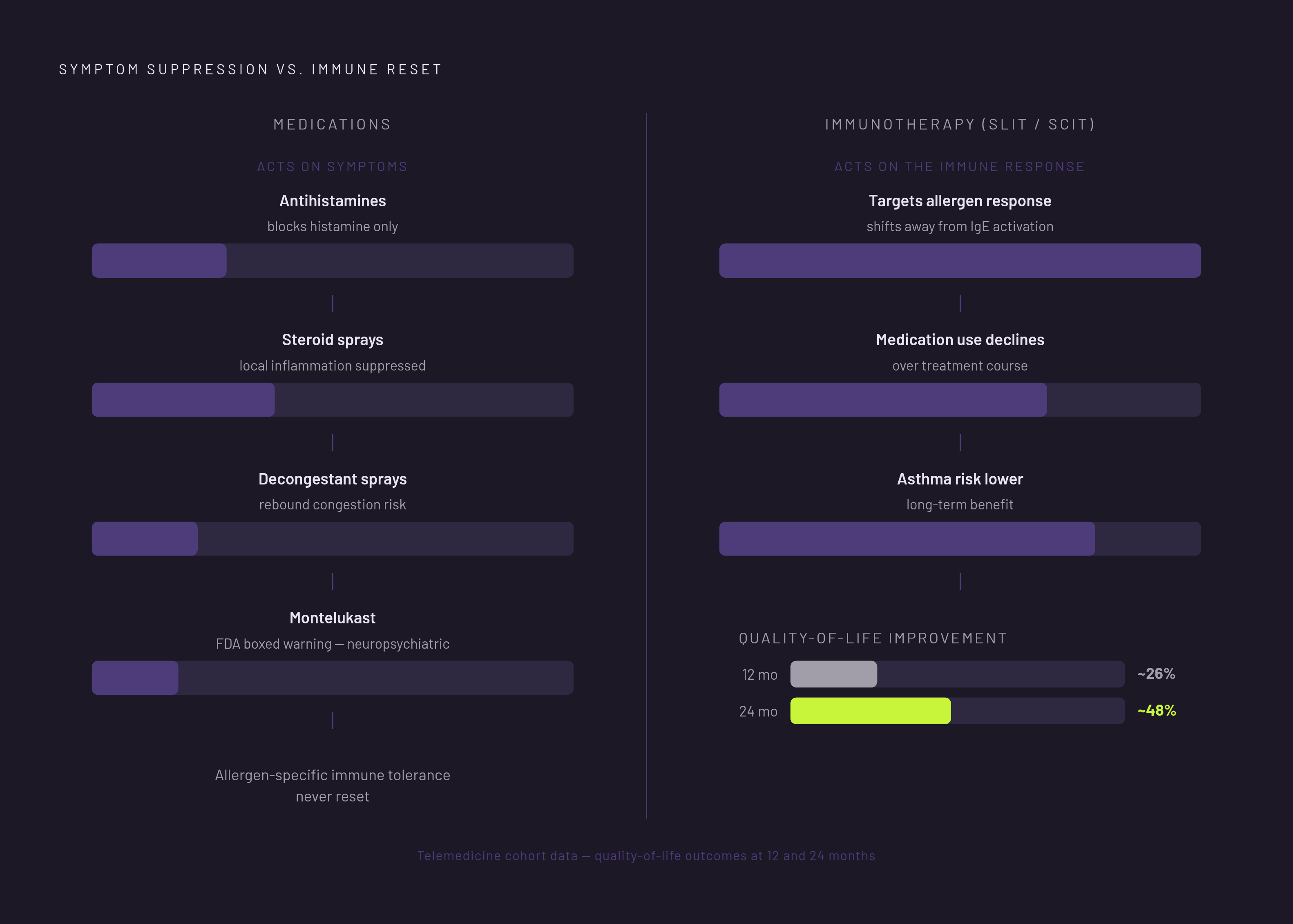
Nasal sprays do not all work the same way. Steroid sprays suppress local inflammation and have a more favorable side-effect profile, but they do not reset allergen-specific immune tolerance. Long-term use of decongestant sprays can cause rebound congestion, limiting their usefulness for sustained control. Montelukast, another symptom-focused option, has an FDA boxed warning for serious neuropsychiatric effects and is no longer first-line under ICAR 2023 guidelines.
Mast cell stabilizers work at an earlier stage of the response. Medicines including cromolyn sodium, tranilast, and nedocromil suppress multiple mediator pathways, but practical limitations include poor bioavailability, frequent dosing, delayed onset, and, for some agents, problematic side effects. Jansen et al., 2026 cited these problems as reasons to study next-generation stabilizers. That remains an active research frontier, distinct from a treatment that durably changes allergen tolerance.
How immunotherapy works against the priming mechanism at the immune level
Allergen immunotherapy approaches the problem from the other direction. Instead of mainly blocking substances released after activation, it aims to change how the immune system responds to the allergen itself. It is the potentially disease-modifying treatment class for IgE-mediated respiratory allergy. In threshold terms, the aim is to make familiar exposures less able to trigger symptoms.
Sublingual immunotherapy, or SLIT, delivers allergen extract under the tongue. Langerhans cells and dendritic cells in the oral lining help initiate a response that favors tolerance. With repeated treatment, the immune response slowly shifts away from IgE-mediated activation, so there is less signaling and mediator release. This works against the direction of priming, although it is not a promise that every source of mast cell activation will disappear.
Clinical benefits are consistent with that immune shift. Real-world cohorts have found that after SLIT, people use less medication over the long term and have a lower risk of developing asthma. These findings support its potential to change the course of respiratory allergy. They do not make it a guaranteed cure.
Some patients, particularly children, need less medication with limited changes in symptom scores, a “symptom-medication decoupling” that means symptoms and medication dependence need to be considered together when judging benefit.
Can allergy shot patients switch to sublingual drops at home?
A 2026 retrospective longitudinal cohort of telemedicine-delivered personalized SLIT found that quality-of-life improvement increased through 30–36 months of treatment. That gives the remote approach evidence beyond convenience alone. It does not establish that drops outperform shots or that every shot patient should switch. Both subcutaneous immunotherapy, or SCIT, and SLIT can meaningfully reduce symptoms, with broadly comparable effectiveness across the evidence described here.
For someone considering a switch, setting is an immediate difference. Shots must be given in a clinic, where patients stay for a 30-minute observation period because rare systemic reactions, including anaphylaxis, can occur. Drops can be taken at home after an initial evaluation, while FDA-approved SLIT tablets require the first dose to be supervised. SLIT reactions are mostly local to the mouth, whereas SCIT may produce more systemic reactions.
Shots and custom drops can address multiple environmental allergens simultaneously, which may suit patients with several clinically relevant sensitivities. FDA-approved tablets target specific allergens, including grass with Grastek and Oralair, ragweed with Ragwitek, and house dust mite with Odactra. A tablet may cover a patient’s relevant allergy well, but it may not cover the full profile of someone reacting to several allergens.
Regulatory status and cost also belong in the decision. Compounded multi-allergen drops use extracts approved for allergy testing and shots, but those extracts are not approved for sublingual use, and the compounded drops are not individually FDA-approved. Insurance generally does not cover them. At-home dosing can support better completion than weekly clinic visits, but the appropriate choice still depends on allergen profile, safety, access, lifestyle, and cost.
How at-home testing identifies which allergens are driving the priming cycle
Before choosing an immunotherapy format, the relevant allergens need to be identified. At-home specific IgE blood testing uses a finger-prick sample to show sensitization to dozens of allergens, so a person can be tested without going to a clinic. That can make an initial assessment more accessible to someone who has never been formally tested.
Tree pollen is associated with spring symptoms, grass pollen with summer symptoms, and weed pollen, including ragweed, with fall symptoms. Dust mites and mold can persist indoors throughout the year, contributing to a more continuous pattern. Comparing that pattern with the sensitization profile helps show which exposures could explain the person’s symptoms and which positive results do not fit them.
A positive IgE result shows sensitization. A high number is not a direct measure of danger, and a low number is not a guarantee of safety. IgE levels also do not directly predict how much clinical improvement a person will gain from SLIT. High IgE without matching symptoms may not require treatment, while symptoms without a dramatic elevation may still be clinically meaningful. A physician uses the test results to help decide which treatment fits the patient.
Raising the threshold durably — why timing and persistence determine whether immunotherapy works
Immune tolerance develops through repeated exposure over time, with consistent low-dose treatment over months and years forming part of the mechanism. That makes patience a biological requirement rather than an administrative inconvenience. It also explains why early results may understate the benefit of a completed course.
The same telemedicine cohort found that clinically meaningful symptom improvement grew from roughly a quarter of patients at 12 months to nearly half at 24 months. Its quality-of-life trajectory continued improving later in treatment. This pattern fits with an immune response that changes slowly, though an observational cohort does not directly measure a rise in the mast cell threshold. Sustained benefits lasting one to two years after a completed three-year course also support the possibility of lasting tolerance.
Earlier treatment offers an opportunity to address the allergic response before more disruption to sleep, daily function, or respiratory health accumulates. That does not mean untreated allergies inevitably worsen each year, or that immunotherapy guarantees prevention of future disease. There is the strongest reason to start when the sensitization profile, symptoms, and a physician’s assessment all point to a treatment that fits the patient.
Persistence then determines how much opportunity treatment has to work. Treatment at home can help patients get better results when it is easier to keep up with than repeated clinic visits. The goal is not simply to endure today’s exposure with fewer symptoms, but to build a more tolerant response to tomorrow’s.
Sources
- Frontiers
- Changing the threshold—Signals and mechanisms of mast cell priming - Halova - 2018 - Immunological Reviews - Wiley Online Library
- The recent advances of mast cells in the pathogenesis of ...
- Food allergy: begin at the skin, end at the mast cell?
- Editorial: Mast cells in allergic diseases
- Sublingual Immunotherapy (SLIT) Evidence & Guidelines Hub (2025)