Immune Tolerance Mechanisms in Allergen Immunotherapy
Sublingual immunotherapy retrains immune tolerance through blocking antibodies and regulatory cells.
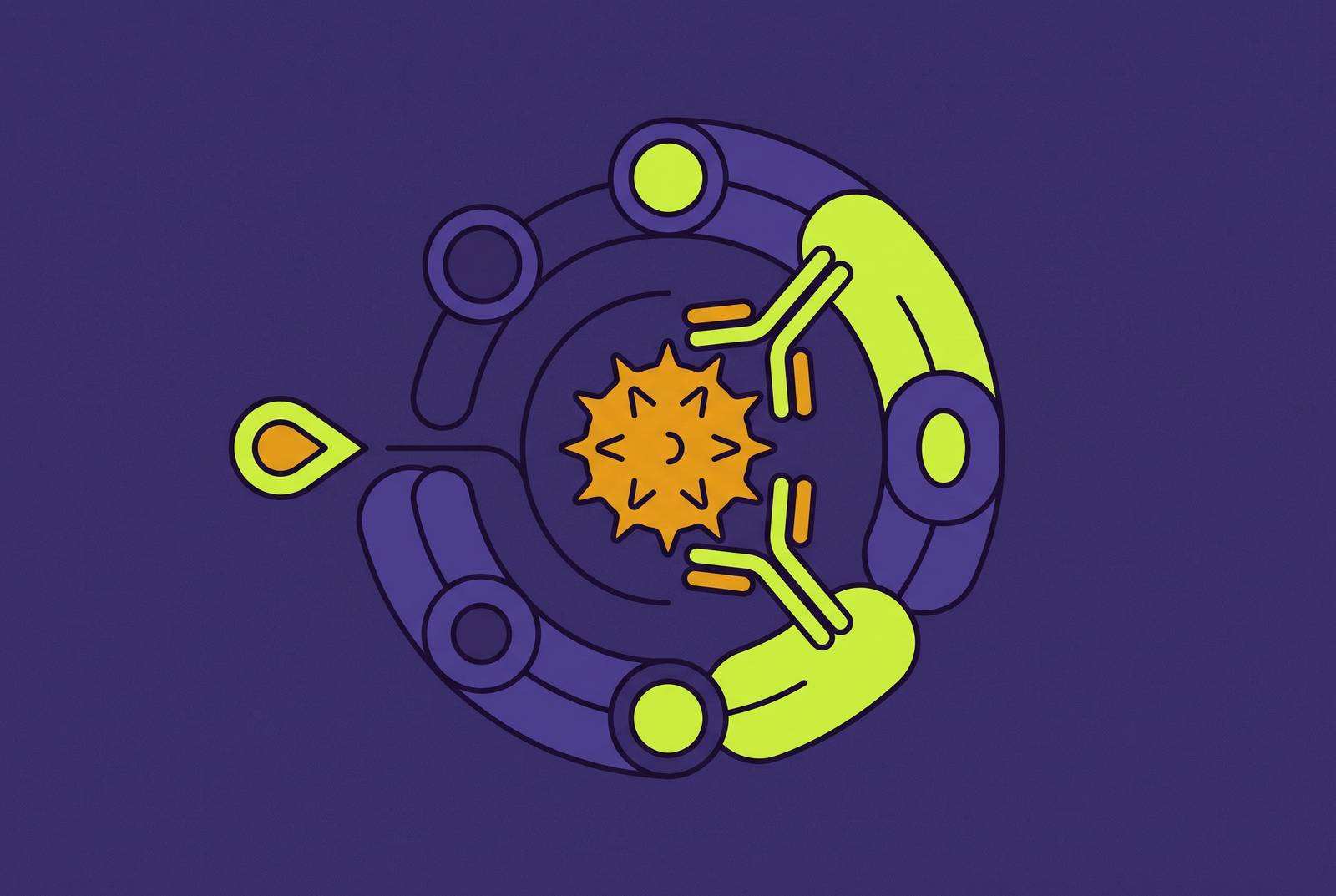
At-home sublingual immunotherapy is a physician-guided alternative for adults who want to switch from allergy shots. Both routes can retrain the immune response. The immune tolerance mechanisms in allergen immunotherapy explain why relief can last after treatment ends, but the evidence depends on the preparation, dose, and completion of a sustained course.
Why the immune system attacks harmless substances in the first place
An allergy begins when the immune system learns the wrong lesson about a harmless substance in the environment. During sensitization, cells lining exposed surfaces release alarm signals called alarmins. Cells that present allergens to the immune system then steer immature T cells toward a type 2 helper T cell response, known as Th2. These Th2 cells send out signals that tell B cells to make allergen-specific IgE antibodies. IgE attaches to receptors on mast cells and basophils, leaving them primed for another encounter.
That next encounter starts the elicitation phase. When the same allergen comes back, it makes primed mast cells release their contents and adds to local Th2 inflammation. The familiar symptoms therefore come from a response prepared during an earlier exposure. A failure of tolerance involves several kinds of cells, so changing one symptom does not necessarily change the allergy.
What medications do and do not do to this cycle
Antihistamines, nasal sprays, and decongestants act after this cascade has begun. Antihistamines block histamine receptors, but they do not change IgE levels, mast cell priming, or the Th2 response. Nasal treatments can keep symptoms in check without teaching the immune system to tolerate the trigger. This ceiling distinguishes medication from immune-retraining treatments, including sublingual immunotherapy delivered through telehealth platforms such as Wyndly.
Medication also has limits that matter apart from its mechanism. First-generation antihistamines such as diphenhydramine and chlorpheniramine are strongly discouraged for routine allergy management because of sedation and anticholinergic effects, without a therapeutic advantage over second-generation options. Gray et al.’s 2015 JAMA Internal Medicine study found that people whose anticholinergic drug use added up to a high amount over time had a much higher risk of dementia. Nasal decongestant sprays should not be used beyond three consecutive days because they can cause rebound congestion. If symptoms come back whenever the drug wears off, the immune response behind them has stayed the same.
The two-layer mechanism by which immunotherapy actually changes the immune response
Allergen immunotherapy, or AIT, addresses that gap through two linked processes. The first is desensitization, which reduces the responsiveness of mast cells and basophils during treatment. The second is immune tolerance, which changes how the body handles the allergen. Desensitization is like quieting an alarm while it rings, whereas tolerance is closer to changing what makes the alarm sound. The distinction matters because reduced reactivity during treatment is not, by itself, proof of lasting tolerance.
The tolerance layer includes allergen-specific IgG4 antibodies that compete with IgE for allergen binding. These blocking antibodies intercept the allergen without triggering mast cell release. Regulatory T cells also suppress the dendritic cells that sustain inflammatory T cell activity, reduce several effector T cell responses, and curb mast cell, basophil, and eosinophil activity. Regulatory B cells contribute IL-10, an anti-inflammatory signal that helps dampen type 2 inflammation and supports the shift toward blocking antibodies. Wyndly’s personalized, doctor-guided at-home treatment uses this same sublingual mechanism without weekly clinic visits.
Why tolerance persists after treatment stops — the role of trained innate immunity
Adaptive immunity, which includes allergen-specific antibodies and regulatory cells, seems to explain only part of the effect. Research also points to trained innate immunity, a form of memory in the parts of the immune system that respond more broadly. In epigenetic reprogramming, an immune cell’s operating instructions are rewritten. Changes in cell metabolism help support this altered state.
Dendritic cells, innate lymphoid cells, and their precursors can acquire this memory without the allergen-specific receptors used by adaptive immunity. In allergy, maladapted innate responses may amplify inflammation, while AIT appears to help restore their proper calibration. Treatments being tested that target these metabolic and epigenetic changes have shown protective antiallergic effects, but researchers are still working out how this explains what happens to each patient. Reprogramming at the precursor level appears more stable than receptor-level sensitization, although its reversibility remains an active research question.
How the sublingual route specifically triggers tolerogenic signaling
Sublingual immunotherapy, or SLIT, uses an oral lining that is more than a passive surface for delivery. It contains dendritic cells that favor immune tolerance. These cells capture and process the allergen, then present it in a setting that encourages regulatory T cells and limits Th2 effector cells.
The contrast with accidental airway exposure is important. An allergen presented in an inflammatory airway setting can reinforce the response that caused symptoms in the first place. The oral mucosal environment instead biases signaling toward regulation, making the route biologically suited to the treatment’s aim. Local oral reactions are the main side effect, and systemic reactions are rare. A large European post-marketing surveillance study found no confirmed fatalities and a systemic reaction rate of approximately 0.01–0.05%, although a low rate does not mean that reactions are impossible.
What the evidence shows about how long the immune changes last
Trials of grass pollen sublingual tablets provided evidence of benefit beyond active dosing: patients who finished three years of therapy still had improved symptoms for at least two additional years after they stopped. It supports the biological account of tolerance, while also setting a boundary around what has actually been measured. The result applies specifically to the studied tablets and treatment courses.
Real-world cohorts also report that, after SLIT, people use less medication over the long term and have a lower risk of developing asthma. Some trials show fewer asthma exacerbations, though the effects on day-to-day asthma control vary more. Pediatric trials generally mirror adult findings, particularly for standardized tablets. But studies differ enough that evidence for the specific product matters. The practical implication is to plan for at least three years of standardized, adequately dosed treatment, because shorter courses do not reliably produce the same durability.
Can I switch from allergy shots to sublingual drops at home instead
For someone considering a switch, a biological comparison shows that allergy shots, also called subcutaneous immunotherapy, and SLIT both produce IgG4 blocking antibodies, induce regulatory T cells, and reduce Th2 activity. Shots show symptom score reductions of roughly 30–40% versus placebo for seasonal allergic rhinitis. SLIT generally shows a smaller reduction, although the gap narrows substantially for seasonal grass and ragweed.
The next comparison is whether the treatment course is workable. Shots carry a small but real risk of systemic reactions and require observation after each injection, as well as repeated clinic visits on a fixed schedule. SLIT is initiated under supervision and then taken daily at home, with local oral reactions as its main adverse effect. For adults whose shot schedule makes completion difficult, physician-guided at-home SLIT is a credible alternative when the switch follows a treatment plan. Wyndly offers SLIT to take at home, with treatment tailored to each patient by board-certified physicians. Adherence matters most in practice, because an effective route cannot deliver its full long-term benefit if the patient cannot complete it.
The one unsolved problem — predicting in advance who will respond
Even with what is known about these mechanisms, clinicians cannot reliably tell how a patient will respond before treatment starts. There are no validated biomarkers that consistently separate likely responders from non-responders. A measurable immune change is not necessarily a reliable forecast of how much relief one person will experience. That gap limits precision at the treatment-selection stage, but it does not erase the clinical evidence that immunotherapy works.
A doctor monitoring symptoms and response can adjust or redirect a course that is not working, rather than treating prescription and delivery as the whole service. Telehealth care can support that process through virtual consultations, testing, personalized plans, and ongoing oversight. Research into HLA genotypes suggests that differences in genes affect how people respond, and genetic and single-cell analysis may help predict those responses more reliably. Until those findings lead to clinical tools that doctors can rely on, monitoring under a physician’s guidance helps match the evidence from groups of patients to one patient’s needs.
Why untreated allergies exact costs that go far beyond seasonal symptoms
Allergic inflammation can affect attention and processing speed, while immune activation that lasts adds to fatigue. Nasal congestion adds another burden by disrupting breathing during sleep. As a result, many hours in bed may still fail to produce restorative rest.
Chronic nasal obstruction can also drive habitual mouth breathing, which compounds sleep disruption. In children, it is associated with craniofacial and dental developmental changes, making persistent obstruction more than a seasonal nuisance. Longer pollen seasons widen the annual window in which these burdens can accumulate. Symptom medication can still provide useful relief, but relief does not by itself close the sensitization-and-elicitation cycle. Treatment can change the response producing these burdens.
What immune retraining actually requires from a patient
Durable tolerance requires a treatment plan that matches the biology. The key conditions are the right allergens, an adequate dose, and sustained treatment. Because tolerance is allergen-specific, validated testing must be interpreted with the patient’s symptoms rather than treated as a generic list of substances to include. A positive test can reflect a clinically silent sensitization, which is another reason physician judgment matters. The commitment is not simply to take something daily, but to continue a properly selected course long enough for lasting change to develop.
Delivery can either support or obstruct that commitment. Its program is FSA/HSA eligible, though the chosen treatment and the care provided throughout it still need to fit the patient. The strongest durability evidence still needs to be matched to the specific preparation. Someone considering a move from shots must assess whether a physician-guided at-home course offers a sustainable path to immune retraining.
Sources
- Allergen‐Specific Immunotherapy and Trained Immunity - Martín‐Cruz - 2025 - Allergy - Wiley Online Library
- [Mechanisms of allergen-specific immunotherapy] - PubMed
- Mechanisms in AIT: Insights 2021
- Grand Challenges in Allergen Immunotherapy
- Induction of Tolerance via the Sublingual Route: Mechanisms and Applications
- Mechanisms of allergen-specific immunotherapy and immune tolerance to allergens
- Mucosal Immunity and Sublingual Immunotherapy in Respiratory Disorders